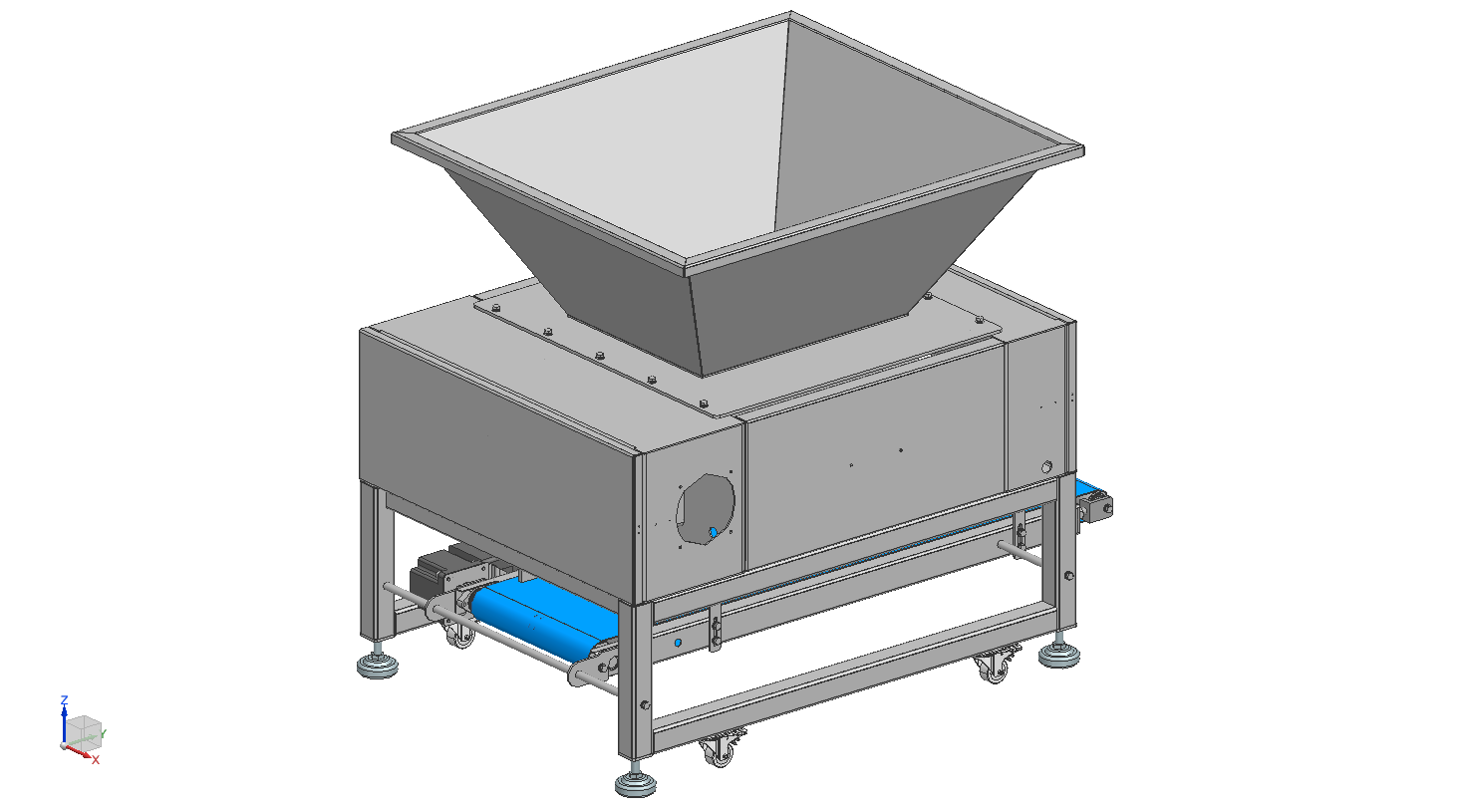
What tool is designed to separate dough into consistent portions? In commercial bakeries and industrial food factories, the answer is a Dough Divider Machine.
A Dough Divider Machine is designed to take a larger mass or continuous flow of dough and divide it into controlled portions before rounding, fermentation, rolling, pressing, shaping, or baking. Instead of operators repeatedly cutting and weighing dough by hand, the machine standardizes this early production step so downstream equipment receives pieces with more consistent size and weight.
That apparently simple function has a significant influence on the entire bakery process. If individual portions vary, finished breads or flatbreads may differ in diameter, thickness, baking time, package weight, and appearance. As production volume increases, manual portioning also becomes increasingly difficult to maintain consistently across operators and shifts. Commercial bakery guidance therefore treats dough dividing as one of the key automation stages when manufacturers move from small-batch production toward higher-volume processing.
AnHui JinKe Foodstuff Machinery Co.,Ltd. supplies industrial dough-processing and flatbread-production equipment, including a dedicated Dough Divider Machine category designed for precise and repeatable dough portioning. According to the company's current product information, its dividing systems can process different dough characteristics, including softer, stickier formulations and denser doughs, while customized capacities and portion sizes can be configured for specific production requirements.
Quick Answer: What Tool Separates Dough?
A Dough Divider Machine is the commercial bakery tool designed specifically to divide bulk dough into uniform portions.
Depending on the machine design, it may use:
Mechanical cutting
Servo-controlled cutting
Hydraulic pressure
Volumetric dividing
Continuous extrusion
Programmable multi-stage cutting
Some machines only divide dough. Others combine dividing with rounding, while industrial production lines may connect the divider directly to a rounder, fermenter, roller, press, or other forming equipment.
The correct equipment therefore depends on whether the bakery needs only portion control or a fully integrated dough-processing system.
Why Does Dough Need to Be Divided Accurately?
Dough portion weight establishes the starting point for every unit produced downstream.
If a bakery intends to manufacture 120 g flatbreads but the dough divider produces pieces ranging from 105 g to 135 g, later forming equipment may create noticeably different finished products even when press pressure, roller settings, and baking conditions remain unchanged.
Consistent dividing supports more predictable:
Finished product weight
Diameter
Thickness
Proofing behavior
Baking time
Moisture content
Package weight
Product appearance
This is particularly important for commercial customers such as supermarkets, food-service distributors, restaurant chains, and private-label buyers that expect repeatable product specifications.
JinKe's product page positions dough dividing as a precision stage intended to improve uniformity across products such as bread, pastries, rolls, and flatbread applications.
How Does a Dough Divider Machine Work?
Different divider designs use different mechanical principles, but the basic production logic is similar.
1. Dough Enters the Machine
The dough may arrive from:
A mixer
Hopper
Conveyor
Manual feeding station
Continuous upstream production system
Before dividing, the dough should have sufficiently stable consistency because major differences in hydration, temperature, or density can affect portioning performance.
2. The Machine Measures or Controls the Dough Flow
Depending on the divider, the machine may determine portion size through volume, cutting distance, timing, chamber size, extrusion rate, or servo-controlled movement.
More advanced automatic systems allow operators to store or adjust these parameters electronically.
JinKe's current automatic customized cutting divider uses a PLC + touchscreen control system and supports customized dividing modes for different products and portion requirements.
3. Dough Is Cut Into Individual Portions
The machine separates the dough according to the selected program.
In industrial lines, this step must happen fast enough to match downstream capacity without damaging the dough structure unnecessarily.
The ideal result is not simply “many pieces.” It is a continuous flow of portions that are consistent enough for the next machine to process reliably.
For an automated factory, the divider should therefore be selected according to both upstream and downstream production speeds.
Dough Divider Machine vs. Dough Divider Rounder
These two equipment terms are related but not identical.
A Dough Divider Machine focuses primarily on separating dough into controlled portions.
A dough divider rounder performs two processes:
Dividing the dough.
Rounding each portion into a more uniform dough ball.
Commercial equipment guides commonly describe divider-rounders as useful for bread rolls, buns, pizza dough, and similar products where the portion needs a rounded shape before proofing or further processing.
For flatbread factories, separating these operations can provide greater production flexibility because dividing, rounding, resting, and forming can each be optimized independently.
What Types of Dough Divider Machines Are Available?
Commercial buyers generally encounter several broad equipment types.
Divider Type
Typical Application
Main Advantage
Manual Divider
Small bakeries
Low investment
Hydraulic Divider
Bread and larger dough batches
Strong dividing force
Semi-Automatic Divider
Medium-volume bakery
Balance of cost and labor saving
Automatic Divider
Industrial production
Higher speed and consistency
Continuous Cutting Divider
Flatbread/production lines
Easy line integration
Divider-Rounder
Buns, rolls, pizza
Dividing + rounding
Each type fits a different production scale.
Manual Dough Divider
Manual machines use mechanical force and operator input.
They can work well for smaller bakeries where production volume is limited and electricity-free operation is useful.
The trade-off is that throughput depends more heavily on the operator.
Hydraulic Dough Divider
Hydraulic machines use hydraulic pressure to divide larger dough masses.
They are often used for bread production where relatively large portions need to be separated in batches. Current commercial guides describe hydraulic systems in manual, semi-automatic, and automatic configurations depending on required capacity and control level.
Fully Automatic Dough Divider Machine
An automatic divider is better suited to continuous high-volume operations.
These systems can incorporate:
PLC control
Servo drives
Recipe settings
Continuous feeding
Automatic alarms
Production data monitoring
Integration with upstream/downstream conveyors
JinKe's current automatic cutting divider uses servo-controlled cutting and PLC/touchscreen operation, with customizable dividing modes for different flatbread applications.
The machine is currently listed for dough used in products including tortilla, paratha, lavash, roti, chapati, and parotta.
These specifications refer to the published JKJX-FKJ configuration; customized projects may use different dimensions or operating parameters.
Which Products Can a Dough Divider Machine Process?
A commercial divider may be used for a broad range of bakery products, provided the machine is compatible with the dough characteristics and required portion range.
Possible applications include:
Tortilla
Chapati
Roti
Paratha
Parotta
Lavash
Bread rolls
Buns
Pizza dough
Flatbread
Pastries
Specialty bakery products
JinKe's divider category specifically states that its equipment can be adjusted for different dough characteristics, including soft and sticky dough as well as denser, firmer formulations.
This flexibility is important because dough consistency can vary greatly between a high-hydration flatbread formulation and a firmer bread dough.
Why Is Manual Dough Cutting Difficult at Scale?
Manual portioning can work effectively in a small artisan bakery.
The difficulty appears when production volume increases.
Imagine a factory producing:
8,000 flatbreads per shift
If every dough portion must be manually cut and weighed, operators repeat the same task thousands of times.
This creates several production challenges:
Higher labor demand
Repetitive work
Slower throughput
Greater dependence on operator experience
Portion-size variation
Increased rework
Commercial bakery equipment guides consistently identify labor reduction and more repeatable portion control as primary reasons for automating dough dividing.
The business case becomes stronger as daily output grows.
Why Portion Accuracy Matters Financially
Weight variation is not only a quality issue. It can also affect ingredient cost.
Suppose the target dough weight is:
100 g
but average over-portioning is:
3 g
For 10,000 pieces per day:
3 g × 10,000 = 30 kg extra dough per day
Even small systematic overfilling can therefore create meaningful ingredient loss at industrial scale.
Underweight portions create a different problem because finished products may fail to meet required package or customer specifications.
The goal is therefore not simply to avoid large errors, but to keep portion variation tight enough that the production team does not need to intentionally overfill every piece to protect against underweight products.
How to Choose the Right Dough Divider Machine
A useful purchasing process begins with the product, not the machine catalog.
Step 1: Define the Required Dough Weight Range
Ask:
What is the smallest portion?
What is the largest portion?
Will several products share the machine?
Are future products likely to use different weights?
A bakery producing only 50 g buns has different requirements from a flatbread factory that needs 80 g, 120 g, and 180 g dough pieces.
If one machine will support several products, provide the supplier with a weight matrix.
Product
Target Dough Weight
6-inch tortilla
Example: 45 g
8-inch tortilla
Example: 70 g
Chapati
Example: 80 g
Roti
Example: 100 g
Large wrap
Example: 150 g
These figures are illustrative only; your actual formulation determines the correct weight.
Step 2: Calculate Required Capacity
Capacity should be based on real production requirements.
Assume the bakery needs:
30,000 pieces per day
with:
10 effective operating hours
Required average output is:
30,000 ÷ 10 = 3,000 pieces/hour
You should then allow some production margin for cleaning, adjustments, and minor interruptions.
Do not choose a divider whose maximum theoretical output is exactly equal to your daily requirement.
Step 3: Check Dough Characteristics
This is one of the most important factors.
Provide the supplier with information on:
Flour type
Hydration
Dough temperature
Oil content
Sugar
Fat
Fermentation status
Stickiness
Elasticity
Two doughs of the same weight may behave very differently inside a dividing mechanism.
JinKe's product category specifically emphasizes adjustable processing for dough ranging from softer and stickier formulations to denser and firmer types.
Step 4: Check Portion Accuracy
Ask the supplier:
What accuracy can be achieved with my dough?
Is accuracy stated in grams or percentage?
Does accuracy change at higher speeds?
How does sticky dough affect performance?
Can the machine be tested using my formulation?
Competitor buying guides consistently identify weight accuracy as one of the major selection criteria because portion variation affects both finished-product consistency and ingredient yield.
Avoid evaluating accuracy claims without knowing the dough type used during the test.
Step 5: Match the Divider to Downstream Equipment
A divider cannot be selected independently from the rest of the production line.
If the divider outputs 6,000 pieces per hour but the downstream press handles only 3,000, the extra divider capacity provides little benefit.
Conversely, a slow divider can become the bottleneck for an otherwise high-capacity line.
JinKe provides multiple connected dough-processing categories through its Dough Preparation Equipment, allowing capacity planning across more than one stage.
Step 6: Evaluate Controls and Recipe Changeover
For a single-product bakery, simple controls may be enough.
For a factory producing several flatbreads, recipe storage can save significant setup time.
JinKe's JKJX-FKJ currently includes:
PLC control
Touchscreen interface
Memory storage
Custom dividing logic
Multiple language options
Automatic error display
These functions are designed to simplify recipe switching and production monitoring.
Step 7: Examine Food-Contact Materials
Dough-contact components should use appropriate food-grade materials and be accessible for cleaning.
The current JinKe automatic divider lists food-grade SS304 stainless steel for product-contact parts.
When comparing suppliers, also ask:
Which parts touch the dough?
Can cutting components be removed?
Can conveyors be cleaned easily?
Are there inaccessible crevices?
How much daily cleaning time is required?
A stainless-steel exterior alone does not guarantee hygienic design.
Step 8: Check Machine Safety
Automatic cutting equipment contains moving mechanical components, so protection is important.
The current JinKe divider includes:
Emergency-stop button
Protective cover
Automatic alarm
Automatic shutdown
Error-code display
These features can improve operator control and simplify troubleshooting.
Destination-market safety requirements should still be verified separately.
Dough Divider Machine vs. Hand Cutting
Factor
Manual Dough Cutting
Automatic Dough Divider
Portion Speed
Operator dependent
Continuous
Weight Consistency
More variable
More controlled
Labor Requirement
Higher
Lower repetitive labor
Production Scale
Small
Medium–industrial
Recipe Switching
Manual weighing
Programmable depending on machine
Line Integration
Limited
Strong
Production Data
None/manual
Available on advanced systems
Operator Fatigue
Higher
Lower repetitive workload
Manual cutting remains appropriate for artisan production where product variation may even be desirable.
Industrial flatbread manufacturing, however, generally benefits more from predictable portions because forming, baking, and packaging equipment are designed around repeatable input.
Dough Divider vs. Dough Cutting Machine: Is There a Difference?
The names overlap.
A dough divider emphasizes portion control.
A dough cutting machine emphasizes the mechanical method of separating the dough.
In many industrial flatbread applications, the same equipment performs both roles, which is why JinKe describes its model as an automatic dough cutting and dividing system.
When sourcing equipment, do not rely solely on the machine name. Check:
How dough enters
How portion size is controlled
Whether pieces are weighed or volumetrically measured
Whether the machine rounds the dough
Whether it works continuously
Servo-Controlled Cutting vs. Basic Mechanical Dividing
Advanced machines may use servo control to improve repeatability and allow electronic adjustment.
Servo-controlled movement can help coordinate:
Cutting position
Timing
Production speed
Portion settings
Conveyor movement
JinKe's current automatic divider uses servo-controlled cutting together with PLC control.
For multi-product production lines, this provides more flexibility than a machine requiring major mechanical changes every time portion specifications change.
What Happens After Dough Dividing?
Dividing is usually an early step rather than the end of dough processing.
A typical flatbread workflow may be:
Dough Dividing
The bulk dough becomes controlled portions.
Dough Rounding
Individual portions are formed into smoother balls.
Because each downstream stage depends on the portion entering it, dividing accuracy helps establish consistency for the rest of the line.
JinKe's broader product catalog includes Tortilla Production Line equipment as well as individual dough-processing modules, allowing buyers to configure either a complete production system or upgrade a specific stage.
What Capacity Should a Commercial Bakery Choose?
There is no universally correct number.
A useful approach is to calculate:
Required hourly capacity = Daily production target ÷ Effective production hours
Then add suitable headroom.
For example:
Daily Requirement
Effective Hours
Required Average
5,000 pcs
8 h
625 pcs/h
10,000 pcs
8 h
1,250 pcs/h
20,000 pcs
8 h
2,500 pcs/h
30,000 pcs
10 h
3,000 pcs/h
50,000 pcs
10 h
5,000 pcs/h
The selected machine should account for:
Cleaning
Maintenance
Recipe changeover
Feeding interruptions
Downstream stoppages
Buying the largest available machine is not automatically the best strategy because unused capacity increases capital cost without necessarily increasing revenue.
When Should a Bakery Upgrade to an Automatic Dough Divider?
Automation becomes more attractive when several of these conditions appear:
Daily production continues to grow.
Portion inconsistency creates complaints or waste.
Skilled labor is difficult to recruit.
Manual weighing becomes a bottleneck.
Multiple shifts require more standardized processes.
Downstream machines are waiting for dough.
Customers require tighter weight specifications.
Commercial bakery guides generally position automatic machines more strongly for higher-volume factories where labor reduction and repeatability justify the additional equipment complexity.
Common Dough Dividing Problems and What They May Mean
Portions Vary in Weight
Check:
Dough consistency
Feeding rate
Machine settings
Cutter calibration
Recipe changes
Dough Sticks to the Machine
Possible factors include:
High hydration
Dough temperature
Inappropriate contact surfaces
Insufficient cleaning
Incorrect machine setup
Dough Pieces Tear
The dividing action may be too aggressive for the formulation, or dough properties may not match the machine settings.
Production Speed Is Too Low
Check whether the divider itself is the bottleneck or whether downstream equipment is forcing it to run more slowly.
Too Much Dough Waste
Review cutting logic, portion calibration, transfer design, and manual trimming requirements.
A machine trial using the actual dough is one of the most reliable ways to identify these issues before purchasing.
Maintenance Requirements Buyers Should Consider
A Dough Divider Machine operates directly with sticky food material, so daily maintenance should not be treated as optional.
A practical maintenance program may include:
Removing residual dough
Cleaning food-contact surfaces
Inspecting cutters
Checking conveyor alignment
Inspecting sensors
Checking protective covers
Monitoring drive components
Following the lubrication schedule
Never apply lubricant indiscriminately around food-contact areas. Use only the maintenance methods and lubricant specifications approved by the machine manufacturer.
For an automated factory, preventive maintenance is especially important because a failed divider can stop every downstream machine even when the oven, roller, and stacker remain functional.
Information to Send When Requesting a Quote
A good RFQ should contain more than “I need a dough divider.”
Provide:
Requirement
Information
Product
Tortilla, roti, chapati, etc.
Dough Weight
g/piece
Weight Range
Minimum–maximum
Dough Hydration
% if known
Dough Type
Soft, sticky, firm, fermented
Required Capacity
pcs/hour
Daily Output
pcs/day
Production Hours
hours/day
Upstream Equipment
Mixer/feeder
Downstream Equipment
Rounder/roller/press
Voltage
Local standard
Factory Space
Available dimensions
Product Variety
Number of recipes
Destination
Country/city
Installation
Remote/on-site
This information allows the supplier to determine whether a standard configuration is sufficient or a customized dividing system is required.
Questions to Ask a Dough Divider Machine Supplier
Before placing an order, ask:
What dough weight range can the machine handle?
What accuracy can it achieve with my recipe?
What is the realistic output with my dough?
Can it process high-hydration dough?
Can portion sizes be changed from the touchscreen?
How many recipes can be stored?
What food-contact materials are used?
How long does daily cleaning take?
What spare parts should I keep?
Can the machine connect to my existing rounder or press?
What power supply is required?
What safety systems are included?
Is installation support available?
Can the equipment be expanded later?
Can you test my actual dough before production?
These questions provide a much clearer picture of production suitability than comparing machine price alone.
AnHui JinKe Foodstuff Machinery Co.,Ltd. manufactures equipment for dough preparation and automated flatbread production. Its current product structure covers dough dividing, rounding, rolling, pressing, fermentation, baking, cooling, stacking, and complete flatbread-production systems.
The company's Dough Divider Machine category is designed for commercial bakeries and food factories that require more repeatable dough portions and faster processing than manual cutting can provide. The category also supports customized solutions where buyers require specific capacities, portion sizes, or integration with existing dough-processing equipment.
For industrial automation, the current JKJX-FKJ Automatic Dough Cutting Divider Machine includes PLC + touchscreen control, servo-controlled dividing, SS304 food-contact parts, customizable dividing modes, automatic error shutdown, multilingual operation, and optional on-site installation.
A Dough Divider Machine is specifically designed to separate bulk dough into controlled individual portions for commercial bakery production.
What is another name for a dough divider?
Depending on the design, it may also be called a dough cutter, dough portioning machine, bakery divider, automatic dough cutting machine, or dough divider rounder when rounding is included.
What does a Dough Divider Machine do?
It divides larger quantities of dough into portions with controlled size or weight before the dough moves to rounding, fermentation, rolling, pressing, shaping, or baking.
Why do commercial bakeries use automatic dough dividers?
They reduce repetitive manual portioning and help provide more consistent dough weights at higher production speeds.
Can a Dough Divider Machine handle sticky dough?
Some machines can. JinKe states that its dough divider category can be configured for different dough characteristics, from soft and sticky formulations to dense and firm dough.
Can JinKe's dough divider make different portion sizes?
Yes. The current automatic JKJX-FKJ model supports customizable dividing modes and sizes through its control system.
What products can JinKe's divider process?
The current machine is listed for tortilla, paratha, lavash, roti, chapati, and parotta dough, with customization available for different applications.
What material contacts the dough?
JinKe lists food-grade SS304 stainless steel for the food-contact components of the JKJX-FKJ divider.
What is the power of JinKe's current automatic divider?
The published JKJX-FKJ model lists 0.95 kW rated power.
Is a dough divider the same as a dough rounder?
No. A divider portions the dough, while a rounder shapes individual portions into smoother balls. Some machines combine both processes.
What machine normally comes after a dough divider?
Depending on the product, the next stage may be a dough rounder, fermenter, roller, press, or forming machine.
Can a dough divider be integrated into an automatic tortilla line?
Yes. Dough dividing is commonly one of the early stages in automated flatbread manufacturing and can be integrated with rounding, resting, pressing, baking, cooling, and stacking equipment.
Conclusion
So, what tool is designed to separate dough? For commercial bakery and industrial food production, the dedicated equipment is a Dough Divider Machine.
Its role may appear simple, but portioning accuracy has an influence far beyond the dividing stage. Consistent dough input helps downstream machinery produce more repeatable weight, thickness, diameter, baking performance, and finished appearance. At industrial scale, accurate dividing can also reduce the labor and material inefficiencies associated with manually cutting and weighing thousands of individual portions.
The most appropriate divider should be selected according to actual dough characteristics, portion-weight range, required output, production-line speed, hygiene requirements, controls, factory layout, and future product plans. Capacity alone is not enough: the divider must also match the rounder, fermenter, roller, press, or other equipment that follows it.
AnHui JinKe Foodstuff Machinery Co.,Ltd. supplies a dedicated Dough Divider Machine range for commercial dough preparation. Its current category emphasizes uniform portioning, flexible settings for different dough characteristics, high-efficiency processing, durable construction, and customized integration with other bakery equipment.
For factories requiring automated cutting, JinKe's JKJX-FKJ Automatic Dough Divider combines servo-controlled cutting, PLC/touchscreen operation, recipe-oriented dividing logic, SS304 food-contact components, safety protection, production monitoring, and customization for products including tortilla, chapati, roti, lavash, paratha, and parotta.
When the divider is properly matched to the dough and the rest of the production line, it becomes more than a labor-saving tool: it establishes a controlled starting point for every individual product moving through the factory.