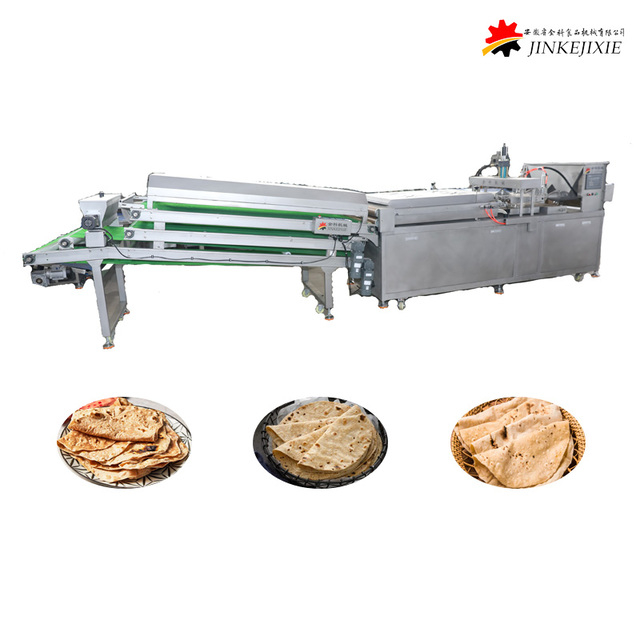
For an industrial bakery, fermentation is not simply a waiting period between mixing and baking. It is a controlled processing stage that influences dough extensibility, gas development, texture, flavor, volume, and the way dough behaves when it reaches downstream forming equipment. When production expands from small batches to thousands of pieces per hour, relying on room temperature and manual timing becomes increasingly difficult.
A Dough Fermentation Machine provides a more controlled environment for this stage. By regulating temperature, humidity, residence time, and dough movement, the equipment can help commercial bakeries reduce batch-to-batch variation and maintain a more predictable dough condition before rolling, pressing, shaping, or baking.
This becomes especially important in automated flatbread and bakery lines. As Jinke's production-line guidance emphasizes, industrial output depends on the coordination of each processing stage rather than the performance of one machine in isolation. Likewise, its analysis of soft and crispy lavash production shows that dough hydration, gluten development, temperature, fermentation, forming, and baking parameters need to be considered as one interconnected process.
AnHui JinKe Foodstuff Machinery Co.,Ltd. supplies dough-processing and automated bakery equipment for commercial food manufacturers. Its current Dough Fermentation Machine range is designed to provide controlled and repeatable fermentation for industrial bakery applications. The current horizontal model combines temperature and humidity control with continuous high-capacity operation and can be integrated with other bakery machinery.
What Is a Dough Fermentation Machine?
A Dough Fermentation Machine is commercial bakery equipment used to create controlled conditions for dough fermentation or proofing.
In a traditional bakery, dough may simply rest in a room or covered container. However, changes in ambient temperature, humidity, airflow, dough temperature, and production timing can cause one batch to ferment differently from another.
An industrial fermentation machine reduces this environmental variability by controlling factors such as:
Temperature
Relative humidity
Fermentation time
Air circulation
Dough residence time
Product movement through the system
Commercial proofing equipment generally uses controlled temperature and humidity to promote predictable yeast activity. Warm, humid conditions encourage fermentation while helping prevent the dough surface from drying prematurely.
For automated production, the machine can also serve as a process bridge between dough preparation and forming. Divided and rounded dough pieces can enter a controlled resting or fermentation stage before they move to rolling, sheeting, pressing, molding, or baking.
Why Is Controlled Dough Fermentation Important?
Fermentation changes more than dough size.
During yeast fermentation, sugars are metabolized and gases are produced within the dough structure. At the same time, the dough continues to develop chemically and mechanically. The result influences extensibility, elasticity, aroma, internal structure, and how the dough responds during downstream processing.
When conditions vary excessively, commercial manufacturers may experience:
Uneven dough expansion
Inconsistent product diameter
Dough tearing during rolling
Excessive shrink-back after pressing
Variable thickness
Irregular baking
Differences in softness and texture
Increased waste
A controlled system helps create a repeatable processing window.
For high-volume production, repeatability is particularly important because even a small inconsistency becomes significant when thousands of pieces are produced during each shift.
How Does a Dough Fermentation Machine Work?
The basic principle is straightforward: the equipment places dough in an environment where the variables that influence fermentation can be managed more accurately.
A typical industrial process follows several stages.
1. Dough Enters the Fermentation System
Dough pieces normally arrive after upstream preparation such as dividing and rounding.
In many automated bread processes, the sequence is broadly:
Mixing → Dividing → Rounding → Fermentation/Resting → Rolling or Forming → Baking
Intermediate proofing systems are commonly positioned between rounding and forming because the resting period allows dough to relax before mechanical flattening or molding.
A colder environment slows yeast activity, while warmer conditions generally accelerate it. The ideal setting depends on the formulation, yeast level, dough temperature, product type, and desired fermentation result.
Industrial proofers therefore rely on heaters, sensors, and controllers rather than uncontrolled room conditions.
Jinke's current horizontal fermenter uses adjustable temperature control and is also described as supporting cold-fermentation applications.
3. Humidity Is Regulated
Humidity helps protect the dough surface.
If the surrounding environment is too dry, the surface can lose moisture and develop a skin. This can interfere with expansion and create defects during pressing, rolling, or baking.
Commercial proofing equipment therefore typically uses water or steam-based humidification together with air circulation to maintain a more consistent environment.
The appropriate humidity should always be established according to the actual dough and process rather than assuming one universal setting.
4. Dough Remains for a Controlled Time
Fermentation time is another critical variable.
Too little time may leave the dough excessively tight or insufficiently developed. Too much time may result in over-fermentation, excessive gas development, weakening structure, or production delays.
Industrial systems therefore coordinate conveyor speed and machine residence time with the target recipe.
Jinke's current JKXFJ horizontal model lists a standard fermentation time of 10–15 minutes, which should be understood as a model-specific operating specification rather than a universal fermentation time for every bread or dough product.
5. Dough Moves to the Next Process
After controlled fermentation or resting, dough can move automatically toward rolling, pressing, shaping, or other production equipment.
This integration is important because the benefits of controlled fermentation can be lost if dough sits for unpredictable periods between machines.
Jinke Dough Fermentation Machine: Current Model Specifications
Sourdough, yeast-leavened, brioche, sweet and artisan dough
These are specifications for the currently published model and should not be assumed to apply to every customized fermentation system. Jinke states that higher-throughput solutions can be engineered according to production requirements.
Horizontal Fermentation Machine vs. Traditional Proofing Cabinet
Commercial buyers may encounter several different types of fermentation equipment.
A traditional proofing cabinet usually holds racks or trays inside a controlled chamber. It is commonly suitable for batch bakery operations.
A horizontal or continuous system operates differently.
Feature
Proofing Cabinet
Horizontal Fermentation Machine
Production Style
Batch
Continuous
Product Transfer
Manual or rack-based
Conveyor/integrated
Line Integration
Limited to moderate
Strong
Space Use
Vertical cabinet
Long horizontal process
Best Application
Smaller batch production
Industrial continuous lines
Automation
Low–medium
Medium–high
Capacity
Model dependent
Designed for higher throughput
For an industrial production line, continuous equipment can simplify transfers because the dough does not need to be manually unloaded from racks and moved to another processing machine.
The choice should therefore depend on factory throughput and production flow rather than assuming one design is universally better.
Fermentation vs. Proofing vs. Resting: Are They the Same?
These terms are often used interchangeably in commercial machinery descriptions, but they can refer to different processing purposes.
Fermentation
Fermentation broadly describes biochemical activity in dough, particularly yeast activity that produces gas and develops flavor.
It can occur:
During bulk fermentation
During intermediate fermentation
During final proofing
Under cold fermentation conditions
Intermediate Resting or Proofing
After dividing and rounding, dough can become mechanically stressed.
A controlled resting period allows the gluten network to relax before rolling or flattening.
This is particularly important for flatbread because highly elastic dough may contract after sheeting or pressing.
Commercial intermediate proofers are specifically used to provide this controlled relaxation stage between portioning and forming.
Final Proofing
Final proofing usually occurs after the dough has been shaped and before baking.
At this stage, gas expansion and dough development help establish the final volume and internal structure.
When selecting equipment, buyers should therefore tell the manufacturer exactly where fermentation occurs in their production process.
Why Fermentation Matters in Flatbread Production
Not every flatbread uses the same fermentation process.
Some flatbreads rely heavily on yeast fermentation, while others require only controlled dough relaxation. Formulation, hydration, flour strength, product thickness, and baking method all influence the required processing conditions.
Jinke's article on producing soft versus crispy lavash at scale illustrates this relationship clearly: dough hydration and gluten development determine how the material behaves during sheeting, while mixing and dough temperature affect the strength and extensibility of the dough before it enters downstream equipment.
For soft flatbread, insufficient relaxation may create:
Excessive shrink-back
Uneven diameter
Torn sheets
Poor flexibility
For certain yeast-leavened breads, insufficient fermentation can also reduce gas development and alter texture.
The fermentation stage should therefore be configured around the target product rather than copied from another bakery recipe.
Which Products Can Use a Dough Fermentation Machine?
According to Jinke's current product information, the horizontal fermentation system can be used with multiple dough categories, including:
Yeast-leavened dough
Sourdough
Brioche
Sweet dough
Artisan dough formulations
It can also be integrated into broader bakery production systems.
Depending on the customized process, fermentation or intermediate resting equipment may be relevant for products such as:
Bread
Rolls
Baguettes
Pizza bases
Pita
Some flatbreads
Sweet bakery dough
Artisan bakery products
However, the required time, temperature, humidity, and handling method must be validated for the actual product.
How to Choose a Dough Fermentation Machine
A buyer should not select the machine simply by capacity.
The equipment needs to match the complete manufacturing process.
Start With Your Product
Before requesting a quotation, identify:
Product name
Dough weight
Dough hydration
Yeast content
Flour type
Dough temperature
Desired fermentation time
Target final texture
This information helps determine whether the application requires a short intermediate relaxation period, longer fermentation, cold fermentation, or another controlled process.
Match Capacity to the Entire Production Line
A 3,000-piece fermentation system does not automatically mean the complete bakery can produce 3,000 finished products at the required cycle.
The line capacity is determined by the slowest section.
For example:
Divider → Rounder → Fermenter → Roller → Oven
If the rounder processes 6,000 pieces per hour but the downstream roller handles only 3,000 pieces per hour, the effective production capacity remains limited by the roller.
Jinke's current Dough Rounder Machine, for example, lists up to 14,000 pieces per hour for a six-row configuration. Such upstream capacity needs to be coordinated with the fermenter and downstream equipment rather than considered independently.
Check Fermentation Time and Residence Time
One of the most important engineering questions is:
How long does each dough piece remain inside the machine?
If your process requires 20 minutes of resting but the system is designed for 10 minutes at target throughput, either the machine footprint, conveyor path, production speed, or process design may need to change.
Residence time and capacity are directly connected.
Increasing throughput while maintaining the same fermentation time usually requires:
More conveyor length
Additional levels
Larger chambers
Multiple lanes
A larger machine footprint
This is why throughput claims should always be evaluated together with residence time.
Evaluate Temperature Accuracy
Temperature consistency matters more than simply having a temperature setting.
Ask:
What is the adjustable temperature range?
How many sensors are installed?
Where are the sensors located?
How uniform is temperature across the machine?
How quickly does the system recover after a door or access panel is opened?
Can recipes be stored?
A commercial fermentation machine should create repeatable conditions throughout the dough path rather than one accurate reading near the sensor.
Evaluate Humidity Control
Humidity should also remain sufficiently consistent across the fermentation area.
Ask whether the system uses:
Steam
Water spray
Atomization
Integrated humidification
Also consider drainage and sanitation, because humid environments require appropriate cleaning design.
Jinke's current horizontal model provides adjustable humidity control and uses insulated chambers designed to maintain controlled fermentation conditions.
Consider Factory Space Early
The JKXFJ model is currently listed at approximately:
7279 × 1520 × 4000 mm
A machine of this scale requires more than its physical footprint.
The facility also needs space for:
Operator access
Cleaning
Maintenance
Electrical access
Upstream machinery
Downstream equipment
Product transfers
For a new bakery project, machine layout should be planned before construction or utility installation whenever possible.
How a Fermenter Fits Into a Complete Production Line
A fermentation machine is rarely used alone in a high-output factory.
The objective is to ensure that dough moves through the line at the required speed without unnecessary waiting or manual transfers.
Automatic Fermentation vs. Manual Dough Resting
For smaller production volumes, manual resting remains practical.
However, as production grows, several limitations become more noticeable.
Factor
Manual Resting
Automatic Fermentation
Temperature Control
Environment dependent
Controlled
Humidity Control
Limited
Adjustable
Timing
Operator dependent
Repeatable
Product Handling
Manual
Can be automated
Labor Requirement
Higher
Reduced handling
Capacity
Limited
Industrial scale
Line Integration
Low
High
Batch Consistency
More variable
More repeatable
The financial value of automation depends on output and labor structure.
A small bakery producing a few hundred pieces per day may not need a continuous fermentation system. A factory processing thousands of pieces per hour has a much stronger reason to integrate fermentation with other production stages.
How Fermentation Can Affect Downstream Forming
This is one of the most overlooked reasons for using controlled fermentation or resting equipment.
Pressing and rolling performance depends heavily on dough rheology.
If the dough is too elastic, a pressed disc may contract immediately after forming.
If it is too weak, it may tear during high-speed transfer.
If the surface dries during resting, rollers can produce cracks or irregular shapes.
Controlled fermentation helps manufacturers deliver dough to the forming equipment within a narrower condition range.
Jinke's lavash-production analysis similarly emphasizes that hydration, gluten development, dough temperature, and mechanical sheeting conditions must be coordinated because the physical state of the dough determines its performance downstream.
What Happens When Fermentation Is Poorly Controlled?
Several production problems can indicate that fermentation conditions need improvement.
Dough Shrinks After Pressing
Possible causes include insufficient relaxation or excessively elastic dough.
Dough Surface Becomes Dry
Humidity may be too low or dough may be exposed to uncontrolled air.
Product Size Varies
Uneven fermentation or inconsistent dough condition can contribute to differences during pressing or rolling.
Dough Becomes Too Soft
Excessive fermentation, excessive temperature, or long residence time may weaken the dough.
Product Texture Changes Between Shifts
Differences in ambient temperature, resting time, ingredient temperature, or operator practices may be influencing the process.
Automation cannot correct every formulation problem, but controlled equipment makes it easier to identify and stabilize the process variables.
Does Every Flatbread Need Fermentation?
No.
Different flatbreads use different formulations and processes.
Some use yeast fermentation extensively, while others rely on unleavened dough or relatively short resting periods.
This is why an equipment supplier should ask about the actual recipe before recommending a fermentation machine.
For buyers planning a larger flatbread facility, Jinke's Automatic Flatbread Production Line range covers several production concepts, including tortilla, roti, chapati, taco, pita, and parotta lines.
The fermentation configuration should be selected according to the target product rather than assuming all flatbread processes are identical.
Cold Fermentation vs. Warm Fermentation
Warm proofing and cold fermentation serve different manufacturing objectives.
Warm Fermentation
Warm conditions generally accelerate yeast activity and are commonly used where production needs predictable fermentation within a shorter manufacturing cycle.
Cold Fermentation
Lower temperatures slow fermentation.
This approach can be used in certain bakery processes to extend fermentation time and develop different flavor characteristics.
Jinke's current horizontal fermentation machine is described as supporting adjustable temperature conditions, including cold fermentation.
Before using cold fermentation in a continuous line, however, production managers should consider the much longer residence times that may be required. A process that lasts hours rather than minutes has very different equipment and factory-space implications.
Hygiene and Cleaning Should Influence Machine Selection
Fermentation equipment operates in a warm and often humid environment, making hygienic design particularly important.
Buyers should check:
Food-contact materials
Surface accessibility
Removable components
Drainage
Conveyor cleaning access
Dead zones
Control-panel protection
Moisture management
Jinke's current fermentation-machine page states that the system uses smooth surfaces and removable chamber components intended to support regular cleaning and maintenance.
Cleaning time should also be included when calculating actual daily production capacity.
A line theoretically capable of operating 24 hours per day still needs planned sanitation and maintenance periods.
Energy Consumption Is More Than Rated Power
The current JKXFJ model lists a rated power of 2 kW, but buyers should not evaluate operating cost from one number alone.
Actual energy consumption depends on factors such as:
Ambient temperature
Target fermentation temperature
Humidity level
Production schedule
Insulation performance
Start-up frequency
Door or chamber opening
Machine utilization
Good insulation can reduce the frequency at which heating and humidification systems need to compensate for environmental losses.
Important Questions to Ask Before Buying
Before purchasing a Dough Fermentation Machine, ask the supplier:
Is the machine intended for intermediate resting or final proofing?
What is the usable temperature range?
What humidity range can be controlled?
What residence time is available?
What throughput can be achieved at that residence time?
What dough weight range can the system handle?
Can it process my exact dough formulation?
Can it integrate with my existing divider and roller?
How much factory space is required?
What power supply is required?
Which components need daily cleaning?
Which spare parts should be stocked?
Can process settings be customized?
Can the machine support future capacity expansion?
Is installation and commissioning support available?
The answer to these questions is more useful than comparing machines only by headline capacity.
Information to Provide When Requesting a Quote
For a more accurate quotation, commercial buyers should prepare a basic technical brief.
Requirement
Information to Provide
Product
Bread, pita, flatbread, roll, etc.
Dough Weight
Grams per piece
Dough Type
Yeast, sourdough, sweet dough, etc.
Required Capacity
Pieces/hour
Fermentation Time
Target minutes
Temperature
Target range
Humidity
Target range if known
Upstream Machine
Divider/rounder
Downstream Machine
Roller/press/oven
Factory Space
Available dimensions
Power Supply
Voltage/frequency
Working Hours
Hours per shift
Destination
Country/city
Installation
Remote or on-site
If the process has already been validated manually, sharing existing fermentation parameters can help equipment engineers design the system more accurately.
AnHui JinKe Foodstuff Machinery Co.,Ltd. supplies commercial food-processing machinery for dough preparation, flatbread production, baking, cooling, and downstream handling.
The company's current Dough Fermentation Machine category focuses on controlled and repeatable dough fermentation for bakery and food-production facilities. The published horizontal model combines adjustable temperature and humidity, digital controls, high-capacity dough handling, insulated construction, real-time monitoring, and integration with other bakery machines.
The current JKXFJ model is specified with a maximum capacity of 3,000 pieces, 10–15-minute standard fermentation time, 2 kW rated power, and a 7279 × 1520 × 4000 mm footprint. Jinke also states that capacity can be customized for different production requirements.
A Dough Fermentation Machine creates controlled temperature, humidity, and time conditions for dough fermentation or resting, helping commercial bakeries achieve more consistent dough behavior before forming or baking.
Is a dough fermentation machine the same as a proofer?
The terms are sometimes used interchangeably, but the exact process can differ. A fermentation machine may be used for intermediate dough relaxation or controlled fermentation, while a final proofer usually refers to the last rise before baking.
What temperature should dough ferment at?
There is no single temperature for every product. Commercial proofing conditions vary according to dough type, yeast, process stage, and target product. The appropriate setting should be validated for the actual recipe.
Why is humidity important during dough fermentation?
Controlled humidity helps prevent excessive surface drying while dough ferments or rests. A dry surface can create skin formation and cause difficulties during expansion, rolling, or pressing.
How long does dough need to stay in a fermentation machine?
It depends on the product and process. Jinke's current JKXFJ horizontal model lists a standard machine residence time of 10–15 minutes, while other bakery proofing processes can require substantially longer periods.
Can a Dough Fermentation Machine improve product consistency?
It can reduce variation caused by uncontrolled temperature, humidity, and resting time, making the dough condition more predictable before downstream processing.
Can the machine be integrated into an automatic production line?
Yes. Jinke's horizontal system is designed for integration with commercial bakery equipment such as dough-processing machines and industrial ovens.
Can it handle cold fermentation?
Jinke's current horizontal model is specified with adjustable temperature control that supports cold-fermentation applications.
What is the capacity of Jinke's current fermentation machine?
The published JKXFJ model lists a maximum batch capacity of 3,000 pieces. Customized capacity solutions can also be discussed for higher-throughput projects.
What machines usually come before the fermenter?
Depending on the process, dough may pass through a divider and rounder before entering intermediate fermentation or resting equipment.
What machines come after fermentation?
The downstream machine may be a dough roller, pressing machine, sheeter, molder, or oven depending on the product.
Does every flatbread require fermentation?
No. Flatbread processes differ considerably. Some products depend on yeast fermentation, while others may require only a resting period or may use an unleavened process.
Conclusion
A Dough Fermentation Machine becomes increasingly valuable when a bakery needs to transform fermentation from an operator-dependent waiting stage into a controlled industrial process. By stabilizing temperature, humidity, residence time, and dough handling, the equipment can help deliver more consistent material to downstream rolling, pressing, shaping, and baking operations.
The most important point is that fermentation equipment should not be selected in isolation. Capacity must match the divider and rounder upstream as well as the forming equipment and oven downstream. The required residence time must also be calculated alongside throughput, because increasing production speed without providing sufficient fermentation time can undermine the purpose of the machine.
Product characteristics matter just as much. As Jinke's technical content on industrial flatbread production demonstrates, hydration, gluten development, dough temperature, mechanical handling, and thermal processing are closely connected. A fermentation system therefore needs to be configured around the actual dough rather than around a generic bakery specification.
AnHui JinKe Foodstuff Machinery Co.,Ltd. provides commercial bakery equipment covering dough preparation, controlled fermentation, flatbread production, baking, cooling, and downstream handling. Its Dough Fermentation Machine range is intended for bakeries and food-processing facilities that require more predictable dough fermentation and better integration with automated production.
The right fermentation machine is therefore not simply the one with the highest capacity. It is the machine that provides the required dough residence time, environmental control, hygienic design, factory fit, and production-line compatibility for the specific bakery product you intend to manufacture.