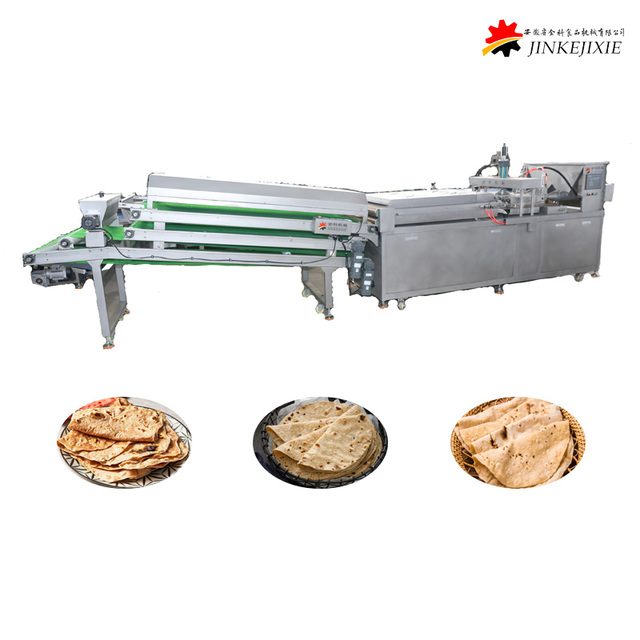
Investing in an Automatic Flatbread Production Line is a major step for bakeries and food manufacturers moving from batch-based production toward continuous industrial output. Instead of relying on separate machines and repeated manual transfers, an automated line can connect dough preparation, dividing, rounding, resting or proofing, pressing, baking, cooling, counting, stacking, and packaging into one coordinated manufacturing process.
For buyers, however, the difficult question is not whether automation can increase production. The real challenge is deciding what level of automation, capacity, product flexibility, and equipment configuration actually matches the factory. A line designed for 6-inch tortillas at high speed will not necessarily be the right system for thicker chapati, pita, roti, or other flatbread products, even when the products appear similar at first glance.
Current industry buying guides repeatedly focus on capacity, automation level, product specification, factory layout, energy source, maintenance, labor requirements, and total cost of ownership when evaluating bakery production equipment. Competitor content also increasingly treats a production line as an integrated manufacturing system rather than simply a collection of individual machines.
Anhui Jinke Foodstuff Machinery Co., Ltd. has specialized in flatbread production machinery since 2008 and provides complete production solutions for international customers across multiple regions. Its current product portfolio covers tortilla, chapati, roti, pita, taco, parotta, and related flatbread equipment, together with dough-processing machines, tunnel ovens, cooling conveyors, and automatic counting and stacking systems.
An Automatic Flatbread Production Line is a connected food-processing system designed to convert prepared ingredients or dough into finished flatbread with limited manual handling between stages.
Depending on the product, a complete line may include:
Dough mixing
Dough dividing
Dough rounding
Dough resting or proofing
Pressing or sheeting
Shape forming
Baking
Cooling
Counting
Stacking
Packaging integration
The exact configuration depends on the flatbread being produced. Tortilla, chapati, roti, pita, paratha, and taco products differ in dough formulation, thickness, fermentation, forming method, baking profile, and final handling requirements, which means the production line should be designed around the finished product rather than forcing every recipe through the same process.
Jinke's current Automatic Flatbread Production Line category supports multiple product families and emphasizes continuous production, intelligent control, lower dependence on manual handling, and repeatable thickness, shape, and texture.
Why Are Bakeries Moving Toward Automatic Flatbread Production?
Manual and semi-automatic production can work well at lower volumes, but labor becomes increasingly difficult to manage as daily demand grows.
A manual operation may require employees to:
Divide dough
Round portions
Transfer dough between stations
Load presses
Monitor baking
Remove products
Cool products manually
Count finished flatbreads
Build stacks
Transfer products to packaging
Each additional transfer introduces labor cost and the possibility of variation.
Automation does not eliminate the need for operators, but it changes their role. Instead of repeatedly handling each piece, workers can monitor machine parameters, ingredient preparation, sanitation, quality control, and packaging performance.
This is particularly valuable when production runs are long because consistent mechanical settings can reduce the variation caused by different operators working across multiple shifts.
How Does an Automatic Flatbread Production Line Work?
Although the exact process changes by product, a typical line can be divided into five main manufacturing sections.
1. Dough Preparation and Portioning
Consistent flatbread starts with consistent dough.
If dough hydration, mixing time, temperature, or portion weight changes continuously, later machines cannot fully correct the problem.
The preparation stage may therefore include:
Dough mixer
Dough divider
Dough rounder
Resting or proofing system
A precision divider helps control portion weight before forming, while rounding creates more consistent dough-ball geometry.
Jinke supplies dedicated Dough Processing Equipment, including dough dividers, rounders, rollers, shape-forming equipment, pressing machines, and fermentation systems.
The company's automatic dough divider, for example, uses PLC and touchscreen control, customized dividing modes, food-contact construction, automatic alarms, and configurable dimensions for integration into different bakery layouts.
2. Resting, Proofing, Pressing, or Sheeting
Flatbread texture depends heavily on how dough is relaxed and formed.
For many wheat-based products, the dough needs enough resting time to reduce excessive elasticity before pressing. If dough is pressed before it relaxes sufficiently, it may shrink back and create inconsistent diameter.
Depending on the recipe and product style, forming may involve:
Hydraulic pressing
Pneumatic pressing
Roller sheeting
Cutting
Moulding
Film-assisted pressing
Thickness control is especially important because even small variations affect baking speed, moisture, flexibility, and final product weight.
3. Baking
The oven is one of the most critical components of an Automatic Flatbread Production Line.
Temperature must be controlled carefully enough to produce:
Consistent color
Correct moisture
Desired surface texture
Appropriate internal structure
Repeatable flexibility
Industrial flatbread lines commonly use continuous tunnel ovens because products can pass through controlled heating zones without stopping the production flow.
Jinke's Industrial Flatbread Tunnel Oven is designed for continuous high-speed flatbread baking and forms part of the company's extended flatbread-production equipment range.
For industrial buyers, the oven should be evaluated according to more than maximum temperature. Consider:
Effective baking width
Number of heating zones
Energy source
Temperature stability
Belt speed
Heat distribution
Cleaning access
Exhaust requirements
A poorly matched oven can limit the entire production line even when the upstream equipment has significantly higher capacity.
4. Cooling
Flatbread should not normally move directly from a hot oven into sealed packaging.
Residual heat can contribute to condensation, sticking, texture changes, and packaging problems.
A controlled cooling conveyor provides enough residence time for product temperature to decline before counting and packing.
Jinke's Bakery Cooling Conveyor is designed for integration with industrial ovens and downstream packaging equipment.
Cooling capacity should be matched to oven output. If the baking section produces faster than the cooling conveyor can handle, the cooling stage becomes the bottleneck.
5. Counting, Stacking, and Packaging
Manual counting may appear inexpensive until the production line reaches several thousand pieces per hour.
At high output, employees need to repeatedly count, align, and transfer products into stacks while maintaining the correct package quantity.
Automatic counting and stacking systems can help standardize this stage.
Jinke's Flatbread Counter Stacker is designed to count and organize flatbreads before packaging, helping connect continuous production with final packing operations.
For higher-speed projects, automated stacking should be evaluated together with the packaging machine because the line is only as fast as its slowest downstream process.
What Products Can an Automatic Flatbread Production Line Make?
“Flatbread” covers many different products.
A production line may be configured for:
Product
Key Process Considerations
Tortilla
Diameter, thickness, pressing, flexible texture
Chapati
Dough hydration, thin forming, baking profile
Roti
Forming consistency and soft texture
Pita
Proofing and oven conditions for pocket formation
Taco
Shape and downstream forming requirements
Paratha
Layering, oil/fat distribution, forming
Parotta
Dough structure and layering
Wrap
Large diameter, thinness, flexibility
Jinke's flatbread equipment portfolio currently separates Tortilla Production Lines, chapati, roti/paratha, pita, taco, and parotta production solutions, which reflects an important engineering point: these products should not automatically be treated as identical manufacturing processes.
Capacity: How Many Flatbreads Per Hour Do You Need?
Capacity is one of the first numbers buyers compare, but it is also one of the easiest specifications to misunderstand.
The correct capacity depends on:
Product diameter
Product thickness
Number of lanes
Dough formulation
Forming method
Baking time
Cooling time
Packaging speed
The same machine may produce significantly different hourly output when product diameter changes.
For example, Jinke's JKBP-650 Automatic Tortilla Production Line is currently specified for approximately:
Tortilla Size
Listed Production Capacity
6 inch
6,000–8,000 pcs/h
8 inch
3,000–4,000 pcs/h
10 inch
3,000–4,000 pcs/h
The model uses PLC + touchscreen control, 304 stainless steel food-contact parts, production-data monitoring, automatic error shutdown, and customizable electrical supply.
Buyers requiring greater throughput can evaluate higher-capacity configurations such as the JKBP-820 Automatic Tortilla Production Line, which Jinke currently lists at approximately 15,500–16,000 pieces per hour for 6-inch tortillas and 7,000–8,000 pieces per hour for 8-inch products.
These examples show why a request such as “I need 10,000 tortillas per hour” is incomplete unless product diameter is also specified.
Do Not Buy Capacity You Cannot Use
More output is not automatically better.
A line capable of producing 15,000 pieces per hour can become an expensive asset if market demand is only 3,000 pieces per hour for one shift.
A realistic capacity target usually includes some headroom for growth but should not be based entirely on an optimistic peak-sales forecast.
Fully Automatic vs. Semi-Automatic: Which Is Better?
This is one of the most important investment decisions.
Neither option is universally better.
Jinke's own comparison positions semi-automatic systems toward startups, smaller factories, lower production requirements, and tighter initial budgets, while fully automatic lines are positioned toward medium and large factories, continuous production, higher demand, labor-cost concerns, and future expansion.
Factor
Semi-Automatic
Fully Automatic
Initial Investment
Lower
Higher
Labor Requirement
Higher
Lower
Continuous Production
Limited
Strong
Product Consistency
More operator-dependent
More repeatable
Expansion Potential
Moderate
Higher
Production Capacity
Low–medium
Medium–high
Process Integration
Partial
Extensive
Best Fit
Startups/smaller plants
Industrial factories
Choose Semi-Automatic When:
Demand is still developing.
Labor cost is relatively low.
Initial investment must remain limited.
Multiple manual processes are acceptable.
Production batches are relatively small.
Choose Fully Automatic When:
Output demand is high.
Labor availability is a concern.
Product consistency is critical.
The line will run for long shifts.
Future capacity growth is expected.
Retail or export contracts require repeatable output.
What Does an Automatic Flatbread Production Line Cost?
There is no reliable universal price for a flatbread line because it is not a standardized single machine.
Cost changes according to:
Capacity
Number of lanes
Product type
Forming method
Automation level
Oven configuration
Gas or electric heating
Cooling length
Counting system
Packaging integration
Control system
Factory voltage
Custom layout
Installation requirements
Current industrial bakery buying guides show why production-line quotations can vary substantially: automation, capacity, product complexity, factory infrastructure, and downstream packaging all contribute to total project investment rather than only the price of the core machine.
For flatbread specifically, the more useful approach is to request a configuration-based quotation rather than searching for one generic “automatic flatbread machine price.”
Calculate Total Cost of Ownership, Not Only Machine Price
Two suppliers can quote different equipment prices while producing very different long-term costs.
A useful TCO calculation should consider:
Total Cost of Ownership = Equipment + Freight + Installation + Utilities + Labor + Energy + Maintenance + Spare Parts + Downtime
Labor
Automation can reduce repeated manual transfer, counting, and handling, although the actual labor requirement depends on line configuration.
Jinke states that its JKBP-650 automated line is designed to reduce manual dependency through connected production from dividing through downstream handling.
Energy
The oven typically represents a substantial long-term energy load.
Compare:
Gas availability
Electricity cost
Heating efficiency
Oven insulation
Production hours
Maintenance
Preventive maintenance is generally cheaper than unplanned line stoppage.
Competitor maintenance guidance illustrates an important production principle: when a critical upstream machine fails, equipment downstream may also sit idle because product flow stops.
For an integrated flatbread line, downtime should therefore be treated as a system-wide production cost.
How Much Factory Space Does the Line Need?
Automatic lines require more than the physical machine footprint.
The factory layout should also provide space for:
Raw ingredients
Dough preparation
Operators
Cleaning
Maintenance access
Electrical cabinets
Oven ventilation
Cooling
Packaging
Finished goods
Spare parts
Jinke's factory-planning guidance specifically recommends considering product specifications, output targets, utilities, ventilation, drainage, floor conditions, and equipment arrangement before finalizing a flatbread production line.
Before requesting a quote, send the manufacturer a factory drawing whenever possible.
What Utilities Should You Confirm Before Ordering?
A production line should be engineered around the factory where it will operate.
Confirm:
Voltage
Frequency
Three-phase power availability
Gas supply
Compressed air
Water
Drainage
Ventilation
Exhaust
Ambient temperature
Jinke's current JKBP-650 and JKBP-820 specifications support customized 220V/380V electrical configurations, reflecting the need to adapt exported equipment to local power conditions.
Utilities should be confirmed before manufacturing rather than modified after delivery.
How Important Is PLC Control?
Modern flatbread lines increasingly use PLC and touchscreen interfaces because multiple processing sections need to remain synchronized.
Useful functions may include:
Line speed adjustment
Temperature monitoring
Output monitoring
Error alarms
Production data
Parameter storage
Emergency shutdown
Jinke's JKBP-650 and JKBP-820 models currently list PLC + touchscreen control together with error-code display and tracking of parameters such as output, temperature, and speed.
For multi-product factories, stored settings can also simplify recipe changeovers once operators establish validated production parameters.
Food Safety and Machine Construction
Food-processing equipment should be easy to clean and designed to minimize contamination risk.
Important purchasing questions include:
What material touches the dough?
Can conveyors be cleaned easily?
Are covers removable?
Are corners accessible?
Are electrical parts protected?
Are emergency stops provided?
Are moving parts guarded?
Jinke's current automatic tortilla line specifications identify food-contact sections constructed with 304 stainless steel together with emergency-stop buttons and protective covers.
Buyers should still confirm the standards required in their destination market before ordering.
Product Flexibility: Can One Line Make Several Flatbreads?
Flexibility can improve equipment utilization, but buyers should avoid assuming every product change requires only one touchscreen adjustment.
Different recipes can require changes to:
Dough hydration
Resting time
Portion weight
Press pressure
Thickness
Tooling
Oven temperature
Conveyor speed
Cooling time
A flexible line is most valuable when the manufacturer understands exactly which products must share the equipment.
Before ordering, provide a product matrix such as:
Requirement
Product A
Product B
Product
Tortilla
Chapati
Diameter
8 inch
10 inch
Thickness
Target value
Target value
Weight
Target value
Target value
Flour Type
Wheat
Wheat
Output
6,000 pcs/h
4,000 pcs/h
Package Count
10
20
This gives the equipment engineer much more useful information than asking for a “multi-purpose flatbread line.”
How to Evaluate a Supplier Before Ordering
An Automatic Flatbread Production Line is a long-term production asset, so supplier evaluation should extend beyond the initial quotation.
Ask the manufacturer:
Can you process my exact recipe?
Can you demonstrate the finished product?
What is guaranteed capacity for my product size?
Which parts contact food?
What are the power and gas requirements?
Which spare parts should I keep in stock?
How quickly can technical support respond?
Is remote commissioning available?
Can engineers provide on-site installation?
What operator training is included?
Can the line expand later?
Can packaging be integrated?
Competitor procurement guidance also emphasizes supplier support, spare parts, maintenance capability, and equipment matching as essential questions before buying commercial bakery machinery.
Why Installation and Training Matter
Even well-designed machinery can perform poorly if it is installed incorrectly or operators do not understand the process.
Commissioning normally involves more than switching on the line.
Engineers may need to adjust:
Dividing weight
Pressing pressure
Line speed
Oven temperature
Baking time
Cooling speed
Stacking count
Jinke describes a project process covering consultation and analysis, R&D design, production and assembly, testing, installation, training, and after-sales support.
Its automatic line pages also list optional engineer on-site service for installation and operator training.
Automatic Flatbread Production Line Buying Checklist
Before asking suppliers for quotations, prepare the following information:
Requirement
Information to Provide
Product Type
Tortilla, chapati, pita, roti, etc.
Recipe
Wheat, corn, whole grain, specialty dough
Diameter
Finished product size
Thickness
Target thickness
Weight
Weight per piece
Capacity
Pieces/hour
Working Hours
Hours/shift and shifts/day
Heating
Gas or electric
Voltage
Local power supply
Factory Space
Available length × width
Automation
Semi or fully automatic
Packaging
Manual or automatic
Stack Count
Pieces/package
Destination
Country/city
Installation
Remote or on-site
Future Products
Products planned later
The more complete this information is, the more accurately a manufacturer can design the line.
Anhui Jinke Foodstuff Machinery Co., Ltd. has focused on flatbread machinery since 2008 and currently provides complete production solutions covering tortilla, chapati, roti, pita, taco, parotta, and related products. The company describes its workflow as including requirement analysis, R&D design, production, testing, installation and training, and after-sales support.
For tortilla manufacturers, the Tortilla Production Line range currently includes multiple capacity levels, including JKBP-650, JKBP-740, JKBP-820, JKBP-950, and higher-output configurations.
This modular product structure allows buyers to configure the production system around actual output, product dimensions, factory conditions, and future growth rather than purchasing a fixed generic line.
FAQ
What is an Automatic Flatbread Production Line?
An Automatic Flatbread Production Line is an integrated system that can connect dough preparation, dividing, forming, baking, cooling, counting, stacking, and packaging-related processes for continuous commercial production.
What products can an automatic flatbread line make?
Depending on its configuration, the equipment can support tortillas, chapati, roti, pita, taco products, paratha, parotta, wraps, and other flatbreads.
How many tortillas can an automatic production line make per hour?
Capacity depends strongly on product size and model. Jinke's JKBP-650, for example, is currently listed at approximately 6,000–8,000 pieces per hour for 6-inch tortillas and 3,000–4,000 pieces per hour for 8- and 10-inch products.
What is the difference between fully automatic and semi-automatic flatbread lines?
Semi-automatic systems generally require more manual handling but reduce initial investment. Fully automatic systems connect more processing stages and are better suited to higher output and continuous production.
How much does an automatic flatbread production line cost?
There is no single standard price. Cost depends on capacity, product type, automation, oven configuration, cooling, stacking, packaging, factory utilities, and customization.
Can one production line make different tortilla sizes?
Selected lines can handle multiple sizes through tooling and parameter changes. The exact size range and changeover procedure should be confirmed for the model being purchased.
Does a flatbread line require a tunnel oven?
High-output continuous production commonly uses tunnel ovens because they integrate directly with upstream forming and downstream cooling equipment. The appropriate oven depends on the product and production volume.
Why is cooling necessary before packaging flatbread?
Cooling helps reduce residual heat before stacking and packaging, which can reduce condensation, sticking, and product-quality problems.
Does Jinke provide a cooling conveyor?
Yes. Buyers can review Jinke's Bakery Cooling Conveyor for integrated industrial cooling applications.
Can Jinke provide automatic counting and stacking?
Yes. Jinke supplies Flatbread Counter Stacker equipment for automated counting and organization before packaging.
Does Jinke support installation and operator training?
Jinke's current line specifications list optional engineer on-site installation and operator-training services, while its overall project workflow includes installation, training, and after-sales support.
Conclusion
Buying an Automatic Flatbread Production Line should be treated as a factory-design decision rather than a simple machinery purchase. Capacity, product diameter, dough formulation, forming method, oven design, cooling, stacking, packaging, labor, utilities, and available factory space all influence whether the line will perform efficiently once it enters daily production.
The most common mistake is selecting equipment according to maximum advertised output without first defining the finished product and real production plan. An 8-inch tortilla and a 12-inch wrap can require very different output conditions even on the same machine, while pita, chapati, roti, and paratha may require different processing logic altogether.
A better purchasing process starts with the product specification, calculates realistic hourly demand, determines whether semi-automatic or fully automatic operation is more appropriate, and then evaluates the complete production flow from dough preparation through packaging. Total cost of ownership—including labor, energy, maintenance, spare parts, installation, and downtime—should also be considered rather than comparing machine quotations alone.
Anhui Jinke Foodstuff Machinery Co., Ltd. has specialized in flatbread production equipment since 2008 and provides integrated solutions for tortilla, chapati, roti, pita, taco, parotta, and other flatbread products.
The right production line is not necessarily the machine with the highest output or the lowest purchase price. It is the system that matches your product, daily demand, factory layout, labor structure, operating costs, and growth plan while producing consistent flatbread shift after shift.