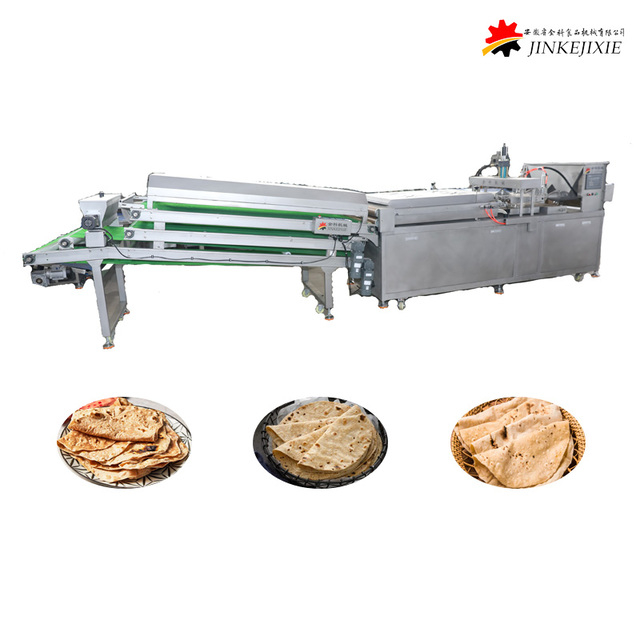
A Chapati Production Line can convert a traditionally labor-intensive process into a continuous manufacturing system capable of controlling dough portions, thickness, diameter, baking conditions, cooling, and finished-product handling at commercial scale. However, selecting the right line is not simply a matter of choosing the machine with the highest pieces-per-hour figure.
For industrial chapati production, the most important variables interact with one another. Dough hydration affects stickiness and extensibility; portion weight influences finished diameter; pressing or sheeting determines thickness; thickness changes the required baking profile; and oven conditions influence puffing, moisture retention, color, and softness. If one stage is poorly matched, the entire production line can become unstable even when every individual machine is operating normally.
This is why searches around automatic chapati machines increasingly focus on capacity, machine features, production applications, automation level, and buying criteria, making a buying-guide format particularly relevant for commercial procurement. Current industry guidance also separates compact machines producing a few hundred chapatis per hour from industrial systems designed for several thousand pieces per hour.
Anhui Jinke Foodstuff Machinery Co., Ltd. has supplied flatbread machinery since 2008 and currently provides dedicated chapati, tortilla, roti, pita, parotta, taco, and other flatbread production solutions. Its published JKBP-350/450 automatic chapati line supports 6–12 inch products at approximately 600–900 pieces per hour, with adjustable 0.5–3.0 mm thickness, PLC control, food-grade 304 stainless steel contact parts, and configurable power supply.
Key Takeaways
Start with the finished chapati specification before selecting machinery.
Required output should be calculated from peak production demand, not daily volume alone.
Dough hydration strongly affects feeding, rolling, pressing, transfer stability, and line speed.
Consistent portion weight is necessary for stable diameter and thickness.
Sheeting and heated pressing respond differently to dough rheology.
Baking capacity must match forming capacity or the oven becomes the bottleneck.
Cooling should be planned before packaging to reduce condensation and sticking.
Fully automatic systems suit continuous medium- and high-volume production, while semi-automatic configurations can fit smaller factories.
A Factory Acceptance Test using the buyer's actual flour and recipe is preferable before large-scale investment.
What Is a Chapati Production Line?
A Chapati Production Line is a coordinated series of food-processing machines used to convert prepared dough into uniformly formed and cooked chapatis.
Depending on the degree of automation, the process may include:
The exact process should be determined by the recipe and target finished product. A soft packaged chapati intended to remain pliable for several days may require different dough handling and thermal control from a chapati produced for immediate consumption in a central kitchen.
Jinke's current JKBP-350/450 system integrates precision dividing, rounding, hydraulic pressing, controlled baking, cooling, and digital production monitoring. The published configuration supports multiple flatbread products through mould and parameter adjustments.
Start With the Finished Chapati, Not the Machine
One of the most common procurement mistakes is selecting equipment first and adapting the product later.
A better approach is to define the product specification before requesting quotations.
Your technical brief should identify:
Product Requirement
Questions to Answer
Diameter
6, 8, 10, 12 inch or custom?
Thickness
Thin, standard, or thicker chapati?
Dough Weight
How many grams per piece?
Flour
Atta, whole wheat, blend, specialty flour?
Hydration
Water as a percentage of flour weight?
Oil/Fat
Added or oil-free formulation?
Texture
Soft, flexible, slightly crisp?
Puffing
Full, partial, or minimal?
Output
Pieces per hour and per day?
Packaging
Fresh, frozen, chilled, retail packed?
Jinke's factory-planning guidance similarly recommends defining product type, diameter, thickness, recipe, and target output before selecting equipment because these variables affect forming method, conveyor dimensions, oven settings, and factory configuration.
How Much Capacity Does Your Factory Need?
Capacity is usually the first specification buyers compare, but advertised output can be misleading if it is considered without product dimensions and operating conditions.
A useful starting calculation is:
Required hourly output = Peak production requirement ÷ Available production hours
For example, if a factory needs to make 8,000 chapatis during an eight-hour production period:
8,000 ÷ 8 = 1,000 chapatis/hour
However, production rarely operates at theoretical maximum speed for every minute of the shift. Time must also be allowed for:
Start-up
Cleaning
Product changeovers
Quality adjustments
Ingredient replenishment
Maintenance
Packaging interruptions
Commercial chapati-machine guidance therefore recommends calculating capacity around peak-hour demand and adding reasonable operational headroom rather than selecting equipment from daily volume alone.
Jinke JKBP-350/450 Capacity
The published JKBP-350/450 line currently provides:
Parameter
Specification
Production Capacity
600–900 pcs/h
Product Diameter
6–12 inch
Thickness
0.5–3.0 mm
Total Power
30 kW
Power Supply
220V / 380V / customized
Control
PLC + touchscreen
Baking Range
180–250°C
Contact Parts
Food-grade 304 stainless steel
Size Changeover
Under 15 minutes
Warranty
1 year
This capacity level can suit commercial bakeries, central kitchens, catering operations, institutional food production, and medium-scale packaged flatbread manufacturers.
For substantially higher production requirements, Jinke also publishes customized gravity-feed chapati solutions, so buyers should discuss the actual target output rather than assuming one standard line fits every factory.
Dough Hydration Can Determine Whether the Line Runs Smoothly
A chapati line does not process “dough” as a generic material. It processes a viscoelastic food material whose behavior changes significantly with hydration, flour composition, temperature, resting time, oil, and mechanical development.
This is why hydration deserves attention before machinery is selected.
Jinke's technical guidance identifies roughly 55–65% baker's percentage as a common chapati hydration region while emphasizing that the correct value depends on flour properties and production architecture. Its more tightly controlled automated processing discussion places a stable operating window around 55–62% for some applications, but this should not be treated as a universal recipe.
If Hydration Is Too Low
Stiff dough can create:
Higher motor torque
Increased roller pressure
Greater gearbox and bearing stress
Poor extensibility
Dough tearing
Reduced puffing
Increased power consumption
Low-hydration dough resists mechanical deformation, so the machine needs more force to push it through feeding and reduction stages.
If Hydration Is Too High
Excessively wet dough can create the opposite problems:
Dough sticking to rollers
Material adhering to belts
Hopper bridging
Irregular transfer
Shape deformation
More dusting flour
Production stoppages
Higher hydration can also cause a round cut piece to stretch or deform during conveyor transfers if the dough lacks sufficient structural strength.
The correct production line should therefore be tested with the buyer's actual flour and formulation whenever possible.
Why Diameter Consistency Starts Before Forming
Buyers sometimes assume that chapati diameter is controlled entirely by the press or cutter. In practice, several upstream variables influence the final size.
These include:
Dough portion weight
Hydration
Gluten development
Resting time
Forming pressure
Roller gap or press gap
Dough temperature
If portion weight varies, the forming equipment must spread different quantities of material across the same target area.
Jinke's JKBP-350/450 uses a servo-driven divider with a published weight tolerance of approximately ±1%, followed by rotary rounding and hydraulic pressing. The purpose of controlling these stages together is to improve consistency before the dough enters baking.
Jinke's own technical discussion of chapati diameter and thickness also emphasizes that dimensional variation creates downstream problems such as packaging jams and uneven baking.
Why Chapati Thickness Matters
Thickness affects much more than appearance.
It influences:
Baking time
Heat penetration
Moisture loss
Flexibility
Puffing
Product weight
Cooling time
If one chapati contains a thick center and thin edges, the edges may become dry or overbaked while the center remains relatively moist.
For automated production, thickness should therefore be controlled across the entire surface, not simply measured at one point.
The JKBP-350/450 lists an adjustable thickness range of 0.5–3.0 mm, giving manufacturers flexibility for different flatbread specifications.
Sheeting or Pressing: Which Forming Method Should You Choose?
Two common approaches in automated flatbread production are multi-stage sheeting and heated or hydraulic pressing.
Neither is automatically better.
The correct technology depends on dough rheology, desired texture, product thickness, capacity, and recipe.
Sheeting
Sheeting gradually reduces dough thickness through rollers.
It is well suited to dough that has enough extensibility to stretch repeatedly without tearing.
Advantages can include:
Continuous processing
Precise thickness reduction
High throughput
Efficient integration with cutters
However, very stiff dough may increase roller load, while overly sticky dough can adhere to surfaces.
Pressing
Pressing flattens individual dough portions between plates.
This can work well when the process requires individually controlled round pieces.
Jinke's JKBP-350/450 uses hydraulic pressing to create controlled flatbread thickness.
Jinke's hydration analysis notes that heated pressing and roller sheeting have different tolerances for dough elasticity and surface tackiness, so buyers should select forming technology together with the recipe rather than independently.
Why Dough Resting Can Improve Machine Performance
Mixing, dividing, and rounding mechanically stress the gluten network.
If dough is immediately forced through forming equipment, it may resist stretching and shrink after pressing.
A controlled resting stage allows:
Flour to absorb water more completely
Gluten tension to relax
Dough extensibility to improve
Mechanical forming to become more predictable
This becomes particularly useful when roundness is critical.
If dough repeatedly springs back from a circular shape into a smaller or slightly oval product, insufficient resting may be one of several possible causes.
Jinke also offers dedicated Dough Fermentation Machines for controlled resting and fermentation within larger production systems. Explore Jinke Dough Fermentation Machines
Feeding Technology Matters
The transition from bulk dough into the forming process can become a bottleneck.
Gravity-feed systems rely on the dough moving downward consistently. This can work effectively within the correct rheological window, but sticky formulations may cling to hopper walls instead of feeding evenly.
Jinke's technical discussion explains that excessive hydration can contribute to bridging or rat-holing in passive hoppers. For challenging formulations, active feeding devices such as rollers or screw-assisted feeding may provide more stable material flow.
For procurement, ask:
How is dough fed?
What hydration range has been tested?
Can sticky whole-wheat dough run continuously?
Does the feed pressure remain stable?
What happens when the hopper level changes?
These questions can reveal more about real production performance than maximum speed alone.
Baking Is Where the Chapati Becomes the Finished Product
The oven must be matched to the forming section.
If the forming system can produce 900 pieces per hour but the baking system can only maintain acceptable product quality at 600, the practical line capacity is 600.
Industrial chapati baking should control:
Temperature
Conveyor speed
Heating-zone balance
Surface color
Moisture loss
Puffing
The JKBP-350/450 uses multi-zone baking with PID temperature control and a listed temperature range of 180–250°C for its published configuration.
Actual settings should be established through product trials because flour, dough thickness, hydration, oil content, and target softness all affect thermal requirements.
Producing a soft chapati is not only about adding more water.
Softness depends on the complete process, including:
Dough hydration
Gluten development
Resting
Thickness
Baking temperature
Baking duration
Moisture loss
Cooling
Packaging
Overbaking can remove too much moisture, while inadequate cooling before sealing can create condensation.
Jinke's JKBP-350/450 integrates a multi-tier cooling system designed to reduce finished-product temperature below approximately 30°C before downstream packaging.
Cooling conveyors are frequently underestimated during factory planning.
Suppose the oven continuously discharges 900 chapatis per hour. If the cooling system provides insufficient residence time, products may enter stacking or packaging while still too warm.
This can contribute to:
Condensation
Sticking
Moisture migration
Unstable packaged texture
Cooling capacity should therefore be calculated as part of the line rather than added after the main equipment has already been selected.
Fully Automatic vs. Semi-Automatic Chapati Production
The correct automation level depends on volume, labor cost, investment budget, and growth plans.
Factor
Semi-Automatic
Fully Automatic
Initial Investment
Lower
Higher
Labor
More operators
Fewer repetitive operations
Production Flow
More manual transfers
Continuous
Consistency
More operator-dependent
More controlled
Capacity
Small–medium
Medium–high
Expansion
Moderate
Stronger
Best Fit
Startups/small factories
Growing industrial plants
Jinke's current production-solution guidance positions semi-automatic systems toward smaller factories and lower initial investment, while fully automatic lines are intended more for medium- and high-volume production, continuous operation, labor-cost concerns, and future expansion.
There is no meaningful universal price for a complete Chapati Production Line because configuration changes substantially between factories.
Price depends on:
Capacity
Product size
Forming technology
Number of lanes
Dough handling
Oven design
Cooling length
Automation level
Counting and stacking
Packaging integration
Electrical standard
Custom engineering
A line producing several hundred chapatis per hour is fundamentally different from a multi-lane industrial system producing several thousand.
Instead of asking only “How much is a chapati machine?”, B2B buyers should request a quotation based on an exact production specification.
Look at Total Cost of Ownership
Machine purchase price is only one part of the financial calculation.
A better formula is:
Total Cost of Ownership = Equipment + Freight + Installation + Labor + Energy + Maintenance + Cleaning + Spare Parts + Product Waste + Downtime
For example, a lower-priced machine may ultimately be more expensive if it:
Requires several additional operators
Produces inconsistent dimensions
Stops frequently because of sticky dough
Uses excessive dusting flour
Is difficult to clean
Has poor spare-parts availability
The goal is therefore not necessarily to purchase the cheapest line, but to achieve the lowest sustainable cost per acceptable chapati.
Labor Requirements
Automation changes labor rather than eliminating it entirely.
Workers are still required for tasks such as:
Ingredient preparation
Mixing
Quality inspection
Machine supervision
Cleaning
Packaging
Maintenance
Jinke states that its JKBP-350/450 automated line is designed so one operator can manage feeding, monitoring, and finished-product collection in the published configuration. This is a manufacturer specification and should be confirmed against the buyer's actual packaging and factory workflow.
Consider Product Changeover Time
Multi-product factories may manufacture:
Chapati
Roti
Tortilla
Pita
Paratha
Lavash
A flexible production line can improve asset utilization, but product changeovers create downtime.
The JKBP-350/450 supports 6–12 inch flatbread and lists size changeovers in under 15 minutes using tool adjustments. It is also described as capable of producing several related flatbread types through mould and setting changes.
Before purchasing, verify exactly what needs to change between your products:
Mould
Roller gap
Portion weight
Press settings
Oven temperature
Conveyor speed
Factory Layout Matters
An efficient chapati plant should move ingredients and products in one logical direction.
Jinke's JKBP-350/450 currently supports 220V, 380V, or customized power specifications for different markets.
Changing major utilities after delivery can create additional cost and commissioning delays, so factory information should be supplied before final engineering approval.
PLC Control and Production Monitoring
For continuous production, process visibility matters.
A modern chapati line may monitor:
Output
Conveyor speed
Oven temperature
Machine status
Fault alarms
Jinke's published JKBP-350/450 configuration uses PLC + touchscreen control and records production parameters including output, temperature, and speed. It also includes automatic shutdown and error-code display for identified faults.
This does not replace operator knowledge, but it makes process deviations easier to identify.
For a serious industrial project, specifications should be verified with production trials.
A useful Factory Acceptance Test should check:
Your flour
Your hydration
Your target weight
Your target diameter
Your target thickness
Required output
Roundness
Puffing
Surface color
Softness
Product transfer
Cooling
Continuous running stability
Jinke's hydration guidance specifically recommends testing with the buyer's actual flour blend because flour protein, damaged starch, bran characteristics, and water absorption can substantially change line behavior.
Chapati Production Line Buying Checklist
Before requesting a quotation, prepare the following information.
Requirement
What to Provide
Product
Chapati / multiple flatbreads
Flour
Atta / whole wheat / blend
Diameter
Inches or mm
Thickness
mm
Dough Weight
g/piece
Hydration
%
Capacity
pcs/hour
Daily Output
pcs/day
Working Hours
hours/shift
Automation
Semi / fully automatic
Heating
Gas / electric
Cooling
Required / existing
Stacking
Required / existing
Packaging
Manual / automatic
Voltage
Local specification
Factory Size
L × W × H
Destination
Country/city
Installation
Remote / on-site
Providing this information makes it much easier for the supplier to recommend an appropriate line instead of quoting a generic machine.
Anhui Jinke Foodstuff Machinery Co., Ltd. has operated since 2008 and focuses on production machinery for tortilla, chapati, roti, pita, taco, lavash, parotta, and other flatbread products. The company's current process covers consultation, engineering design, manufacturing, testing, installation, training, and after-sales support.
Its JKBP-350/450 Chapati Production Line supports:
600–900 pcs/h output
6–12 inch flatbread
0.5–3.0 mm thickness adjustment
Servo-controlled dividing
Rotary rounding
Hydraulic pressing
PLC + touchscreen control
PID-controlled multi-zone baking
Cooling before packaging
Food-grade 304 stainless steel contact parts
For larger factories or different production architectures, Jinke also provides customized chapati and flatbread solutions rather than limiting customers to one fixed capacity.
A Chapati Production Line is a coordinated commercial food-processing system used to automate dough handling, forming, baking, cooling, and other stages required for high-volume chapati manufacturing.
How many chapatis can an automatic machine make per hour?
Capacity varies substantially. Compact commercial equipment can produce hundreds per hour, while industrial systems can produce several thousand. Jinke's JKBP-350/450 is currently specified at 600–900 pieces per hour for 6–12 inch products.
What thickness can the Jinke chapati line produce?
The published JKBP-350/450 configuration supports approximately 0.5–3.0 mm adjustable thickness.
What chapati sizes can the JKBP-350/450 produce?
The current specification lists 6–12 inch finished products.
What dough hydration is suitable for automatic chapati production?
Jinke's technical guidance discusses a typical region around 55–65% baker's percentage, with a narrower stable window around 55–62% for some automated applications. Actual hydration depends on flour, formulation, dough temperature, and forming technology, so production testing is necessary.
Why does chapati dough stick to the machine?
Possible causes include excessive hydration, high dough temperature, insufficient resting, worn or inappropriate contact surfaces, and process settings that do not match the formulation.
Why do machine-made chapatis become oval?
Possible causes include inconsistent portion weight, excessive dough elasticity, high hydration, inadequate resting, transfer deformation, or incorrect forming settings.
Can one production line make chapati and roti?
Some flexible lines can produce several related flatbreads through mould, recipe, and parameter changes. Jinke lists chapati, roti, tortilla, pita, paratha, lavash, and naan among the products supported by the JKBP-350/450 configuration.
Is fully automatic better than semi-automatic?
Not always. Semi-automatic production may be more suitable for small factories with lower output and limited investment, while fully automatic systems are generally more appropriate for continuous medium- and high-volume production.
Does a chapati production line need cooling equipment?
Cooling is strongly recommended when products will be stacked and packaged because excessive residual heat can contribute to condensation and sticking.
Can Jinke customize the production line?
Yes. Jinke states that its production systems can be configured around recipe, product size, output, power supply, factory layout, and other project requirements.
Does Jinke provide installation and training?
The company states that installation, commissioning, operator training, remote technical support, and optional on-site engineering services are available depending on the project.
Conclusion
Choosing the right Chapati Production Line starts with understanding the chapati itself. Diameter, thickness, portion weight, flour characteristics, hydration, softness, puffing, production volume, and packaging requirements should all be defined before machinery is selected.
Capacity is important, but it should not be evaluated alone. Dough rheology determines whether feeding and forming remain stable, portion accuracy influences diameter, forming pressure controls thickness, and oven conditions determine whether the finished chapati is evenly baked without excessive moisture loss. Cooling and stacking then determine whether that product can move efficiently into packaging.
For manufacturers moving from manual production to automation, the biggest benefit is not simply speed. A properly configured line can create a more controlled manufacturing process in which portion weight, forming, baking, cooling, and production data are handled within a repeatable operating window.
Anhui Jinke Foodstuff Machinery Co., Ltd. specializes in commercial flatbread production machinery and currently offers the JKBP-350/450 automatic chapati line for 6–12 inch products at approximately 600–900 pieces per hour.
Manufacturers can combine the production line with Jinke's Dough Divider Machines, Dough Fermentation Machines, Flatbread Tunnel Ovens, Bakery Cooling Conveyors, and Flatbread Counter Stackers to configure a process around their actual factory requirements.
Before ordering, provide the supplier with your real flour, hydration, dough weight, target diameter, thickness, output, factory dimensions, and utility conditions. For larger projects, a production trial using the actual formulation is particularly valuable because a successful Chapati Production Line should not only reach the required speed—it should maintain stable dough handling and consistent finished chapati quality throughout continuous production.