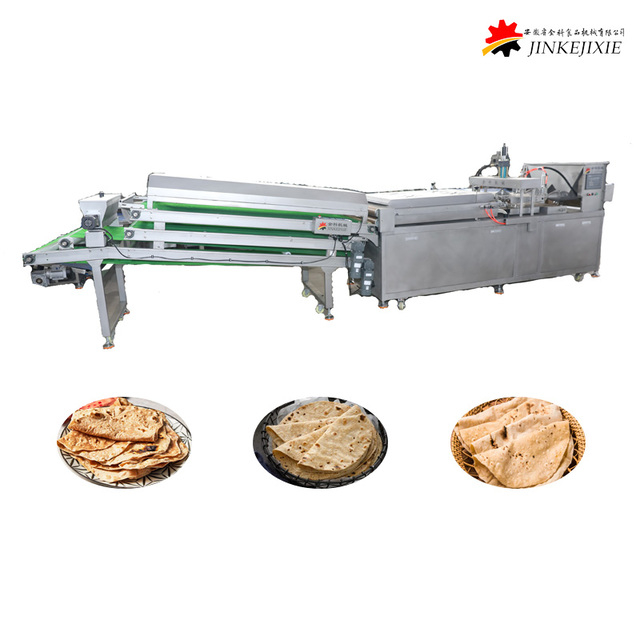
Capacity should always be reviewed together with tortilla diameter, line configuration, and automation level.
1,000–3,000 Pieces per Hour
This range suits small tortilla factories, restaurant suppliers, central kitchens, and first-time automation projects.
Machines in this tier often focus on pressing or forming rather than fully automated production. Some may still require manual dough feeding, collection, or packaging.
The main advantages are lower investment and smaller factory requirements. Power consumption and maintenance needs are also easier to manage.
However, this tier can become restrictive as orders increase. Buyers should estimate future demand before selecting a small commercial tortilla production machine.
3,000–8,000 Pieces per Hour
This range suits growing factories moving away from small-batch production.
The JKBP-650 Automatic Tortilla Production Line reaches 6,000–8,000 pieces per hour for 6-inch tortillas. Output drops to 3,000–4,000 pieces per hour for 8-inch and 10-inch products.
This tier offers a practical balance between capacity and investment. It can suit regional suppliers, foodservice businesses, and manufacturers entering industrial production.
Automation also becomes more useful here. PLC control, baking, cooling, and stacking can reduce dependence on manual handling.
8,000–16,000 Pieces per Hour
This tier is designed for medium industrial production.
The JKBP-950 Automatic Tortilla Production Line reaches 15,500–16,000 pieces per hour for 6-inch tortillas. The same line produces 7,000–8,000 pieces per hour for 8-inch and 10-inch products.
At this output level, manufacturers should plan the whole process carefully.
Mixing, dividing, pressing, proofing, baking, cooling, and stacking must operate at compatible speeds. Packaging can also become a bottleneck.
16,000–20,000 Pieces per Hour
This tier suits large industrial tortilla manufacturers.
JinKe's JKBP-1200 reaches 18,000–20,000 pieces per hour for 6-inch tortillas. It reaches 14,000–16,000 pieces per hour for 8-inch products.
Higher capacity brings greater factory requirements. The line uses more electrical power and requires more operating space.
At this level, downtime becomes expensive. Preventive maintenance, spare parts, and trained operators become more important.
20,000–30,000 Pieces per Hour
This range often requires custom engineering.
JinKe's currently published standard tortilla line reviewed here reaches 20,000 pieces per hour for 6-inch tortillas. Production above that level should not be assumed from standard specifications.
A 20,000–30,000 pcs/h project may need parallel processing lanes, multiple lines, wider ovens, or customized forming systems.
Packaging and cooling must also handle the same output. A faster press provides little value if downstream equipment cannot keep pace.
Tip: For output above 20,000 pcs/h, request a project-specific capacity calculation instead of relying on standard catalogue figures.
Capacity Tier
Typical Factory
Automation Level
Main Consideration
1,000–3,000 pcs/h
Small producer
Semi-automatic
Budget and labor
3,000–8,000 pcs/h
Growing factory
Automatic
Flexibility
8,000–16,000 pcs/h
Medium industrial plant
Fully automatic
Line balance
16,000–20,000 pcs/h
Large manufacturer
High automation
Utilities and uptime
20,000–30,000 pcs/h
Custom industrial project
Customized
Engineering and layout
Why Tortilla Size Changes Production Capacity
The headline capacity of an industrial tortilla production line rarely applies to every product size.
Smaller Tortillas Usually Increase Output
Smaller tortillas occupy less forming and oven space.
For example, the JKBP-1200 reaches 18,000–20,000 pcs/h for 6-inch products. Its output falls to 4,000–6,000 pcs/h for 12-inch tortillas.
That difference is significant.
A buyer producing 12-inch wraps should not select a machine using its 6-inch capacity figure.
Lane Count Affects Throughput
Multi-lane machines process several tortillas during each production cycle.
More lanes can increase output. They also increase machine width and mechanical complexity.
Lane arrangement often changes with tortilla diameter. Larger products may use fewer forming positions across the same machine width.
The JKBP-950, for example, lists different forming arrangements for different tortilla sizes.
Dough Thickness and Recipe Matter
Dough properties also affect production speed.
Soft wheat tortillas may behave differently from corn or high-fiber products. Hydration, elasticity, and thickness influence forming and baking.
Thicker tortillas may require longer baking times. They may also need different pressing settings.
Manufacturers should test their actual recipe whenever possible.
Baking and Cooling Can Limit Final Output
The press is only one part of the process.
Oven dwell time determines how quickly tortillas can move through baking. Cooling time affects when they can be stacked or packed.
If tortillas reach packaging while still too warm, condensation may reduce product quality.
The JKBP-950 uses multi-zone baking and conveyor cooling before stacking and packaging.
Note: Published machine capacity should represent the complete production line, not only the forming section.
How Automation Level Changes Tortilla Production Capacity
Automation affects both output and consistency.
Semi-Automatic Tortilla Machines
Semi-automatic systems retain more manual operations.
Workers may load dough, transfer products, or collect finished tortillas.
These machines suit smaller factories and lower budgets. However, labor availability can limit real output.
Manual steps can also create variation between shifts.
Fully Automatic Tortilla Production Lines
A fully automatic line connects several stages into one workflow.
Continuous processing reduces repeated manual transfer. It also supports more stable line speed.
PLC and Production Data Tracking
Higher-capacity systems benefit from centralized control.
JinKe's JKBP-650, JKBP-950, and JKBP-1200 use PLC and touchscreen control. Their published specifications also include production data tracking for output, temperature, and speed.
This information helps operators identify changes before they become larger production problems.
Packaging Integration
Packaging must match upstream output.
A line producing 16,000 tortillas each hour can overwhelm a manual packing station.
Automatic counters and stackers can reduce this problem. Flow wrapping can then be added when required.
Before purchase, buyers should calculate packs per minute rather than tortillas per hour alone.
How to Choose the Right Industrial Tortilla Machine Capacity
Capacity selection should start with actual sales demand.
Calculate Real Hourly Demand
Begin with expected daily production.
Suppose a factory needs 80,000 tortillas each day. If effective production time is eight hours, the basic requirement is 10,000 pieces per hour.
However, factories also need cleaning, changeover, maintenance, and break time.
A practical line should therefore provide some reserve capacity.
Allow Capacity for Peak Demand
Production rarely stays constant throughout the year.
Retail promotions, seasonal demand, and new customers can increase orders.
Avoid choosing a line that must run at its maximum rating every hour.
At the same time, excessive oversizing increases investment and energy demand.
Match Capacity to Tortilla Diameter
Always request output for your exact tortilla size.
For example:
JKBP-650: 6-inch output of 6,000–8,000 pcs/h.
JKBP-950: 6-inch output of 15,500–16,000 pcs/h.
JKBP-1200: 6-inch output of 18,000–20,000 pcs/h.
The same models produce fewer larger tortillas.
Match Capacity to Product Mix
A single-SKU factory can optimize its equipment around one tortilla size.
A multi-product factory needs more flexibility.
If 6-inch, 8-inch, and 12-inch products share the same line, changeover time should enter the capacity calculation.
Tooling adjustments and production scheduling then become important selection factors.
Tip: Send your supplier a weekly production plan by tortilla size instead of only giving one maximum capacity target.
What Factory Requirements Change as Capacity Increases?
Larger output usually requires more infrastructure.
Floor Space and Line Length
Higher-capacity lines often use wider forming sections, larger ovens, and longer cooling conveyors.
Request the complete layout before placing an order.
Operators need walking space. Maintenance technicians also need access around motors, belts, ovens, and control cabinets.
Electrical and Heating Requirements
Power demand rises as automation increases.
The JKBP-650 lists 60 kW total power. The JKBP-950 lists 130 kW, while the JKBP-1200 lists 180 kW.
Factories must confirm voltage, phase, and available electrical capacity.
JinKe lists 220 V, 380 V, and customized power options for these systems.
Labor and Material Handling
Automation reduces direct handling, but factories still need operators.
Raw materials must reach the mixer. Finished products must move toward packaging and storage.
As output increases, flour handling and dough preparation can become bottlenecks.
Warehouse capacity must also match finished production.
Published features include PLC control, food-grade 304 stainless steel contact parts, production data tracking, and optional engineer installation service.
Custom Projects Above Standard Output
Projects targeting 20,000–30,000 pcs/h should be reviewed separately.
Possible solutions may include parallel lines or custom multi-lane designs.
Actual capacity should be confirmed through production testing and engineering calculations.
Note: JinKe's published standard tortilla models reviewed here reach up to 20,000 pcs/h, so higher targets require project-specific confirmation.
Common Capacity Selection Mistakes to Avoid
Comparing Only Maximum Pieces per Hour
Maximum output often applies to the smallest tortilla size.
Always compare capacity using identical product dimensions.
Buying Too Much Capacity Too Early
Oversizing increases equipment investment and utility requirements.
A large line also needs more floor space and stronger downstream systems.
Choose capacity based on realistic demand and expansion plans.
Selecting Too Little Capacity
An undersized line may operate continuously at maximum speed.
This leaves little room for demand growth or maintenance recovery.
Keep a reasonable output reserve.
Ignoring Downstream Bottlenecks
Mixers, ovens, cooling systems, stackers, and packaging machines must support the same capacity.
A fast forming machine cannot compensate for slow downstream equipment.
Conclusion
Choosing the right industrial tortilla machine means matching capacity with tortilla size, automation level, factory space, utilities, and future demand. A balanced production line improves efficiency and reduces bottlenecks. Anhui JinKe Foodstuff Machinery Co., Ltd. provides tortilla production lines for different capacity levels. Its automated equipment, flexible configurations, and technical support help manufacturers improve output, consistency, and long-term production efficiency.
FAQ
Q: What is an industrial tortilla machine?
A: An industrial tortilla machine automates forming, baking, cooling, and stacking for medium- to high-volume tortilla production.
Q: How much can an industrial tortilla machine produce?
A: Capacity may range from about 1,000 to 30,000 pieces per hour, depending on tortilla size and line configuration.
Q: How do I choose the right industrial tortilla machine capacity?
A: Match output with tortilla diameter, hourly demand, factory space, power supply, and future growth.
Q: Why does tortilla size affect production capacity?
A: Larger tortillas use more forming and oven space, so hourly output usually decreases.