Views: 0 Author: Site Editor Publish Time: 2026-07-26 Origin: Site


The defining characteristic of an authentic lacha paratha is its distinct, crispy layers. You achieve this textural result manually by applying precise amounts of oil or ghee between folded dough sheets to create a reliable lipid barrier. Scaling this delicate culinary process for commercial manufacturing introduces significant engineering challenges. Uneven fat distribution, excessive dough stress, or improper folding at high speeds results in dense, fused flatbreads rather than flaky layers. Food manufacturers must transition from the manual science of dough lamination to advanced automation.
Understanding how a commercial Lacha Paratha Machine automates oil application dictates your production success. You must evaluate specific technical criteria when investing in high-volume equipment. The mechanics of fat dispersion control the final product quality. Mastering these automated systems ensures your flatbreads retain their traditional flakiness at an industrial scale while maintaining consistent throughput.
Lipid Barrier Mechanics: Flakiness depends entirely on preventing gluten networks from fusing during the resting and rolling phases; consistent, automated fat application is the primary differentiator in machine quality.
The Slurry Secret: Utilizing a starch-oil slurry (such as a cornflour and ghee suspension) rather than pure fat creates a superior physical barrier, a process modern industrial lines must be engineered to handle.
Dispersion Technology: Modern equipment utilizes varying oil application methods (spray nozzles, drip-and-brush, or extrusion), each with distinct trade-offs regarding fat viscosity compatibility (oil vs. ghee) and maintenance requirements.
Dough Stress Management: An effective layered paratha production line must balance high-speed oiling and folding with adequate resting conveyors to prevent dough retraction and layer tearing.
Sanitation and Compliance: Oil application systems require rigorous evaluation for clean-in-place (CIP) capabilities to prevent rancidity and ensure food safety compliance at industrial scales.
Layer separation relies on fundamental food science and dough rheology. Oil acts as a hydrophobic barrier between thin sheets of hydrated dough. This barrier prevents gluten strands from bonding during compression and rolling. Without a consistent lipid layer, the dough sheets fuse back together under mechanical pressure. The resulting flatbread becomes tough and dense, losing the characteristic mouthfeel consumers expect.
Traditional methods often utilize a starch-lipid slurry. Mixing oil or ghee with cornflour creates a highly effective paste. The starch particles absorb excess moisture from the dough surface. They also act as microscopic wedges, physically keeping the dough layers apart during the final pressing stage. Translating this method to industrial scales requires specialized pumping and dosing equipment capable of handling suspensions without clogging or separating.
Flour substrate interactions directly impact how laminating fats behave on the production line. Refined flour absorbs fat differently than whole wheat flour. Whole wheat contains bran particles that can disrupt the lipid barrier and tear the dough sheet if not properly hydrated. Dosing systems on an automatic paratha machine must be adjustable. Operators must calibrate the flow rate to prevent dry spots in whole wheat dough or oversaturation in refined flour dough.
The traditional manual method involves smearing fat and dusting dry flour by hand. Continuous commercial production demands absolute consistency across thousands of units per hour. A machine must achieve edge-to-edge fat coverage without pooling. It must apply the fat without tearing the delicate dough sheet or altering the overall hydration ratio.
To evaluate automated lamination equipment, engineers look for specific baseline success criteria:
Volumetric consistency across the entire width of the dough sheet.
Ability to handle varying fat viscosities without nozzle blockages.
Integration of secondary dusting mechanisms to stabilize the lipid layer.
Minimal mechanical stress applied to the dough during the folding phase.
Accessible components for daily sanitation and fat removal.
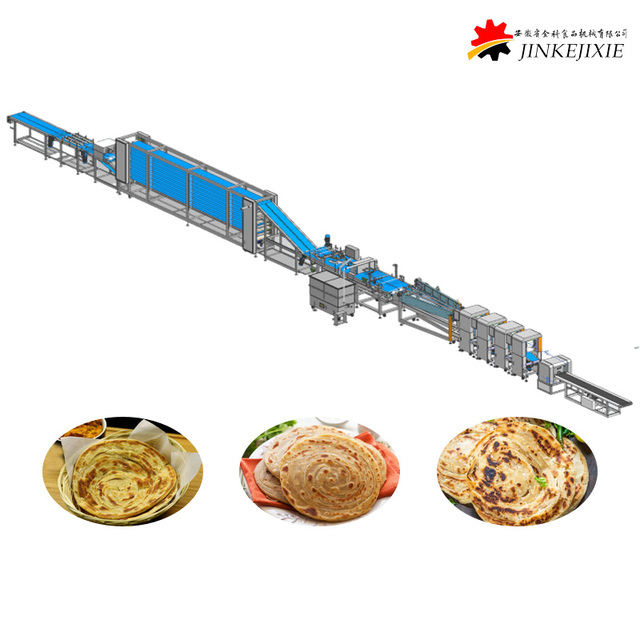
The process begins with continuous dough sheeting. Extruders push the bulk dough through a series of reduction rollers. This thins the dough into a continuous, uniform ribbon. Maintaining consistent thickness before the oiling stage is mandatory. Uneven dough sheets lead to erratic oil absorption, inconsistent layer formation, and weight variations in the final packaged product.
Manufacturers utilize several distinct oil dispensing mechanisms. Each solution category addresses different fat viscosities, factory environments, and production requirements. Selecting the wrong dispensing mechanism leads to constant line stoppages and high scrap rates.
Dispensing Mechanism |
Best Suited For |
Operational Characteristics |
|---|---|---|
Spray Nozzle Systems |
Low-viscosity liquid oils |
Delivers highly uniform, micro-droplet coverage. Requires precise calibration to avoid overspray and waste. |
Drip and Rotary Brush |
Medium-viscosity fats |
Physically spreads fat across the dough sheet. Closely mimics manual application techniques. |
Solid Fat Extrusion |
Solid ghee or margarine |
Utilizes heated hoppers and pump systems. Requires strict temperature control to maintain fat plasticity. |
Slurry-Capable Agitated Dosing |
Cornflour-oil mixtures |
Features continuous agitation to prevent starch sedimentation. Prevents nozzle clogging with viscous pastes. |
Following fat application, the machine executes automated folding and pleating. Mechanical guides gather the oiled dough ribbon. The system pleats the dough and coils it into a tight puck. This coiling action traps the oil layers internally. The precision of this mechanical gathering directly determines the number of visible layers in the final baked product. If the guides apply too much tension, the dough tears and the oil leaks out.
The machine must then manage the puck formation and secondary dusting. Replicating the manual step of dusting the coiled puck with dry flour ensures smooth downstream processing. Automated dusters apply a fine coating of starch to the puck's exterior. This ensures a clean release from the final press plates. It preserves the delicate layer definition established during the coiling phase and prevents the pucks from sticking to the conveyor belts during the resting phase.
Fat compatibility and temperature control are critical evaluation metrics for any facility manager. You must assess the machine's ability to handle your specific recipe under actual factory conditions. If your process requires solid ghee, the system must feature jacketed hoppers and heated transfer lines. This prevents the fat from solidifying and blocking the dosing mechanism during overnight shifts or in colder factory environments.
Distinguish between dual-stage fat management systems. Internal lamination fat dosing creates the internal layers. A separate post-press topical application system is often necessary for authentic flavor profiles. This secondary system applies oil or ghee during the continuous par-baking or industrial griddling stage to activate surface puffing and crisping. Managing two separate fat systems requires advanced PLC integration.
Evaluate the precision and yield control of the oil application unit. Over-oiling leads to severe equipment fouling. Excess fat causes packaging seal failures and rapid product spoilage due to oxidation. Under-oiling results in complete product failure, yielding dense flatbreads with fused layers. A high-quality layered paratha production line provides exact volumetric dosing, usually controlled by servo-driven positive displacement pumps.
Analyze how the machine incorporates dusting mechanisms immediately after oil application. Applying dry flour or starch stabilizes the freshly applied lipid layers. This step prevents the oil from migrating too deeply into the dough matrix before the pressing stage. It is a critical engineering feature for achieving an authentic, flaky texture that survives freezing and reheating.
Examine the trade-offs between throughput and quality. Line speed directly impacts oil absorption and layer integrity. Faster production lines exert more mechanical stress on the dough network. They require significantly longer resting conveyors. Adequate resting time allows the gluten network to relax after the intensive oiling and coiling processes. Skipping the resting phase guarantees misshapen products and severe shrinkage during baking.
Choosing between slurry systems and direct spraying involves significant operational trade-offs on the factory floor. Pumping viscous starch-oil mixtures requires continuous agitation mechanisms in the holding tanks. These systems demand more rigorous daily cleaning protocols to prevent blockages and bacterial growth. Conversely, low-viscosity liquid oil sprays offer cleaner operation but may not provide the same physical layer separation as a starch-thickened slurry, potentially compromising the final texture.
Consider the balance between equipment footprint and resting time. A compact machine saves valuable factory floor space. However, it may lack the necessary resting conveyor length to properly relax the dough. Insufficient resting time forces operators to implement manual intervention. You may need to transfer the coiled dough pucks to secondary proofing racks before pressing, increasing labor requirements and introducing potential contamination points.
Evaluate flexibility versus specialization when planning your production schedule. Dedicated lacha paratha machines feature highly specialized pleating mechanisms designed specifically for multi-layered flatbreads. Modular flatbread lines offer broader capabilities for different products like tortillas or pita. However, modular systems often compromise on the exactness of the oil-folding sequence required for premium lacha paratha, resulting in a less defined layer structure.
Capital expenditure must be weighed against operating expenditure and resource utilization. High-end spray and agitated dosing systems require larger upfront investments. Yet, these advanced systems drastically reduce oil waste through precise targeting. They also minimize the manual labor required for cleaning and maintenance compared to rudimentary drip systems, lowering your daily operational costs and improving overall line efficiency.
Recipe scaling failures present a major implementation risk when moving from manual to automated production. Industrial machines exert entirely different mechanical forces than human hands. Dough that performs perfectly on a benchtop may tear or fuse on a high-speed line. Mitigate this by conducting rigorous pilot testing with the original equipment manufacturer. Use your exact flour specifications, hydration levels, and planned fat types during these trials to identify necessary recipe adjustments before installation.
Sanitation and rancidity are persistent threats in oil-heavy production environments. Fat buildup in mechanical folds, conveyor belts, and rotary brushes creates an ideal environment for rapid bacterial growth and off-flavors. Mitigate this risk by specifying equipment engineered for strict hygiene. Require tool-less disassembly, food-grade stainless steel construction (304 or 316), and accessible wash-down ratings (IP65 or higher) for all electrical components near the oiling station.
Operator calibration errors can ruin entire production runs and waste expensive raw materials. Minor manual adjustments in the oil flow rate drastically alter product quality. Mitigate human error by investing in machines equipped with programmable logic controllers (PLCs) and intuitive human-machine interfaces (HMIs). These systems allow you to save specific recipe profiles, ensuring automated, repeatable dosing control across different shifts and varying operator skill levels.
Audit your current fat application method to determine if a liquid spray, solid extrusion, or slurry system fits your specific recipe requirements.
Measure your available floor space to ensure you can accommodate the extended resting conveyors required for high-speed layer relaxation.
Schedule a factory acceptance test with the manufacturer using your proprietary dough and fat samples to validate performance.
Verify the clean-in-place capabilities of the dosing system to guarantee long-term food safety compliance and minimize downtime.
A: The machine extrudes dough into a thin sheet, applies a precise layer of oil or fat, and uses mechanical guides to pleat and coil the dough. This coiling traps the lipid barrier between the dough folds, mimicking the manual lamination process.
A: Yes, but it requires specific dosing mechanisms. Liquid oils use spray or drip systems, while solid ghee requires heated, jacketed hoppers and extrusion pumps to maintain the fat in a pliable state during application.
A: A slurry mixes oil with cornflour or starch. The starch particles physically wedge between the dough layers and absorb excess moisture, creating a stronger, more reliable barrier that prevents the layers from fusing under pressure.
A: Tearing is prevented by maintaining proper dough hydration, ensuring uniform sheet thickness, and utilizing adequate resting conveyors. Resting allows the gluten network to relax before the mechanical stress of pleating and pressing occurs.
A: Dusting the coiled puck with dry flour prevents it from sticking to the final press plates. It also helps stabilize the outer lipid layers, ensuring a clean release and preserving the distinct layer definition.
A: Industrial machines must feature clean-in-place (CIP) capabilities, tool-less disassembly, and wash-down rated components. Regular, rigorous sanitation protocols using food-safe degreasers are necessary to remove residual fat from nozzles, brushes, and belts.