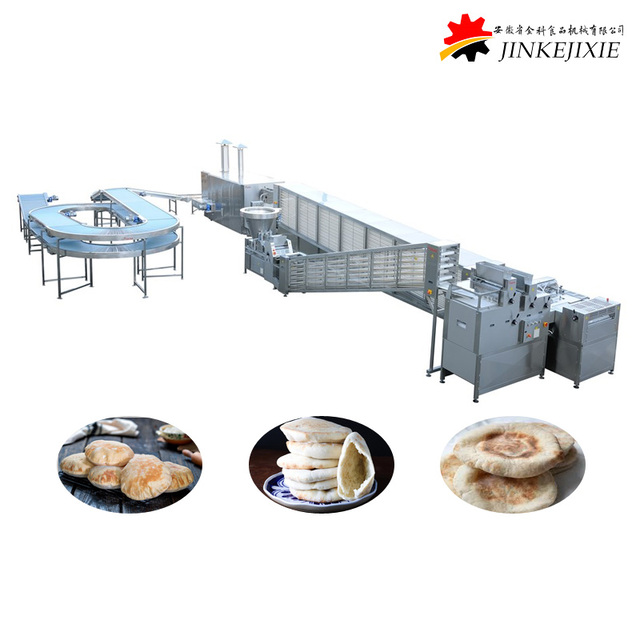
Consumer demand for pita bread is highly segmented, ranging from thin, pocketed Middle Eastern styles to thick, soft, pocketless Greek-style wraps. Translating precise product specifications like a 6-inch diameter or a 1/8-inch thickness into industrial machinery requirements is complex. Misaligning product dimensions, flour types, and hydration levels with equipment capabilities leads to inconsistent baking, high waste, and bottlenecked throughput.
Selecting the right equipment requires reverse-engineering your ideal product. This guide breaks down how to evaluate and configure an industrial pita line based on your target diameter, thickness, and dough characteristics. We will look at the mechanical realities of dough handling, the physics of high-temperature baking, and the specific machinery configurations needed to maintain strict product tolerances at scale.
Dimensional Tolerances: A variance of even 1/16-inch in thickness drastically alters baking physics, requiring precise dough calibrators on any commercial line.
Throughput vs. Footprint: Larger diameters reduce the number of rows that can fit across an oven belt, directly impacting your hourly yield and required oven length.
Equipment Flexibility: Switching between small (e.g., 4-inch) and large (e.g., 10-inch) pitas requires modular die-cutting rollers and adjustable proofing times.
Moisture and Staling Dynamics: Thinner pitas (1/8-inch) dry out faster and require high-temperature, rapid baking, whereas thicker pitas (1/4-inch) demand longer baking times at slightly lower temperatures to preserve pliability and crumb structure.
Flour and Hydration Variables: Flour composition (e.g., whole wheat versus refined white flour) dictates dough elasticity, shrinkage, and the required belt-release configurations on an automatic pita bread machine.
The Impact of Diameter and Thickness on Commercial Production
Defining Success Criteria for Your Target Market
Analyzing the end-use of the product establishes the baseline for your entire operation. Traditional pocket pitas require distinct steam-leavening dynamics. You typically sheet these to a 1/8-inch thickness to facilitate pocket separation. The thin dough allows intense heat to penetrate quickly. This converts internal moisture into steam, forcing the top and bottom layers apart. If the dough is too thick, the heat transfer slows down, and you get a dense flatbread instead of a pocket.
Wrap-style or Greek pitas require structural integrity to prevent tearing under heavy fillings. You usually sheet these to a 1/4-inch thickness. Establish baseline weight-to-diameter ratios to anchor your equipment evaluation. A standard 6-inch diameter, 1/4-inch thick benchmark gives you a concrete target. You use this ratio to calculate the exact dough volume required per piece and the mechanical stress the dough will endure during processing. Knowing your target weight helps you set the initial extruder speeds and reduction roller gaps.
Consider the specific gravity of your dough. Aerated dough behaves differently than dense dough when passing through reduction rollers. You must match your mixing strategy to your target thickness. Over-mixed dough becomes too extensible and loses its shape, while under-mixed dough tears when sheeted to 1/8-inch. Establish strict mixing times and temperatures to ensure the dough hits the hopper in the exact condition required for your target dimensions.
How Thickness Dictates Baking Physics and Shelf Life
The relationship between dough thickness and rapid heat penetration dictates your oven configuration. Thin pitas need a massive, immediate thermal shock. You need bottom heat exceeding 400°C to flash-evaporate the moisture. If the oven temperature is too low, the steam escapes through the porous gluten network. The top layer never lifts, and you produce a reject. Thick pitas require a different approach. You need a balanced heat profile to ensure the center crumb fully gelatinizes without burning the exterior.
Operational realities shift based on these dimensions. Thin pitas are highly susceptible to rapid moisture loss. They require specialized cooling conveyors and rapid packaging integrations to prevent brittle edges. You must move them from the oven to the wrapper quickly, often using ambient air cooling spirals rather than forced chillers. Thicker pitas hold moisture better but require longer cooling times to prevent condensation inside the packaging.
Shelf life depends heavily on how you manage moisture during the bake. A 1/8-inch pita baked too long becomes a cracker within 24 hours. You must calibrate the oven belt speed to achieve the exact color and pocket expansion in the shortest time possible. For 1/4-inch pitas, you extend the bake time slightly and lower the temperature. This preserves pliability and crumb structure, keeping the product soft for days or weeks depending on your formulation.
Flour Composition and Hydration: White vs. Whole Wheat Dynamics
Whole wheat flour blends alter the gluten structure significantly. The sharp bran particles physically cut gluten strands during mixing and sheeting. This results in a less extensible dough. You need stronger sheeting rollers and adjusted thickness calibration to prevent tearing. Whole wheat doughs also absorb more water, changing the specific gravity and handling characteristics of the dough sheet. You cannot run a whole wheat dough using the exact same roller gaps as a white flour dough.
High hydration levels keep thick pitas soft. However, highly hydrated dough behaves differently under mechanical stress. It is inherently stickier and more prone to deformation. Managing this requires specialized flour dusting systems and precise tension control on an automatic pita bread machine. You must ensure the dough sheet releases cleanly from the rollers and cutting dies. If the dough sticks, it stretches, ruining your diameter tolerances.
Protein content also plays a massive role. High-protein flours create a strong gluten network that resists sheeting. The dough wants to snap back. You must implement longer resting times between reduction stages to relax the gluten. Low-protein flours sheet easily but may lack the strength to hold a steam pocket. You must balance your flour specifications with your mechanical capabilities to achieve consistent diameter and thickness.
Configuring a Pita Bread Production Line for Specific Dimensions
Dough Sheeting vs. Dividing and Rounding
Evaluating sheeting lines versus dividing and rounding lines depends heavily on your target product. Sheeting lines are ideal for die-cut, uniform flatbreads. They create a continuous dough ribbon that is gradually reduced in thickness. This ensures highly consistent dimensions and weights across thousands of pieces per hour. You use this method for thin, pocketed pitas where uniform thickness is mandatory for even baking.
Dividing and rounding lines are better suited for traditional, artisan-style edges and thick Greek pitas. This method portions individual dough balls, rests them, and then presses or rolls them flat. It handles dough stress differently, preserving more fermentation gases within the dough matrix. This impacts final diameter retention after baking. Rounded dough pieces tend to have a more robust, less uniform cellular structure.
Process Type
Best For
Thickness Control
Edge Profile
Continuous Sheeting
Thin Pocket Pitas (1/8-inch)
Extremely Precise
Clean, Die-Cut Edge
Dividing & Rounding
Thick Greek Pitas (1/4-inch)
Variable (Pressed/Rolled)
Rounded, Artisan Edge
Die-Cutting Rollers and Diameter Flexibility
The mechanics of rotary cutters dictate the exact diameter of the raw dough piece. These heavy metal cylinders feature sharpened circular dies that press through the dough sheet against an anvil roller. The spacing and size of these dies determine how many pitas you can cut across the width of the dough sheet. You must match the die size to your target baked diameter, factoring in the expected shrinkage during proofing and baking.
Switching from small white loaves to large whole wheat wraps requires changing these die-cutting rollers. This process involves mechanical downtime and labor. Facilities producing multiple sizes must factor in the changeover time and the physical storage of heavy die rollers. Quick-release mechanisms and modular roller designs are critical features for operations requiring high diameter flexibility.
Stop the main conveyor and lock out the equipment power.
Release the pneumatic tension on the anvil roller.
Slide the current die-cutting roller out of the quick-release mounts.
Insert the new die-cutting roller and secure the locking pins.
Re-engage the pneumatic tension and run a test sheet to verify the cut depth.
Secondary Proofing and Post-Sheeting Resting Systems
A post-cutting resting phase on conveyor belts relaxes the dough before baking. The mechanical action of sheeting and cutting introduces significant tension into the gluten network. If baked immediately, the dough pieces will shrink in diameter and distort into oval shapes. You must give the dough time to recover its extensibility.
Conveyor belt material and tension play a massive role during this phase. Thin 1/8-inch dough sheets are fragile. The belts must provide enough grip to transport the dough without slipping, but release the dough cleanly at transfer points. Synthetic mesh or specialized polyurethane belts prevent the dough from sticking, tearing, or deforming during these critical transfers between the proofer and the oven.
Humidity and temperature control within the secondary proofer are also critical. If the environment is too dry, a skin forms on the dough, preventing the steam pocket from expanding. If it is too humid, the dough becomes sticky and jams the transfer to the oven belt. You must maintain precise ambient conditions to ensure the dough enters the oven in the optimal state.
Oven Belt Width and Throughput Calculations
Calculating hourly output requires analyzing the pita diameter against the oven belt width. A wider belt accommodates more rows of product, directly increasing throughput. However, the mathematical trade-off is absolute: increasing the product diameter exponentially decreases the number of units per square meter of baking surface. You must calculate this accurately to size your oven correctly.
Oven Belt Width
Pita Diameter
Rows Across Belt
Estimated Hourly Output (Units)
800 mm
6 inches (150 mm)
4 Rows
6,000 - 8,000
800 mm
8 inches (200 mm)
3 Rows
4,500 - 6,000
1000 mm
6 inches (150 mm)
5 Rows
8,000 - 10,000
1000 mm
10 inches (250 mm)
3 Rows
5,000 - 7,000
Evaluating an Automatic Pita Bread Machine: Features vs. Outcomes
Precision Calibrators for Consistent Thickness
Multi-stage reduction rollers gently bring dough down to 1/8-inch or 1/4-inch without degassing it entirely. Forcing a thick block of dough through a single tight gap destroys the gluten structure and pushes out all fermentation gases. This results in dense, tough bread. Gradual reduction across three or four sets of rollers maintains dough integrity and ensures a uniform cellular structure.
Digital gap controls maintain strict thickness tolerances across different shifts and flour batches. Manual hand-cranks leave too much room for operator error. Motorized calibrators linked to a central control panel ensure that a 1/8-inch setting remains exactly 1/8-inch. This prevents the severe baking inconsistencies caused by even a 1/16-inch variance. You need this precision to maintain product specifications.
The speed differential between consecutive rollers also matters. If the second roller pulls the dough faster than the first roller feeds it, the dough stretches and tears. If it pulls too slowly, the dough ripples and folds. You must calibrate the variable frequency drives (VFDs) on each roller to maintain a smooth, continuous dough sheet with zero tension.
Tunnel Oven Heat Distribution for Variable Thicknesses
Direct gas-fired ovens provide the intense, immediate radiant heat necessary to flash-evaporate internal moisture and create the steam pocket. Indirect heating systems often struggle to deliver the rapid thermal shock required for thin pitas. You need direct flame impingement or high-efficiency radiant burners to hit the required temperatures quickly.
Independent top and bottom heat controls are non-negotiable on a modern Pita Bread Production Line. Thin pitas need aggressive bottom heat to initiate the steam burst, followed by high top heat to set the crust. Thick pitas require a more balanced, moderate heat profile. You must be able to adjust the burner intensity in different zones of the oven to match the specific baking requirements of your product.
Exhaust management is another critical factor. The rapid evaporation of moisture creates a massive volume of steam inside the baking chamber. If you do not extract this steam efficiently, it suppresses the oven temperature and alters the baking environment. You need adjustable exhaust dampers to control the humidity and pressure inside the tunnel oven.
Changeover Speed and Operational Scalability
The labor and time required to adjust an industrial line for different product sizes and thicknesses directly impact daily yield. If changing from a 6-inch pocket pita to a 10-inch wrap takes two hours and three mechanics, production schedules become rigid and inefficient. You lose valuable production time every time you switch SKUs.
Tool-less changeovers and recipe-driven Programmable Logic Controller (PLC) adjustments define modern operational scalability. Operators select a product recipe on a touchscreen, prompting the calibrators, conveyor speeds, and oven temperatures to adjust automatically. Physical changes, like swapping rotary dies, utilize quick-release clamps rather than requiring heavy tooling. This keeps your line running and your operators focused on quality control.
Sanitation also affects changeover speed. Flour dust and dough scraps accumulate quickly. Equipment designed with open-frame construction and wash-down rated components allows your sanitation team to clean the line faster. You need easy access to all belts, rollers, and catch pans to minimize downtime between production runs.
Trade-Offs and Operational Efficiency in an Industrial Pita Line
High-Speed Output vs. Product Versatility
A dedicated, single-size high-speed line is engineered for maximum throughput of one specific product. Every roller, transfer point, and oven zone is optimized for that exact diameter and thickness. This minimizes waste and maximizes hourly yield. You run one product continuously, achieving massive volumes with very little intervention.
A flexible, multi-size line sacrifices some maximum throughput to accommodate variable dimensions. The inclusion of adjustable calibrators, longer resting conveyors to handle different dough types, and modular cutting stations introduces mechanical complexity. You must weigh the benefit of producing multiple SKUs against the slightly lower top-end speed. Versatility allows you to adapt to market changes, but it requires more sophisticated machinery and better-trained operators.
Footprint and Energy Consumption by Oven Size
Baking time requirements for thicker pitas necessitate longer tunnel ovens. A 1/4-inch thick Greek pita requires more time in the baking chamber than a 1/8-inch pocket pita to achieve full crumb gelatinization. To maintain high hourly throughput with a longer bake time, the physical length of the oven must increase. This consumes more factory floor space.
This increased footprint directly impacts energy consumption. Longer ovens require more burners and consume more gas. Evaluating insulated, high-efficiency ovens for continuous high-temperature baking is critical. Advanced refractory materials and heat recovery systems help mitigate the energy demands of running a massive industrial pita line at 500°C (932°F). You must ensure your facility has the necessary gas supply and ventilation infrastructure to support these large ovens.
Implementation Risks and Mitigation Strategies
Dough Shrinkage and Shape Distortion
Dough snapping back, or shrinking in diameter after cutting, is a primary risk caused by gluten tension. When the dough sheet is stretched and compressed through reduction rollers, the gluten strands act like rubber bands. Once the circular die cuts the dough, those strands contract. Your perfect 6-inch circle turns into a 5-inch oval.
Incorporating intermediate resting conveyors (proofers) is the primary mitigation strategy. These multi-tier conveyors give the dough sheet time to relax before it reaches the final cutting stage. Allowing the gluten network to rest dissipates the mechanical tension. This ensures the cut dough pieces retain their intended diameter and circular shape through the oven.
Monitor dough temperature closely; warmer dough relaxes faster but ferments quicker.
Adjust the speed of the resting conveyors to increase or decrease the relaxation time based on the flour's protein content.
Ensure the transfer points between conveyor tiers do not stretch the dough sheet.
Sticky Dough and Transfer Tearing
High-hydration doughs required for soft, thick pitas carry significant risks of sticking to cutting dies and transfer belts. When sticky dough adheres to a rotary cutter, it lifts off the belt, jams the machinery, and creates massive amounts of waste. Transfer points between conveyors are equally hazardous. Sticky dough wraps around the drive rollers and tears the sheet.
Integrating automated flour dusters and air-knife systems ensures clean release on the production line. Flour dusters apply a micro-layer of starch to the top and bottom of the dough sheet, creating a physical barrier against the machinery. Air knives blow high-velocity air at transfer points, actively peeling the dough off the belt and guiding it to the next stage without mechanical scraping.
Calibrate the flour dusters to apply the minimum amount of flour necessary to prevent sticking.
Position air knives precisely at the tangent point of the transfer rollers.
Regularly clean the air knife nozzles to ensure uniform airflow across the width of the belt.
Use synthetic mesh belts that offer less surface area for the dough to adhere to.
Managing Scrap Dough (Rework)
Die-cutting circular pitas from a continuous rectangular dough sheet inherently generates scrap dough. The webbing left behind after the circles are cut can account for 20% to 30% of the total dough volume. Handling this rework manually is labor-intensive and exposes the dough to temperature changes and over-fermentation.
Evaluating automatic scrap return systems is necessary for continuous operations. These systems use overhead conveyors to transport the webbing directly back into the primary dough hopper or the initial sheeting rollers. Proper integration ensures the scrap is reincorporated continuously. This prevents it from altering the hydration, temperature, or yeast activity of the primary batch.
Maintain a consistent ratio of virgin dough to rework dough to ensure uniform baking characteristics.
Monitor the temperature of the rework dough, as the mechanical action of the conveyors can heat it up.
Ensure the scrap return conveyors are enclosed to prevent the dough from drying out during transit.
Conclusion
The ideal diameter and thickness of your pita bread are the foundational metrics that dictate the engineering of your entire production setup. Every mechanical decision, from the gap of the reduction rollers to the length of the tunnel oven, hinges on these specific dimensions. You cannot force a machine designed for thick wraps to produce thin pocket pitas without significant modifications.
Prioritize equipment manufacturers that offer modular calibrators, independent oven zone controls, post-sheeting resting conveyors, and transparent throughput calculations based on your exact product dimensions and flour formulations. Avoid generalized equipment that claims to handle all flatbreads without specific mechanical adaptations.
Define your exact product specifications, including diameter, thickness, and raw dough weight, before evaluating any machinery.
Map out your required hourly throughput to determine the necessary oven belt width and factory footprint.
Request a live test with an OEM using your specific dough formulation, including white versus wheat flour and target hydration levels.
Verify that the equipment can maintain your required 1/8-inch or 1/4-inch thickness at full production speed without causing dough shrinkage.
FAQ
Q: What is the standard thickness for commercial pocket pita bread?
A: Commercial pocket pita bread is typically sheeted to a thickness of 1/8-inch to 1/4-inch. A 1/8-inch thickness is optimal for rapid heat penetration in high-temperature ovens, which flash-evaporates internal moisture to create the signature steam pocket. Thicker doughs resist this rapid expansion and are better suited for pocketless wrap styles.
Q: How does pita diameter affect production line throughput?
A: Pita diameter directly dictates how many dough pieces can fit across the width of the oven belt. A larger diameter reduces the number of rows. This exponentially decreases the total units produced per hour on the same belt width.
Q: How do flour type variations (like whole wheat vs. white) affect thickness settings on an automatic pita bread machine?
A: Whole wheat flour contains bran particles that cut gluten strands, resulting in a less elastic dough compared to refined white flour. Whole wheat doughs also absorb more water. Calibrators must be adjusted to apply less aggressive pressure, preventing the weaker dough sheet from tearing or shrinking during the reduction process.
Q: Why is a secondary resting phase required after sheeting and cutting on an industrial pita line?
A: The mechanical action of sheeting and cutting introduces severe tension into the dough's gluten network. A secondary resting phase (proofing) relaxes this tension. Without it, the dough pieces will snap back, shrinking in diameter and distorting into ovals, and they will fail to rise uniformly in the oven.
Q: Can one automatic pita bread machine produce both thick and thin flatbreads?
A: Yes, provided the machine is equipped with modular, digital reduction rollers, flexible proofing speeds, and highly variable oven temperature controls. The line must be able to adjust the mechanical pressure for different thicknesses and alter the baking profile to accommodate the different heat penetration requirements of thick versus thin dough.
Q: What is the best oven type for an industrial pita line?
A: High-temperature, direct gas-fired tunnel ovens are the industry standard. They provide the intense, immediate radiant heat required to rapidly convert dough moisture into steam. Independent top and bottom heat controls are necessary to manage the aggressive bottom heat needed for pocket expansion.
Q: How do you handle scrap dough when die-cutting round pitas?
A: Scrap dough is managed using automated scrap return conveyors. These systems immediately transport the webbing back to the dough hopper or initial sheeting stage. Continuous reincorporation prevents the scrap from over-fermenting or drying out, maintaining the consistency of the primary dough batch.