Start at the release point, and change one variable at a time. Note the first surface the dough fails to leave, record the setting, change one factor, and re-test at that point. The families to check are formula, dough temperature and rest, and contact-surface condition.
Where should you start when tortillas begin to stick?
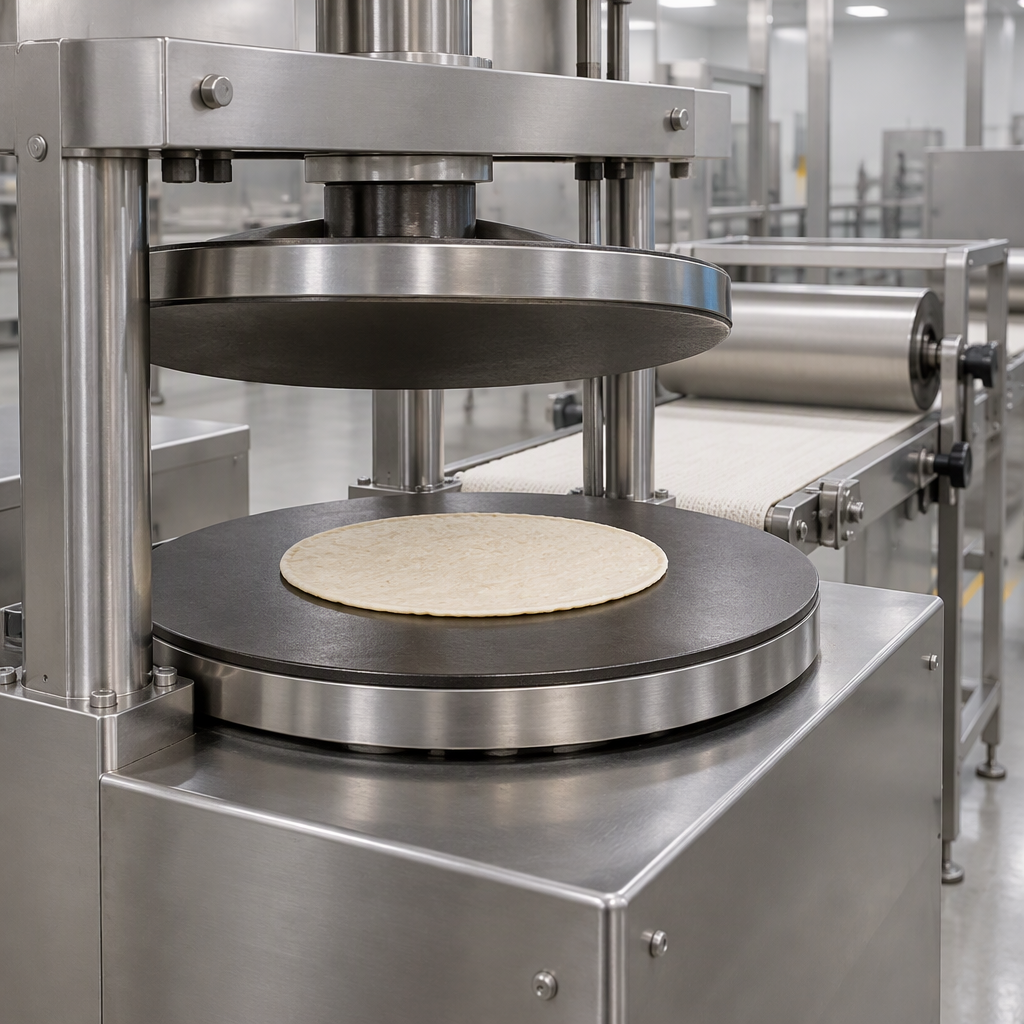
Begin where the dough is released, not where the rejects are counted. Walk the line from the divider to the oven and find the first surface a piece fails to leave cleanly, because that location narrows which variables are worth changing. Re-test at that exact point instead of judging the whole line by the rejects at the end, and switch the line off at the isolator and disconnect the power before any check that involves touching the machine.
| Where the piece fails to release | What it narrows first | Checks to make at that point |
|---|---|---|
| On the press platen, during or just after flattening | The dough surface and the state of the platen itself | Added water and dough temperature; rest time before pressing; the documented cleaning routine and platen surface condition |
| On the belt immediately after the press | Transfer conditions, not only the press | Belt surface and tracking; whether the piece is dragged or distorted at take-off |
| On a forming or sheeting roller earlier in the line | Dough handling ahead of the press | Roller and scraper condition; dough consistency at dividing; how evenly any dusting flour is applied |
| Build-up returning on a surface that was cleaned at the start of the shift | Something systematic about that surface or that batch | Whether the documented cleaning method was followed; surface damage or coating wear; what changed in the formula that day |
Why does tortilla dough stick during production?
Sticking is a symptom rather than a single mechanism: a piece that does not release cleanly from a contact surface. Dough temperature is one of the factors that decides how uniformly dough forms and flattens, and good dough is usually described in plain terms — a study of how wheat and corn doughs are prepared records the target as a dough that is not sticky, soft and pliable. That description tells you what good dough is like, not which variable has drifted, which is why it helps to separate what the dough contributes from what the line contributes.
Dough-side contribution
Signs: pieces cling at several different surfaces, or the whole batch behaves differently from the previous one.
Where to look: flour lot and specification, water actually added, dough temperature after mixing, rest time and piece weight.
Documentation gap: in the dough-preparation study, most people making corn dough did not measure the water they added — a reminder to weigh and record water rather than judging it by feel.
What a change tells you: a formula or preparation change affects every contact point at once, so it is the first family to test when sticking is not tied to one surface.
Limit: a test at the press observes how the dough behaves on that surface; it does not measure stickiness as a property in its own right.
Line-side contribution
Signs: pieces cling at one specific point while other transfers run clean.
Where to look: press platen or press belt, belts after the press, forming and sheeting rollers, scrapers, guides and drop points, any dusting applicator, and the time since the last documented clean.
Record: how long each surface stays clean after a documented clean — that interval shows whether fouling is systematic or a one-off.
What a change tells you: a surface fix is local, so if the same point keeps fouling, confirm the surface condition and the clean interval before you rewrite the recipe.
Limit: better release at one point says nothing about the next, so check the whole line after any change.
Which formula variables should be recorded before you change anything?
Write the batch down exactly as it is now, then change a single item. A published hot-press process for wheat-flour tortillas combined refined wheat flour with shortening, salt, low-fat dry milk, baking powder, SSL and CMC, which shows how many ingredients sit in a routine recipe: water is only one of the variables that can move, so an undocumented change can hide the cause instead of removing it.
- Flour: supplier, specification and lot number, and whether the lot changed on the day the sticking started.
- Added water: measured by weight and recorded per batch, not judged by feel.
- Shortening or oil: type and level as written in the recipe.
- Salt, leavening and any emulsifier or hydrocolloid in the recipe, with its level in the batch.
- Mixing: time, speed and dough temperature immediately after mixing.
- Rest: how long pieces wait before pressing, and where they wait.
- Piece weight after dividing, with the tolerance you accept.
How do dough temperature and rest time affect sticking?
Dough temperature is one of the factors that decides how consistently the dough divides, rounds and flattens, and a rest period lets the pieces relax before they are pressed. Hold both inside a narrow band of your own and treat any drift as a signal: dough that reaches the press warmer, colder, drier or fresher than the batch that ran without sticking is a change you can measure and correct before you touch the machine.
A published pilot process shows how tightly a press stage can be defined: a wheat-flour dough with soybean-residue substitution was divided into 30 g pieces, rested 30 minutes at 29 °C and 85% relative humidity, flattened between platens at 187 °C with a 1.75 mm gap, and baked on a four-pass griddle. Its hardness, cohesiveness, adhesiveness and extensibility were measured on instruments, not judged by hand. Those figures belong to that recipe and pilot line, so treat them as a guide to how much detail to record, not as settings to copy — see the published method and results for the full process.
Do not import another plant's numbers. Recipe, flour quality, ambient conditions and press geometry interact, so a temperature, gap or rest duration that works elsewhere can make your dough worse. Change one of them at a time, keep the rest fixed, and judge the effect on the finished piece as well as on release.
Which equipment contact points should you inspect?
Inspect every surface the dough touches between dividing and baking: press platen or press belt, the belts after the press, forming and sheeting rollers, guides and drop points. Build-up at one transfer can start upstream of it, so record how long each surface stays clean after a documented clean.
Before any manual access — opening a guard, lifting a belt, wiping a platen or reaching inside the press — switch the line off at the isolator, disconnect the power supply, and lock or tag the isolation so the machine cannot be restarted while your hands are inside it. Then use only the access and the cleaning method the machine manual permits. If the manual does not cover the point you need to reach, ask the supplier that commissioned the line to confirm the permitted method before you improvise anything.
- Press platen or press belt: residue that survives the documented clean, scratches, coating wear or polished patches.
- Transfer belts after the press: tracking, tension, surface condition, and whether pieces are dragged or stretched at take-off.
- Forming, sheeting and rolling units: roller and scraper condition and correct settings, without improvised shims or adjustments beyond the manual.
- Guides, chutes and every point where a piece changes direction or drops.
- Dusting or flour applicator, if fitted: whether it applies evenly, and whether nozzles or rollers are blocked.
- Time to foul: hours or units produced before build-up returns after a documented clean.
Keep guards and interlocks working. Never bypass, tie back or remove a guard or interlock to keep the line running while you investigate. Do not alter a platen surface, coating or release treatment, and do not apply an improvised release agent to a food-contact surface, without written confirmation from the machine builder that the change is permitted for that machine and that application.
In what order should you change variables and re-test?
Work from the cheapest and most reversible change towards the most disruptive, and change only one variable at a time. Record the line's current settings first, name the release point you will judge, then alternate between a single change and a re-test at that point until pieces release cleanly — or until the pattern shows the problem is not a single-variable issue.
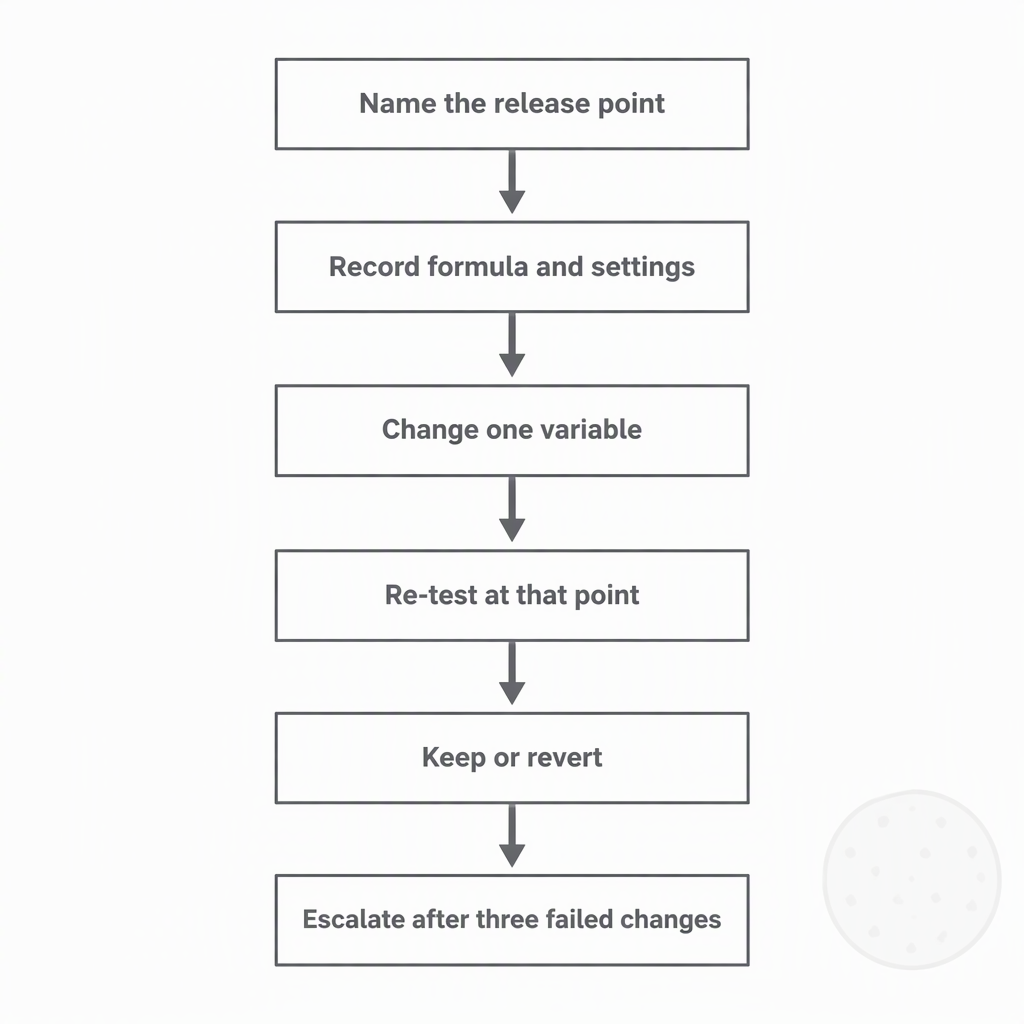
- Name the release point: the first surface a piece fails to leave. Write down where it is.
- Record the current state without altering it: formula, water added, dough temperature, rest, piece weight, machine settings, and time since the last documented clean.
- Check the simple, reversible items first, with the line switched off and disconnected before any manual cleaning: an overdue clean, dough temperature outside your own band, belt tracking, uneven dusting.
- Change one variable only, keeping the flour lot, the formula and every other machine setting identical.
- Re-test at the named release point, and run long enough to judge a whole batch rather than a handful of pieces.
- Keep or revert. Keep a change only if release at that point improves and no new defect appears downstream; otherwise revert it before testing the next variable.
- Escalate when three single-variable changes have failed, or when the failing surface sits inside a guarded area.
- The named release point stays clean through a full run, not just the first pieces.
- Piece weight, shape and thickness sit inside your own recorded tolerance.
- No new defect has appeared downstream: tearing, uneven colour, distorted shape or surface specks.
- The change, the reason and the date are written into the line record so the next shift can repeat or reverse it.
How do you confirm the sticking problem is actually fixed?
Call it fixed when the named release point stays clean across repeated runs with the recorded settings unchanged, and when the result survives a normal clean, a shift change and a new flour lot. A single good hour is not confirmation.
Troubleshooting tortilla sticking is a sequence, not a single fix: name the release point, record the settings, change one variable, and re-test with a keep-or-revert rule. Keep formula, dough temperature and rest, and contact-surface condition inside your own recorded limits, and if three changes fail, bring in the supplier that commissioned the line.
Frequently asked questions about tortilla sticking
What flatbread plants ask most often once a line starts sticking.
Is there one known cause of tortilla sticking?
No. Sticking comes from the dough and the contact surface alike, and the same defect can start on either side. Dough temperature is one of the factors that decides how uniformly dough forms and flattens, so record the temperature and water of the batch that stuck.
What exact dough temperature should we target?
There is no single number that fits every line, so set your own: record the dough temperature at which pieces release cleanly on your press, hold a narrow band around it, and check it after mixing and again at the press. Treat drift outside that band as a signal to investigate.
How can we measure stickiness instead of judging by hand?
Replace hand judgement with a counted, repeatable test: take a fixed number of pieces at the named release point, count how many need help to leave the surface, and scrape and weigh the residue over a set number of pieces. A count taken the same way every shift beats a hand check.
Will adding more flour, oil or an additive stop the sticking?
Extra dusting flour or oil usually masks the symptom and creates a new one: build-up on platens and belts, uneven colour, or drift batch to batch. In the published wheat-flour hot-press formula, SSL and CMC were recipe ingredients, not a cure for sticking, so change one level at a time and judge the finished product as well as release.
Does the same approach apply to corn masa tortillas as to wheat-flour tortillas?
The diagnostic order is the same, but the two doughs do not respond identically. Corn dough is made from corn flour, salt and water, and water addition is the variable most easily left unmeasured, so record and hold it first on a masa line.
A published wheat-flour hot-press formula, by contrast, combines refined wheat flour, shortening, salt, low-fat dry milk, baking powder, SSL and CMC, so a wheat line has more formulation variables to keep constant while you test. Keep a separate baseline for each product you run.
When should we stop line trials and involve the equipment supplier or a dough technologist?
Stop single-variable testing when three changes have failed at the named point, when the affected surface is damaged or sits inside a guarded, interlocked area, when one line sticks while an identical line on the same formula runs clean, or when sticking returns after every documented clean. Then ask the supplier that commissioned the line to confirm the permitted access and cleaning method, or a dough technologist on formula questions.