The changeover begins by identifying which allergen from the outgoing recipe could be carried into the next tortilla SKU, then deciding how that risk will be controlled before production restarts.
For U.S. terminology, FDA lists milk, eggs, fish, Crustacean shellfish, tree nuts, peanuts, wheat, soybeans and sesame as major food allergens, and explains allergen cross-contact as the inadvertent introduction of a major allergen into food; see the FDA overview of food allergies and cross-contact.
The practical planning question is whether the facility has identified the hazard, selected preventive controls, assigned monitoring and verification, and defined records before the next product is released.
Map carryover points from dough to packaging
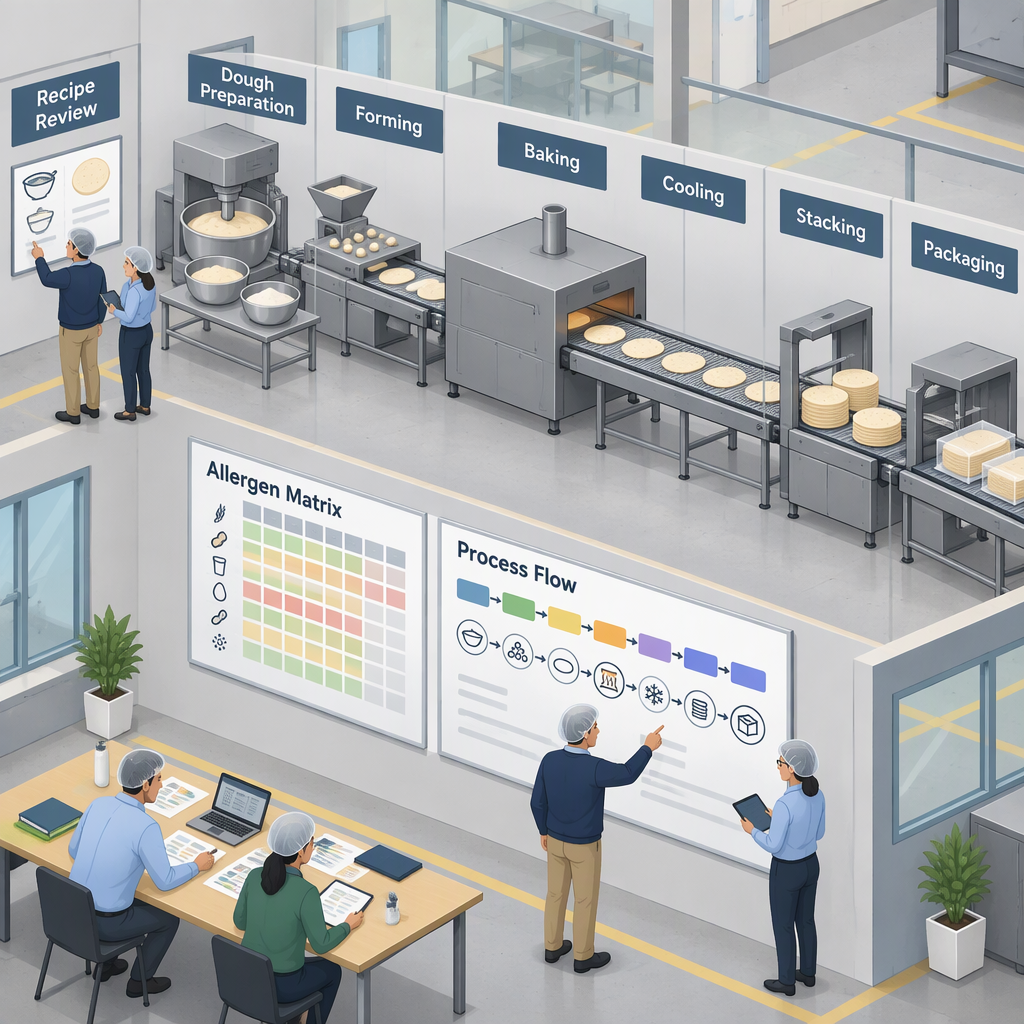
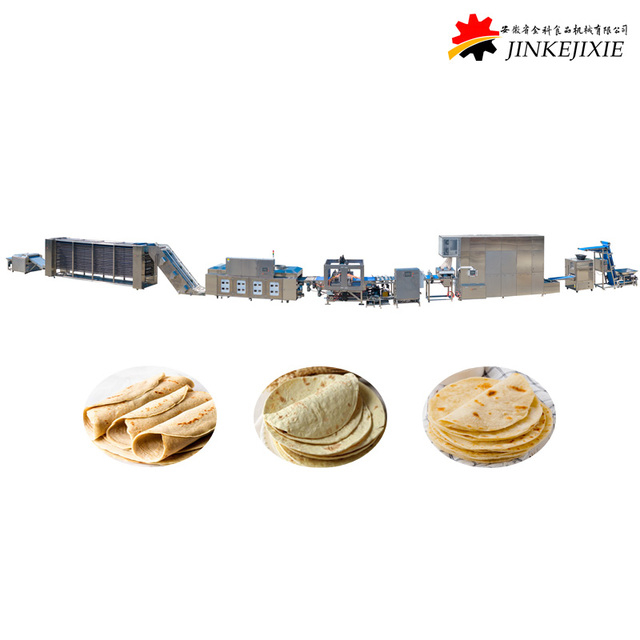
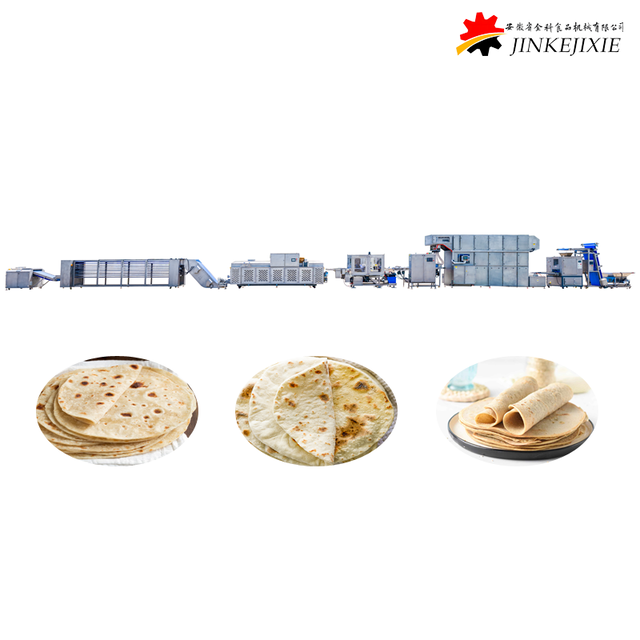
On a tortilla production allergen changeover, map carryover through the full process path: ingredient handling, dough preparation, dividing, rounding, rolling or pressing, baking, cooling, stacking and packaging.
Line area
What to check before changeover
Buyer decision
Dough preparation and upstream handling
Confirm the outgoing and incoming recipe allergen profiles, including flour, inclusions, oils, seasonings and rework.
Decide whether the next SKU can follow the previous SKU or needs a different sequence.
Dividing, rounding, rolling and pressing
Review product-contact surfaces, transfer points and dough accumulation areas along the forming path.
Ask which access points, removable parts or cleaning methods are compatible with the selected line design.
Baking, cooling and stacking
Consider belts, trays, guides, cooling paths and stacking contact areas as part of the same material flow.
Define whether dry cleaning, wet cleaning, inspection or product hold steps are needed for the facility’s process.
Packaging connection
Check that labels, film, cases and allergen declarations match the product being released.
Prevent a clean line from producing a mislabeled product.
Build the changeover sequence before the first trial run
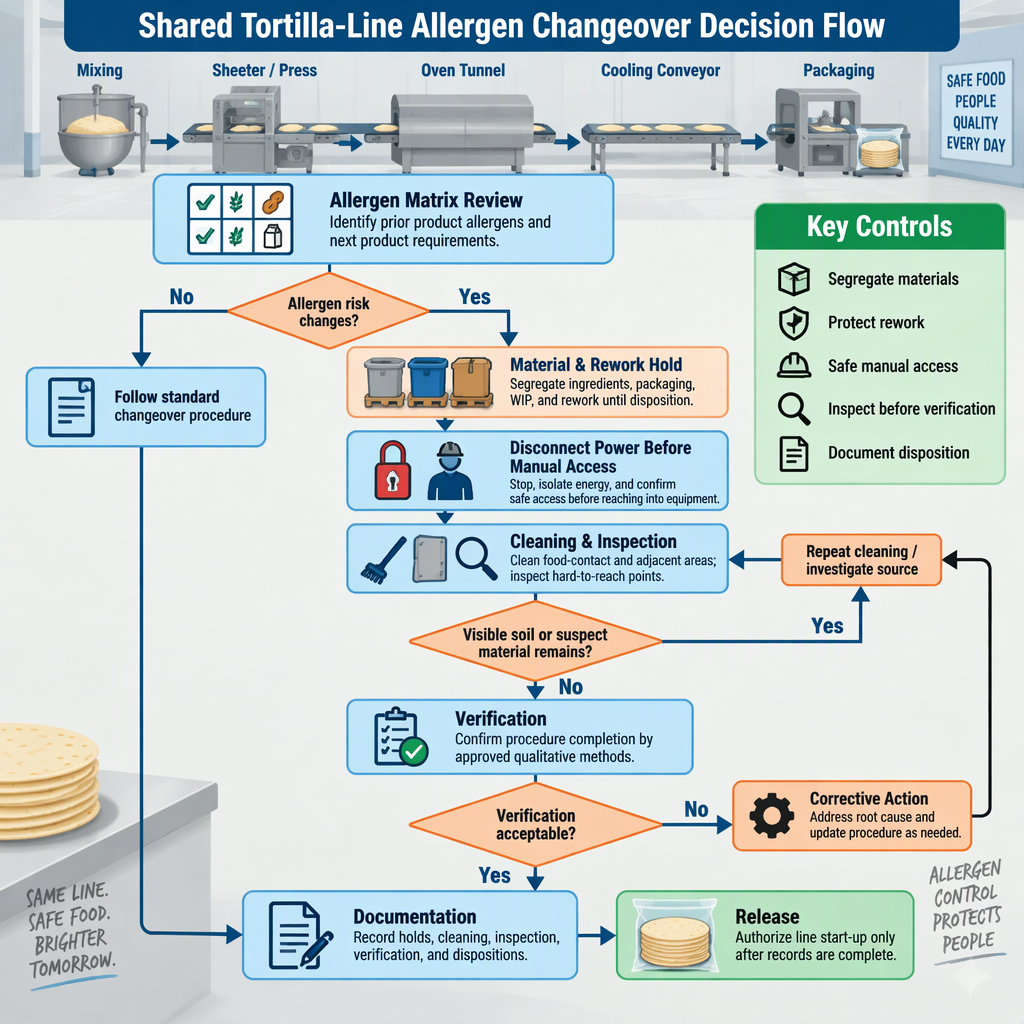
A workable sequence should move from allergen identification to material removal, cleaning, inspection, verification, documentation and release, with corrective action defined before the trial begins.
Create an allergen matrix for outgoing and incoming tortilla recipes, including sesame, wheat, soy, dairy, egg or nut-containing ingredients where they apply.
Remove exposed ingredients, work-in-process and rework that could introduce an undeclared allergen into the next SKU.
Before manual access to mixers, conveyors, rollers, press areas, ovens, coolers, stackers or packaging equipment, switch off and disconnect the applicable electrical power or other energy source, then follow the model manual’s permitted access points only.
Clean shared equipment and food-contact areas between uses, using the facility’s approved cleaning materials and staff procedures for the product and soil type.
Perform the planned monitoring and verification activities, record the results, and define corrective action before restart if the result is not acceptable.
Release the next SKU only after the responsible food-safety or quality function has the required verification and records.
Separate cleaning verification from validation
Verification checks whether the planned changeover was completed for a batch; validation supports whether the chosen method is capable for the allergen, product matrix and equipment arrangement.
Verification
Verification fits the batch-release question: whether monitoring, corrective actions and records show that the planned controls were performed.
Examples can include sanitation sign-off, line inspection, label check and approved test records, depending on the facility plan.
Validation
Validation belongs to the food-safety planning question: whether a control is appropriate for the hazard and process conditions.
Do not buy equipment or write an RFQ around an invented swab limit, ppm threshold or test frequency; ask the qualified food-safety team to define the method.
FDA’s preventive-controls guidance page describes its draft, non-binding guidance as covering hazard analysis, preventive controls, monitoring, corrective actions, verification and records. That scope supports a planning structure, not a universal allergen residue limit.
Set rules for labels, rework and partial batches
A changeover plan should decide what happens to labels, rework, held product and partial batches before the next tortilla SKU is allowed to run.
Situation
Planning rule
Escalation trigger
Advisory allergen statement
FDA states advisory statements should not substitute for current good manufacturing practices or truthful labeling.
If the label is being used to cover an uncontrolled changeover risk, stop and review the control plan.
Rework from an allergen-containing tortilla
Treat rework as part of the allergen profile because it can carry allergens into another product.
If identity, quantity or destination is unclear, hold it for quality review.
Partial batch at the end of a run
Tie disposition to the facility’s preventive controls, corrective actions and records.
If a deviation is found, release should wait for documented corrective action.
Packaging after cleaning
The released product still needs labeling that matches the actual allergen content and market requirements.
If film, cartons or printed labels do not match the SKU, stop before packing.
Prepare RFQ data before asking about shared-line changeovers
Before asking a supplier for a shared tortilla-line proposal, prepare process and allergen data so the discussion stays specific to recipe, dough behavior, forming, baking, cooling, sanitation and line connection needs.
Recipe allergen matrix for every SKU planned on the shared line, including ingredients, toppings, processing aids and rework policy.
Target process flow from dough preparation through dividing, rounding, rolling, pressing, baking, cooling, stacking and packaging.
Expected dough characteristics, product sizes and points where dough can accumulate or transfer between surfaces.
Facility cleaning constraints, including dry or wet cleaning preference, water management, chemical compatibility review and access restrictions.
Responsibility map for hazard analysis, preventive controls, monitoring, corrective actions, verification and records.
Questions for the supplier about access, removable parts, belt choices, cleanability of transfer points and how the proposed layout supports the facility’s sanitation plan.
Keep the supplier discussion practical: ask how the proposed tortilla line supports your documented changeover method, but do not expect the equipment quote itself to replace food-safety validation.
Document release records before production restarts
The next SKU should restart only after the facility has the monitoring, verification, corrective-action and release records required by its food-safety plan.
Completed changeover record showing the product, allergen profile, responsible personnel and time of release decision.
Cleaning and inspection sign-off for the planned areas of the shared tortilla line.
Verification results or quality-release checks required by the facility’s validated method.
Corrective-action record if cleaning, inspection, test results, label checks or material segregation did not meet the plan.
Label and packaging confirmation that the declared allergens match the released tortilla SKU.
The FDA Preventive Controls for Human Food draft guidance page identifies food-safety-plan elements such as hazard analysis, preventive controls, monitoring, corrective actions, verification and records; use those categories to organize release documentation, while confirming current requirements for each destination market.
Know when to stop and escalate
Treat the changeover as non-routine when the allergen status, cleaning result, label match or corrective-action record is uncertain.
Hold unclear rework instead of blending it into a later batch.
Pause if the packaging material does not match the SKU and allergen declaration.
Do not set a pass/fail allergen swab number in procurement copy unless the facility’s qualified team has validated it.
Ask the supplier about line access and layout, but keep product release authority with the food-safety and quality system.
Conclusion
A strong allergen changeover plan links recipe risk, shared-line carryover points, cleaning, verification, corrective action and records before the next tortilla SKU is released.
For equipment selection, translate that plan into concrete process data: recipes, dough path, forming and baking sequence, cooling and stacking needs, packaging handoff and cleaning-access expectations.
The best RFQ conversation is not “can this line handle allergens?” but “how does this proposed tortilla line support our documented allergen matrix, sanitation method, verification plan and release records?”
FAQs about allergen changeovers on shared tortilla lines
What is an allergen changeover on a tortilla line?
It is the planned transition from one SKU to another where the outgoing product, ingredient, rework or label could introduce an allergen that is not intended for the next tortilla product.
Can a factory use one universal cleaning method for every tortilla allergen?
No. The facility should validate the method for its allergen, product matrix, equipment path and release criteria, then verify that each batch changeover followed the plan.
Where are the main carryover points on a tortilla production line?
Key points include dough preparation, dividing, rounding, rolling or pressing, baking, cooling, stacking and packaging connections, because these areas define the product-contact path.
Do advisory allergen labels replace cleaning controls?
No. FDA states that advisory statements should not be used as a substitute for current good manufacturing practices, and labels still need to be truthful and not misleading.
What should procurement ask a tortilla-line supplier?
Ask how the proposed line layout supports access, material removal, cleaning, inspection and packaging handoff for your documented SKU sequence and allergen matrix.
Who should approve restart after the changeover?
The facility’s assigned food-safety or quality function should approve restart after required monitoring, verification, corrective-action and record checks are complete.
Should the line be powered during manual cleaning access?
Before manual access to any powered tortilla-line equipment, switch off and disconnect the applicable power or energy source, then follow the equipment manual’s permitted access instructions.