Tortillas usually crack after baking or cooling because flexibility has been lost somewhere in the material-and-line system, not because of one universal fault. Start tortilla cracking troubleshooting by recording when cracks first appear, then check dough quality, forming, baking, cooling, stacking and packaging one zone at a time.
Map the cracking symptom before changing the recipe
Before changing flour, water, bake profile or equipment settings, define the cracking symptom by timing, location, frequency and product condition because tortilla quality is tied to resistance against tearing, cracking, crumbling and breaking.
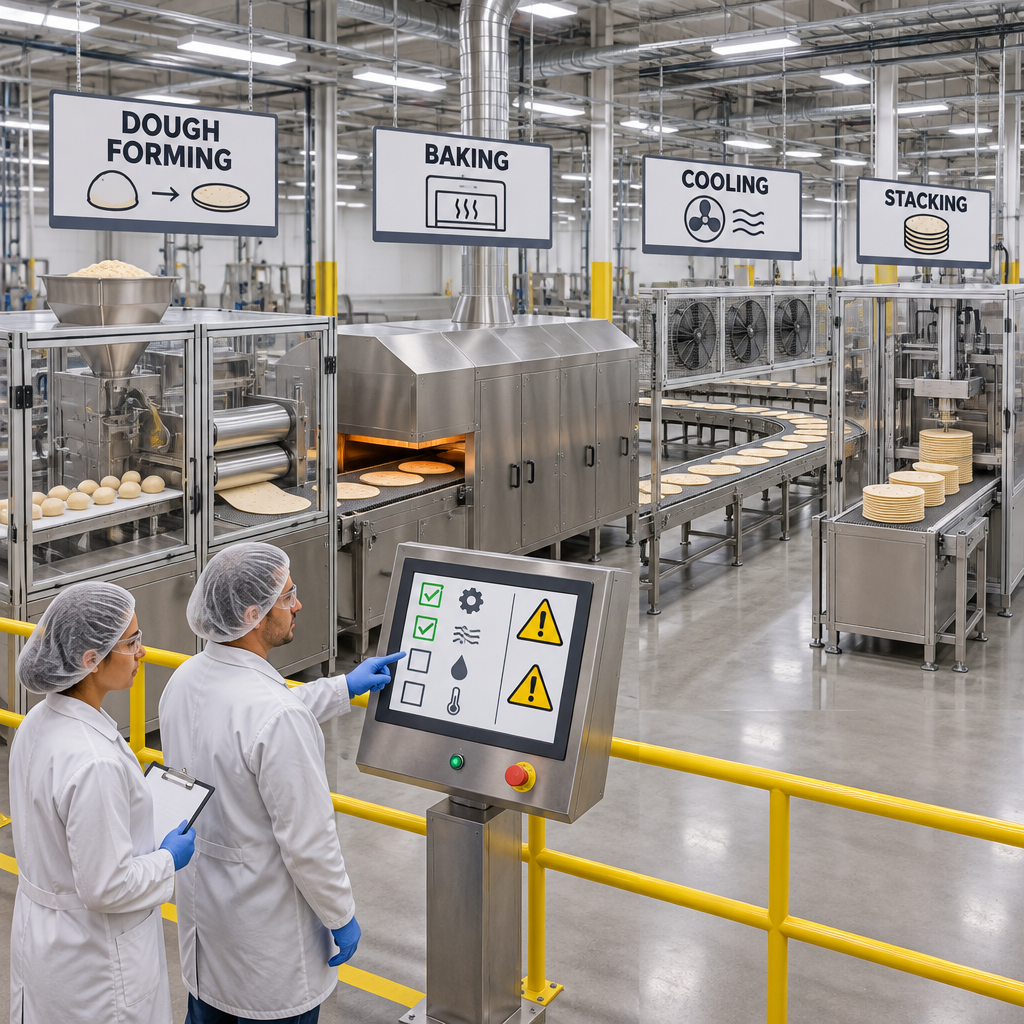
A continuous tortilla line can move dough through processing, forming, baking, cooling and stacking, so a crack seen at the packing table may have started earlier in the line.
- Record whether the crack appears at oven exit, after cooling, during stacking, during folding, or after short storage.
- Separate edge cracks, center cracks, surface checking, tearing during handling and brittle breakage.
- Keep samples from the same batch at each observation point so the team can compare texture instead of relying on memory.
- Include the handoff between dough preparation, forming accuracy, resting time, baking temperature, cooling capacity and packaging speed in the observation log.
Check flour, dough development and moisture-related variables
Ingredient and dough checks belong early in the sequence because flour properties, moisture, damaged starch, protein content and dough or tortilla properties are associated with tortilla quality and shelf stability.
| Observation | Likely check | Controlled action |
|---|---|---|
| Tortillas crack during bending or rolling. | Review flour lot, hydration records, mix development and dough rest consistency. | Compare the affected batch with a normal batch before changing formula targets. |
| Edges crack while centers remain flexible. | Check dough-piece weight variation, sheeting or pressing uniformity and edge drying before bake. | Retest after correcting forming uniformity rather than assuming the oven is the only cause. |
| Texture becomes less rollable during storage. | Track rollability and tear behavior over the same storage interval for each trial. | Use the same handling method, timing and sample size when comparing trials. |
The USDA Agricultural Research Service publication record on flour properties and tortilla quality links tortilla quality with flour properties, moisture, damaged starch, protein content and resistance to cracking-related defects.
Trace the line zone by zone from forming to packaging
After the dough checks, trace each production zone because tortilla factory performance depends on coordinated dough preparation, forming accuracy, resting time, baking temperature, cooling capacity and packaging speed.
| Line zone | What to compare | Why it matters |
|---|---|---|
| Forming | Dough-piece weight, thickness, diameter, edge condition and transfer alignment. | Non-uniform pieces can bake and cool unevenly. |
| Baking | Top and bottom color, moisture loss signs, blistering and oven-exit flexibility. | Cracking visible immediately after bake points the team toward the dough-and-oven interface. |
| Cooling and stacking | Product temperature at stack, surface dryness, sticking, curling and handling damage. | Cracking that appears after cooling or stacking may reflect post-bake handling and moisture redistribution. |
| Packaging | Packaging speed, stack height, product temperature and sealing timing. | Packaging should be checked as part of the continuous system, not as an isolated end step. |
| Symptom timing | First zone to investigate | Do not assume |
|---|---|---|
| Cracks at oven exit | Dough condition, forming uniformity and bake balance | That cooling is the only problem |
| Cracks after cooling | Cooling exposure, transfer stress and stack condition | That the flour lot alone is responsible |
| Cracks during folding or packing | Final texture, rollability, stack temperature and handling force | That one speed change will solve every product size |
Separate oven-exit cracks from cooling and stacking cracks
The most useful split is whether the tortilla is already brittle at oven exit or becomes brittle later, because cracking is a flexibility defect that can be affected by both material properties and post-bake handling.
| Checkpoint | If acceptable | If cracking appears |
|---|---|---|
| At oven exit | Move samples to a controlled cooling comparison. | Check dough development, piece uniformity and baking balance first. |
| After conveyor cooling | Compare with samples cooled off-line under controlled handling. | Review airflow exposure, transfer drop points and product dwell consistency. |
| At stacking | Compare top, middle and bottom tortillas in a stack. | Review stack temperature, alignment and compression or sliding damage. |
| After storage | Run the same rollability or bending check at fixed time points. | Separate immediate process cracking from storage-related texture change. |
Inspect handoffs, surface condition and sanitation boundaries
Transfer points can create or reveal cracking because automatic tortilla production uses conveyors, temperature control and line automation across multiple stations.
- Watch whether tortillas bend sharply, slide unevenly, catch at a guide, or drop from one belt to another.
- Check whether flour dust, oil carryover, sticking, surface drying or residue is changing how pieces release and stack.
- Review whether upstream speed, cooling capacity and packaging speed are synchronized as one continuous system.
- Compare the first pieces after startup, after a stop, after cleaning and during steady running.
Change one variable, retest, and confirm the result
A reliable troubleshooting trial changes one variable at a time and confirms the result with repeated texture checks, because tortilla rollability can be evaluated with tear-related measurements and rollability scoring in controlled product studies.
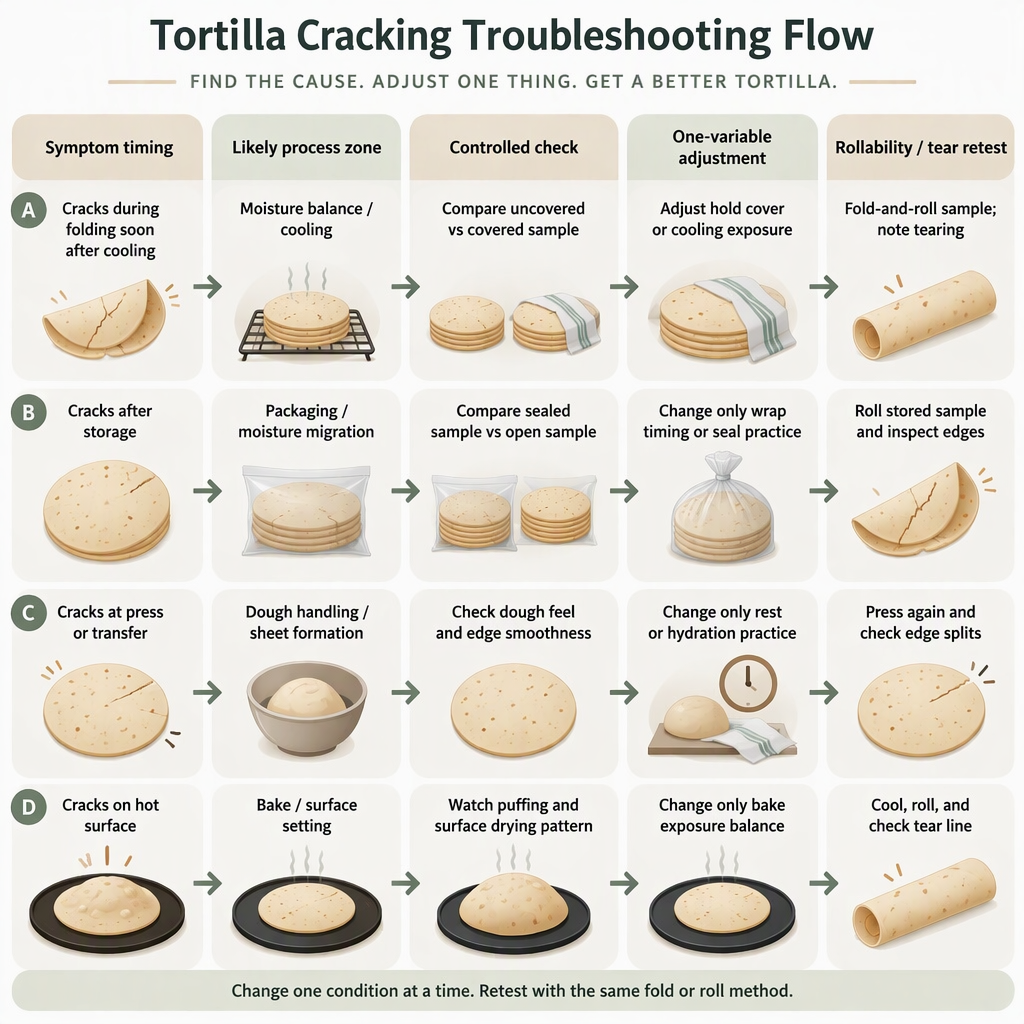
- Define the defect: crack timing, location, affected product size, batch, line speed and observation point.
- Hold normal production records: flour lot, dough temperature, mix time, rest time, forming dimensions, bake condition, cooling exposure and packaging timing.
- Choose one suspected variable and set a narrow trial window instead of changing the formula and line speed together.
- Collect control and trial samples at the same stations and at the same post-bake time intervals.
- Compare rollability, tearing tendency and breakage under the same handling method for each sample group.
- Keep the adjustment only if it improves cracking without creating sticking, tearing, underbaking, poor stack release or package problems.
- Use the same operator method for bending or rolling samples.
- Photograph comparable defects with time, station and batch notes.
- Do not combine trial data from different formulas unless the goal is formula comparison.
- Stop the trial if food-safety, equipment-safety or product-release limits are reached.
The USDA Agricultural Research Service abstract on whole wheat tortilla texture describes extensibility or tear testing and rollability scoring during storage, which supports using repeatable texture checks instead of visual judgment alone.
Conclusion: use a controlled troubleshooting sequence, not a universal fix
Once the likely zone is narrowed, keep troubleshooting disciplined: confirm the symptom, isolate the process stage, adjust one variable and retest before adopting a line-wide change.
- Cracking is a quality and flexibility problem that can involve flour, moisture and dough or tortilla properties.
- A tortilla line should be checked through processing, forming, baking, cooling and stacking rather than at the oven alone.
- Line coordination matters because preparation, forming, baking, cooling and packaging interact as one production system.
- Retesting should use consistent rollability, tear or handling checks so the team can compare trials fairly.
For factories comparing equipment or process changes, the practical next step is to bring sample records, defect photos and line-zone observations to the supplier discussion. That keeps the discussion focused on the actual cracking pattern rather than on a generic formula or a single promised fix.
FAQs about tortilla cracking troubleshooting
These quick answers help production, process and equipment teams decide what to check before changing settings or requesting new line components.
Why do tortillas crack after cooling if they looked fine after baking?
Cooling can reveal a flexibility problem that was not obvious at oven exit. Compare oven-exit samples with cooled samples from the same batch before assigning the cause to one station.
Should the factory check flour before checking the oven?
Flour properties, moisture, damaged starch and protein content are all relevant to tortilla quality, so flour and dough records should be checked early, especially when a new lot or formula change coincides with cracking.
How can we tell whether the oven or cooling section is responsible?
Take samples at oven exit, after cooling and after stacking. If cracks are already present at oven exit, investigate dough, forming and bake balance first; if they appear later, examine cooling exposure, transfer and stack handling.
Can one emulsifier or additive solve all cracking?
No. Texture and rollability behavior depends on the product system and must be tested under the factory’s own formula, storage and handling conditions.
Can transfer points cause cracking even when the recipe is correct?
Yes. A continuous system depends on coordinated forming, baking, cooling and packaging, so mechanical handoffs, speed mismatch and stack handling can contribute to cracking symptoms.
How many variables should we change in one trial?
Change one main variable at a time whenever possible. If the team changes hydration, bake balance and cooling exposure together, the result may improve temporarily without showing which factor mattered.
What information should we prepare before asking a supplier for help?
Prepare defect photos, timing, formula version, flour lot, dough-rest notes, forming dimensions, bake observations, cooling condition, stack behavior and packaging timing so the discussion follows the connected production system.