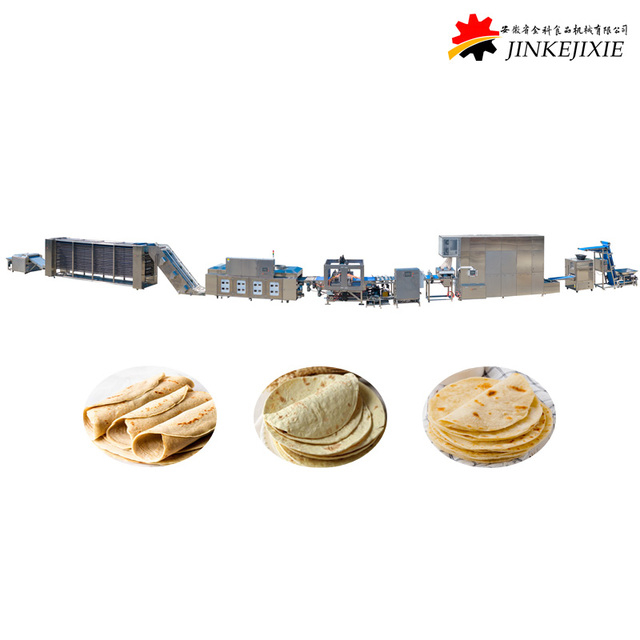
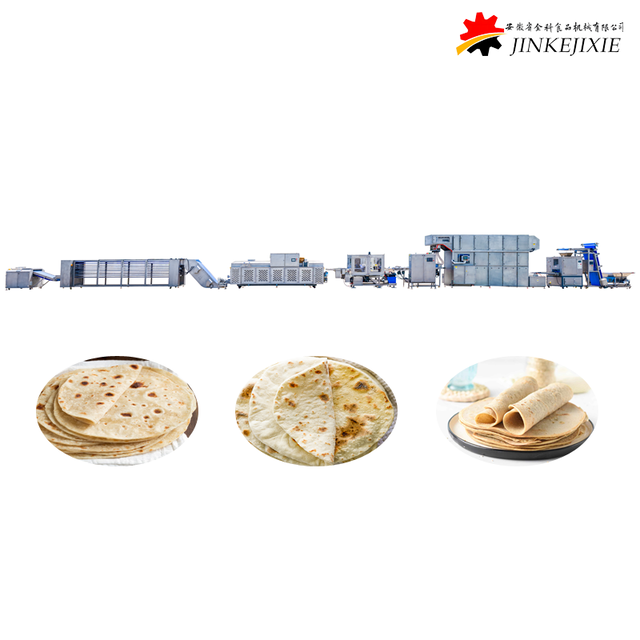
A useful tortilla equipment factory acceptance test does not start with a generic “run the line” trial. It starts with an agreed protocol that defines the recipe, materials, sample plan, operating conditions, line modules, measurement methods, acceptance criteria, deviations and final disposition before the equipment leaves the supplier.
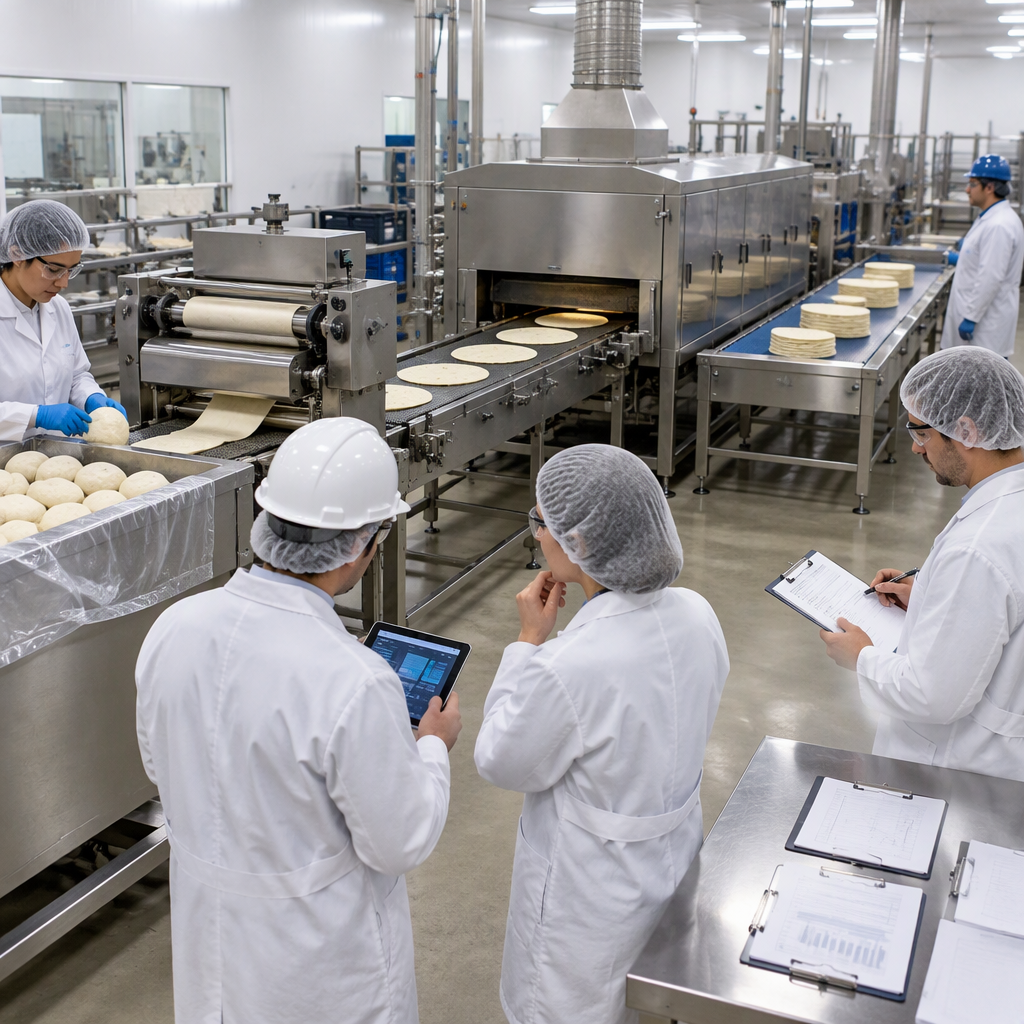
What a tortilla equipment FAT should prove
A tortilla equipment FAT should prove that the tested system meets the agreed purchase specification under documented factory conditions, while leaving site utilities, final installation and production ramp-up for later site acceptance work.
The FAT framework should define scope, activities and responsibilities before testing begins. IEC 62381:2024 is written for automation systems in the process industry, but its public description is useful for structuring a project-specific FAT plan: the parties agree what will be tested, who is responsible and how the result will be documented.
| Buyer question | What to define before FAT | Acceptance decision |
|---|---|---|
| Is the test representative? | Recipe, flour or masa basis, dough hydration target, resting assumptions, tortilla size and packaging or stacking objective. | Accept only if the tested conditions match the protocol or deviations are recorded. |
| Is the equipment scope clear? | Line stages may include dough preparation, dividing, rounding, rolling, pressing, laminating, baking, cooling and stacking, depending on the supplied configuration. | Accept each included module against the purchase scope, not against a vague full-line expectation. |
| Is the result measurable? | Measurement methods, sample count, instruments, tolerances and retest rules should be defined in the project test plan. | Do not rely on appearance alone when a measurable criterion was required. |
A FAT is not a substitute for a site acceptance test. Utilities, room conditions, local ingredients, operators, sanitation procedures and downstream equipment can change the final production result, so unresolved site-dependent items should be listed for SAT instead of being hidden in the FAT report.
Set test conditions before measuring output
Write the test conditions and sample plan into the FAT protocol before production starts; otherwise the buyer and supplier may be judging different products, different speeds or different quality expectations.
The protocol should convert the purchase requirement into a testable plan. For tortilla equipment acceptance testing, that means defining the product family, recipe window, target tortilla size, planned line sequence, warm-up rules, sampling locations, number of samples, measurement tools, pass/fail limits and the method for recording deviations.
- State the exact product to be tested: flour tortilla, corn tortilla, chapati, roti, lavash or another flatbread type.
- Record material inputs: flour or masa source, water addition, oil or shortening use, leavening system, dough temperature target and any pre-mix assumptions.
- Define the operating mode: manual feeding, automatic feeding, continuous run, batch trial, single module test or full connected line test.
- Set the sample plan: where samples are taken, how many pieces are measured, how often they are taken and who signs the record.
- Agree measurement methods: calibrated scale, diameter template, thickness gauge, moisture method, color reference, stack height check or package-count verification where applicable.
- Define what happens to nonconforming results: immediate adjustment, repeated run, engineering change, shipment hold or item transferred to SAT.
Avoid universal sample quantities or universal tortilla tolerances unless they are written into your contract, product specification or FAT protocol. A snack-size tortilla, a wrap tortilla and a regional flatbread can require different measurements and different acceptance limits.
Separate material, equipment and finished-product checks
Divide the FAT into material verification, equipment verification and finished-product verification so that a good-looking tortilla is not mistaken for proof that every machine function is ready for shipment.
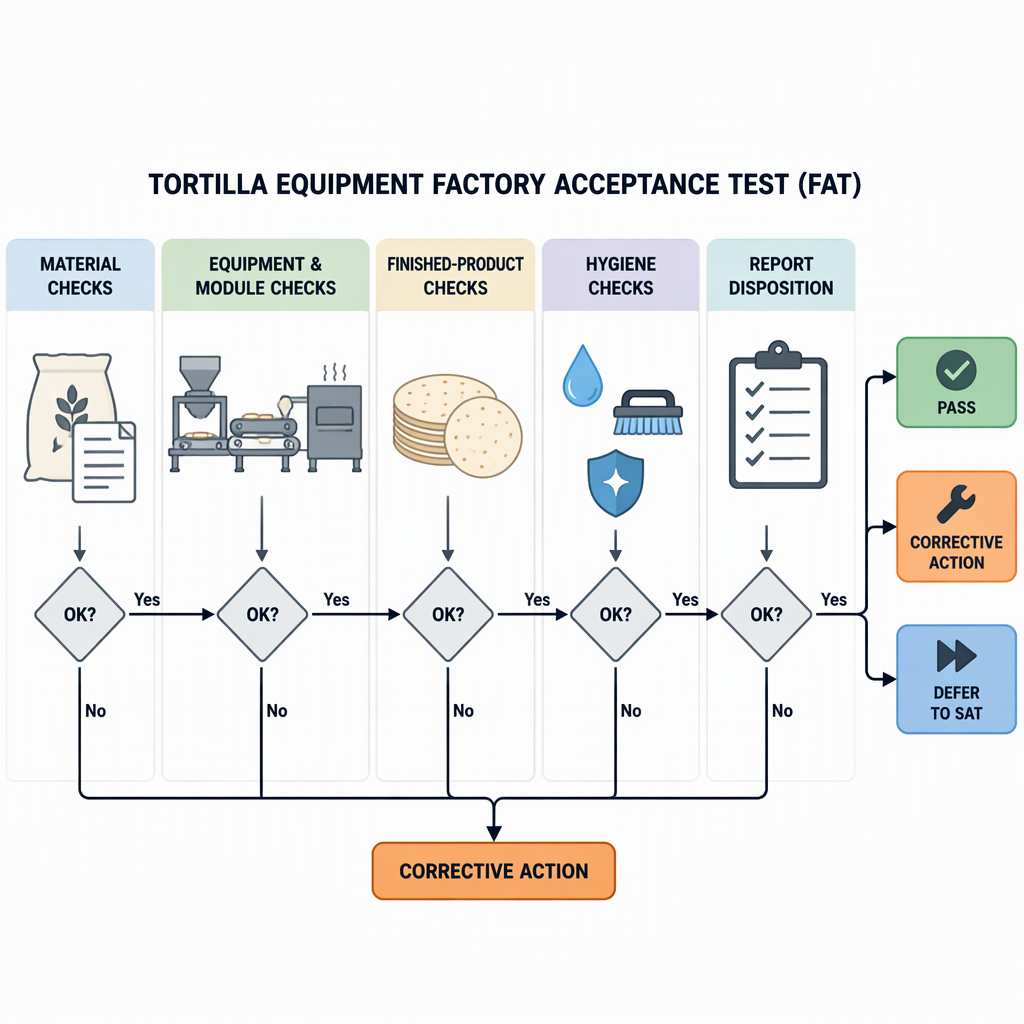
A flatbread line may involve dough preparation, dividing, rounding, rolling, pressing, laminating, baking, cooling and stacking modules. Each stage can affect the finished tortilla, but each stage should still have its own observable checks.
| Verification area | What to measure | Why it matters | Typical record |
|---|---|---|---|
| Materials | Ingredient batch, dough formula, dough condition, input weight and holding time stated in the protocol. | Material variation can make equipment performance look better or worse than it is. | Material log and recipe sheet. |
| Equipment | Dough handling, dividing, rounding, forming or pressing, baking, cooling, stacking and transfer behavior for the included modules. | Module performance must be visible before finished-product data can be interpreted. | Machine checklist, settings sheet and deviation list. |
| Finished product | Weight, diameter, thickness, shape, surface color, bake marks, moisture or texture criteria when those limits are contractually defined. | Finished tortillas show whether the line produced the agreed product under the agreed test conditions. | Sample measurement sheet with acceptance decision. |
| Food-contact condition | Cleanability, condition of food-contact surfaces, seams and areas where food particles or organic matter could accumulate. | Equipment condition can affect contamination control and product safety. | Hygiene inspection checklist and corrective-action log. |
| Result pattern | Likely decision | Buyer action |
|---|---|---|
| Materials outside protocol | Repeat after correcting inputs | Do not accept or reject the machine on an invalid material trial. |
| Equipment unstable but product appears acceptable | Correct and retest | Ask for the module issue to be documented and demonstrated again. |
| Equipment stable but product outside target | Review recipe, settings and tolerance | Decide whether the issue is specification, adjustment or machine-related. |
Measure dough handling, forming, baking and cooling stability
Measure each relevant process stage from dough preparation to stacking, because tortilla quality problems often appear as accumulated variation rather than as one isolated machine fault.
- Dough preparation and handling: record formula, batch size, mixing or feeding condition, dough temperature target and visible dough consistency at the start of the test.
- Dividing and rounding: measure piece weight variation, piece shape, transfer consistency and whether dough pieces arrive at the next stage without damage.
- Rolling, pressing or laminating: check diameter, thickness, roundness, surface damage and whether forming settings remain stable during the run.
- Baking: record oven or baking-zone settings, belt behavior, bake color, blistering pattern and underbake or overbake observations according to the agreed product specification.
- Cooling: measure product temperature or cooling condition at the agreed handoff point when the downstream process requires it.
- Stacking and discharge: check count accuracy, alignment, damaged pieces, missed transfers and readiness for the next operation.
- Record machine settings at the start, after adjustments and at the end of the run.
- Separate short adjustment trials from the formal acceptance run.
- Identify whether each defect is material-related, setting-related, mechanical, control-related or still unresolved.
- Keep retained samples or photo records only when the protocol defines how they will be used.
For procurement teams, the key is repeatability under the written test condition. A single attractive tortilla is weak evidence; a logged sequence of samples from defined points is stronger evidence for an acceptance decision.
Verify hygienic design, cleaning access and contamination controls
Include hygienic design and cleaning-access checks in the FAT because tortilla equipment must be practical to clean and inspect for the intended food-manufacturing use.
EHEDG GL 8 Hygienic Design Principles frames hygienic design as a risk-based way to help prevent contamination in food products and notes that poorly designed entities can be difficult to clean. That makes cleanability a procurement issue, not only a sanitation-department issue.
- Ask the supplier to demonstrate accessible inspection points for food-contact and near-food-contact areas included in the purchased machine scope.
- Check that food-contact surfaces, seams and areas where particles could accumulate are reviewed against the applicable regulatory and buyer requirements.
- For U.S.-bound projects, use 21 CFR §117.40 as reproduced by Cornell LII as a reference point for cleanability, contamination protection, suitable food-contact surfaces and seam conditions, while confirming the official and local requirements that apply to your facility.
- Confirm how the machine will be cleaned in normal production, including access, tools, cleaning chemicals, water exposure limits and parts that must not be manually accessed by operators.
- Before any manual access for inspection or cleaning demonstration, require the machine to be switched off and disconnected from its power source, then follow only the access method permitted by the machine manual and supplier instructions.
Hygienic design review should be tied to the intended use of the equipment and manufacturing environment.
Regulatory language for human-food equipment emphasizes cleanability, protection against contamination and suitable food-contact surfaces; buyers should confirm the adopted rules and any local amendments for their own market.
Do not treat a FAT walkaround as sanitation validation. The FAT can identify design, access and documentation issues, but the buyer still needs site-specific cleaning procedures, training and verification after installation.
Check controls, alarms and line handoffs
Controls and line handoffs should be tested as defined functions: start, stop, recipe setting, alarm response, transfer behavior, data records and agreed interfaces with upstream or downstream equipment.
The public IEC 62381 description includes FAT, FIT, SAT and SIT concepts for demonstrating that an automation system meets its applicable specification. For tortilla equipment, use that idea carefully: it supports a structured control-test plan, but it does not create tortilla-specific machine performance limits.
- Define the control scope: list the panels, sensors, motors, belts, oven controls, safety-related interlocks and data outputs included in the purchase contract.
- Test normal operation: start-up, changeover setting, speed adjustment, recipe selection and planned stop should be demonstrated under the agreed FAT conditions.
- Test abnormal responses: blocked transfer, missed product, alarm display, emergency stop reset procedure and restart logic should follow the supplier’s documented method.
- Check handoffs: verify physical transfer points, signal exchange and responsibility boundaries where the tortilla line connects to cooling, stacking, packaging or plant controls.
- Record unresolved items: site-only signals, plant network integration and utility-dependent tests should be assigned to SAT with an owner and due date.
Do not bypass guards, defeat interlocks or improvise fault tests during the FAT. If a function cannot be tested safely at the supplier’s factory, record the limitation and define a controlled test for installation or SAT.
Specify the FAT report package and acceptance decision
The FAT report should make the acceptance decision traceable: what was tested, under which conditions, what passed, what failed, what changed and what remains open before shipment or SAT.
A measurable FAT is only useful if the record is complete enough for purchasing, engineering, quality and operations teams to make the same decision after the visit. The report should be agreed before the test so the supplier knows which records must be prepared.
- Signed FAT protocol and final report version.
- Equipment scope, module list and serial or project identifiers where applicable.
- Recipe, material batch, sample plan and actual operating conditions.
- Measurement sheets for material, equipment, finished-product, hygiene and control checks.
- List of adjustments made during the test and whether the formal run was repeated afterward.
- Nonconformity list with owner, corrective action, retest requirement and shipment impact.
- Items deferred to SAT, including site utilities, installation, integration and operator-training dependencies.
- Final disposition: accepted for shipment, accepted with open items, hold for correction, or retest required.
Decision rule: accept the FAT only when the agreed scope has measurable evidence, deviations are documented and every open issue has a clear owner and next step.
Conclusion
A tortilla equipment FAT should be judged by traceable evidence, not by a short demonstration run or a sample tray of acceptable-looking tortillas.
The strongest procurement approach is to define the recipe, samples, line stages, hygiene checks, control functions, reporting format and pass/fail logic before the test starts.
For flatbread lines that include dough handling, forming, baking, cooling and stacking, measure each stage separately and then connect the results to finished-product acceptance.
FAQs about tortilla equipment acceptance testing
Use these questions before signing the FAT report so procurement, process and quality teams agree on what has actually been proven.
How many tortillas should be measured in the FAT?
Use the sample quantity written in your purchase specification or FAT protocol. If no number is defined, agree it before testing begins, including sample points, timing and retest rules.
Should the FAT use the buyer’s own recipe?
Use the buyer’s recipe when the contract requires product-specific acceptance. If a supplier demonstration recipe is used, record that limitation and avoid treating the result as proof for a different production formula.
Is finished tortilla appearance enough for acceptance?
No. Appearance is only one result. Weight, diameter, thickness, bake condition, module stability, controls, hygiene access and documented deviations may all be needed depending on the agreed specification.
Which tortilla line modules should be included?
Include the modules in the purchase scope, such as dough preparation, dividing, rounding, rolling, pressing, laminating, baking, cooling or stacking when those stages are part of the supplied line.
What hygiene evidence should a buyer request?
Request a cleanability walk-through, access demonstration, food-contact surface review, sanitation documentation and a list of any areas that require special cleaning tools or site procedures.
Can unresolved items be accepted after FAT?
Yes, if they are documented with an owner, due date, retest method and shipment impact. Do not accept vague open items that have no measurable closure path.
What belongs in SAT rather than FAT?
Final installation, plant utilities, local ingredients, operator training, downstream packaging integration and plant-network connections often need site acceptance testing because they depend on the buyer’s facility.