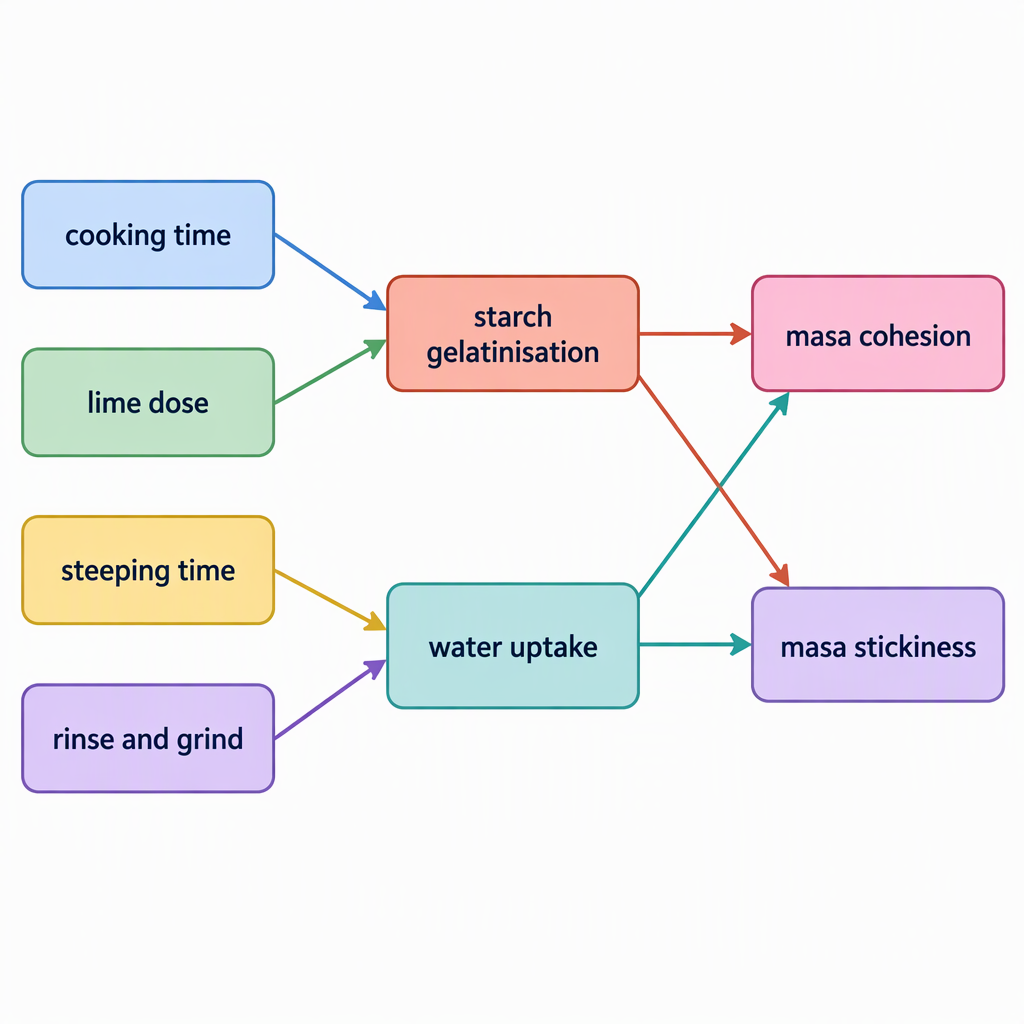
Four conditions decide nixtamalization: cooking time in the calcium hydroxide solution, lime dose, steeping time, and rinse and grind. Longer cooking gives softer, stickier masa with more resistant starch, so fix the cooking window first and trial the rest on your own maize before you buy.
What are the steps from raw maize to masa?
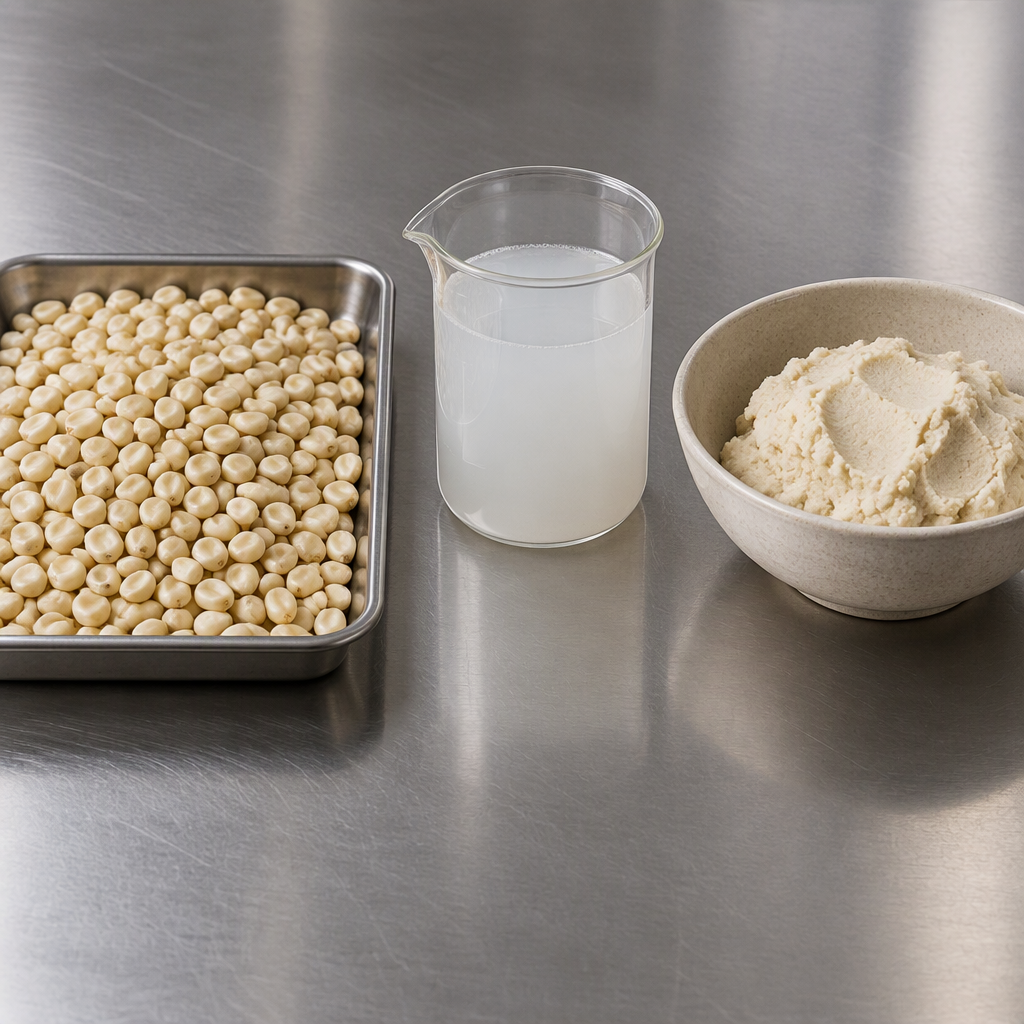
Nixtamalization cooks maize in an alkaline calcium hydroxide suspension, rests the grain in that cooking liquid, then rinses and wet-grinds it into masa. The published reference sequence cooks for about 30 minutes before the nixtamal steeps.
- Heat water with food-grade calcium hydroxide to make the lime suspension; the published laboratory protocol used 1% lime with three parts water.
- Add the maize and cook it in the suspension for your target time, with around 30 minutes as the published reference point.
- Steep the nixtamal in the cooking liquid; the protocol judged cooking adequate when the nixtamal reached 50% moisture after 15 hours of steeping.
- Drain the steep liquid, known as nejayote, and rinse the nixtamal to remove loosened pericarp and surplus lime.
- Wet-grind the rinsed nixtamal into masa and pass it to the forming station.
Calcium hydroxide is strongly alkaline, so treat the suspension as a chemical hazard and use the eye, skin and respiratory protection your safety data sheet specifies. Where cleaning, clearing or inspection requires manual access inside a cooker, steeping tank or grinder, switch the machine off and disconnect or lock out its power supply or battery first, then follow the manufacturer's manual for the access it permits; never reach into equipment that is still energised.
How does cooking time change masa and tortilla texture?
Longer cooking gives a softer, stickier, more hydrated masa. In a controlled study of native Chiapan maize, cooking longer lowered tostada hardness and raised stickiness and resistant starch, with the measured values in the table below.
Tostada attributes measured in one native-maize nixtamalization study | Measured attribute | Reference cooking | Extended cooking | Treatment without a second cooking step |
| Tostada hardness | 10.5 N | 7.5 N | Not reported |
| Stickiness intensity | 3.75 | 4.50 | Not reported |
| Resistant starch | 3.7% | 5.6% | 2.4% |
Those values come from one laboratory study of native Chiapan maize with its own 1% lime and 30, 90 and 180 minute protocols. Expect the direction to hold - longer cooking, softer and stickier masa - but not the magnitudes, because maize variety, lime quality and equipment settings shift the result. Set a cooking window your equipment can repeat.
How do calcium hydroxide dose and steeping time change the nixtamal?
The lime dose sets how much alkali the grain is exposed to, and the steep gives that alkali and the water time to move through the kernel. A published laboratory protocol used 1% lime with three parts water and defined adequate cooking as the nixtamal reaching 50% moisture after 15 hours of steeping; both values were chosen for that study's maize and tortilla process, not as universal settings.
Dose, steep and rinse are tuned together, so weigh the lime rather than estimating a volume, keep the supplier's food-grade specification and safety data sheet on file, and trial the three settings as one set on the maize you actually buy.
Should the line run fresh nixtamal masa or dry masa flour?
Both routes are used commercially, and the choice is about control, storage and composition. In the published assessment, dry-flour tortillas differed from fresh-nixtamal tortillas in B vitamins, sodium, iron, calcium and protein quality, so they do not deliver the same product.
Fresh nixtamal masa: cook, steep, rinse and grind in house
- Process control: you set lime dose, cooking time, steeping time, rinse and grind.
- Inputs and storage: whole maize, food-grade calcium hydroxide and water, with wet nixtamal, nejayote and fresh masa all managed on site.
- Consistency: driven by holding cook, steep, rinse and grind, so drifts show up as changes in masa behaviour.
- Composition: fresh-nixtamal tortillas measured differently from dry-flour tortillas in B vitamins, sodium, iron, calcium and protein quality.
- Line implications: cooking, steeping, rinsing and grinding capacity must match the former and oven, with water supply and drainage designed in.
- What to confirm: equipment that holds the cooking and steeping window repeatably, grinder adjustability, and a hygienic route from nixtamal to former.
Dry masa flour: reconstitute on site
- Process control: you set water addition, mixing time and masa temperature, while nixtamalization happens at the flour mill.
- Inputs and storage: bagged flour and water, with dry storage instead of a wet by-product stream.
- Consistency: set by the flour specification and your mixing step, so lot-to-lot flour variation becomes a supplier variable.
- Composition: dry-flour tortillas differed from fresh-nixtamal tortillas in B vitamins, sodium, iron, calcium and protein quality.
- Line implications: no cooking, steeping, rinsing or wet grinding, but more mixing and dough handling, plus dust control.
- What to confirm: flour specification and lot consistency, mixer repeatability, masa feed to the former, and hygiene in a dry-to-wet process.
Masa meets the line at four measurements: water absorption, mixing energy, masa temperature, and whether it holds together when pressed. Set your own bands and check them at the grinder outlet, using the reference values in the checklist below.
Those are measurements of one laboratory dough system, not a recipe: your maize, lime and grinder move that window, so set your own masa moisture, temperature and piece-weight bands and check them at the grinder outlet. Wet masa is perishable, so clean and temperature-control the grinder-to-former route within your food-safety plan, and switch off and disconnect or lock out power before any manual cleaning or unblocking.
What should a buyer confirm with a nixtamalization equipment supplier?
Confirm five measured values with a corn cooking supplier: the cooking time and temperature window held, how lime dose is verified, the steeping time and nixtamal moisture endpoint, control of rinse and grinding, and the masa absorption and temperature delivered to the former - each with a tolerance, not a brochure range.
Decision areas to settle with a corn cooking supplier | Decision area | What you specify | What the quotation should confirm |
| Cooking control | The cooking time and temperature window your maize needs | Controller type, sensor position, and how the batch is held and recorded at temperature |
| Lime dosing | Lime dose as a percentage of maize weight, plus the water-to-maize ratio | How lime is weighed or metered, and how the dose is verified during a shift |
| Steeping | Steeping time and the nixtamal moisture endpoint before grinding | Tank size and insulation, temperature control, and how moisture is checked |
| Rinse and nejayote | Rinse water volume, drain time and the by-product route | Wash and drain design, water use per batch, and waste handling |
| Grinding and masa | Target masa moisture, absorption and temperature at the former | Grinder type and adjustment range, masa temperature control and feed method |
| Line interface | Products per hour, piece size, and masa demand of former and oven | How cooker output, forming and baking capacities are matched, including buffers |
| Cleaning and hygiene | Food-contact materials, cleaning method and access | Access points, drainage, and the isolation procedure for safe manual access |
| Support | Installation, commissioning, training, spare parts and technical support | Scope of each item, the response route, and the documents supplied with the machine |
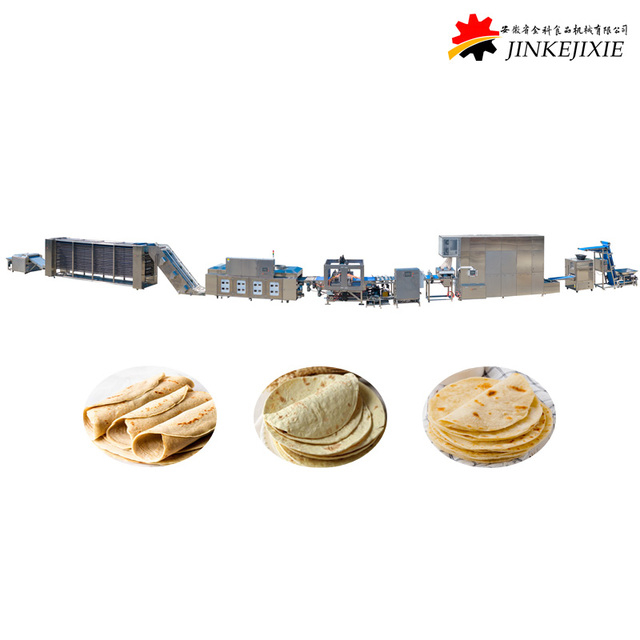
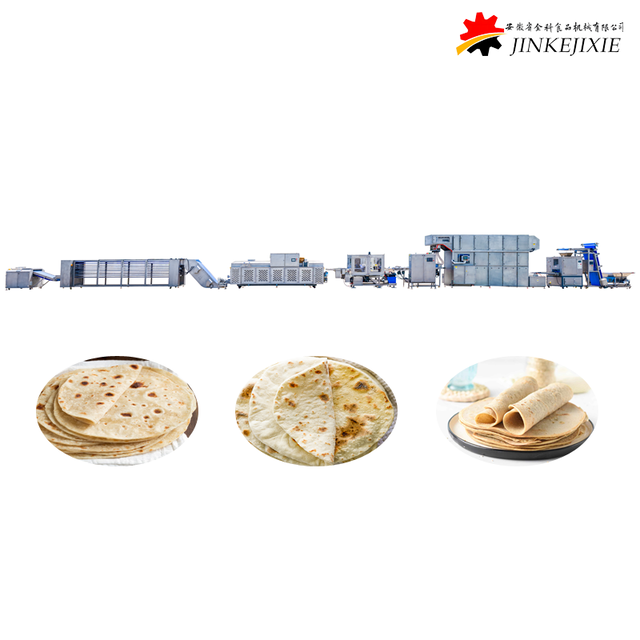
AnHui JinKe Foodstuff Machinery Co.,Ltd is a flatbread and tortilla production line machinery manufacturer in Hefei, Anhui, China, and states it has built these lines since 2008. Its published range covers tortilla, taco, pita, chapati/roti and paratha lines, dough preparation, and fermenting, baking, cooling and stacking equipment. It states that over 90% of components are made in house, with installation and commissioning, training, spare parts and remote support provided; confirm each item's scope in your order documents.
What belongs on the pre-RFQ process data sheet?
Send every supplier the same data sheet covering the product, the process window you want to hold and the site the equipment must work in, and label your values as targets to be met rather than standard settings.
- Maize: type or variety, kernel grade, moisture and broken-kernel limits, origin and supplier.
- Lime: food-grade calcium hydroxide, dose as a percentage of maize weight and the water-to-maize ratio, with the published protocol using 1% lime with three parts water.
- Water: quality, temperature and volume per batch.
- Cooking: target time and temperature window, and how the end point is judged, with about 30 minutes as the published reference.
- Steeping: time, vessel, and the nixtamal moisture endpoint before grinding, such as the 50% moisture after 15 hours used in the cited protocol.
- Rinse and by-product: rinse volume, drain time, and how nejayote is handled and disposed of.
- Masa: target moisture, water absorption and temperature at the grinder outlet, against the 120 to 136% absorption and 1.17 to 1.90 minute mixing in the cited dough system.
- Forming and baking: piece weight and diameter, former speed, and bake time and temperature profile, with the cited tortillas formed at 12 cm and 21 g and baked for 1 minute at 148 °C.
- Products and throughput: product list, piece sizes, units per hour, shift pattern and changeover time.
- Utilities and environment: steam, gas, electricity supply and phase, compressed air, water supply and drainage, and ambient conditions.
- Hygiene and access: food-contact materials, cleaning method, drainage, and the power-isolation procedure required before manual access during cleaning.
- Site and installation: floor space, layout constraints, delivery and installation access, commissioning window, operator training and spare-part expectations.
What is the practical answer for a tortilla or flatbread plant?
Cooking time, lime dose, steeping and grinding are the conditions that decide masa behaviour, and longer cooking makes masa softer and stickier, so fix those four, hold them, and buy equipment that can control and record them. Measure the masa at the grinder outlet on every batch rather than trusting the recipe alone.
- Extending cooking moves masa towards softer, stickier behaviour and raises resistant starch, while the exact figures stay tied to the study's maize and protocol.
- Fresh nixtamal masa gives you control of the process, while dry masa flour trades that control for simpler storage and handling and produces tortillas with different measured levels of several nutrients.
- Set masa moisture, temperature and piece weight bands, and check them before the oven rather than after it.
- Send suppliers your targets and tolerances, and require cooking, dosing, steeping and masa data as measured values.
- Run a bench trial on your own maize before committing to a configuration.
Frequently asked questions about nixtamalization conditions and masa
These are the questions buyers ask most often when comparing nixtamalization systems.
How much calcium hydroxide should we use?
A published laboratory protocol used 1% lime with three parts water, judging the cook by nixtamal moisture rather than by the clock. Weigh the lime instead of estimating a volume, confirm the food-grade documentation with your lime supplier, and treat the dose as a trial starting point for your own maize.
How long should the maize cook and steep?
The published reference cooks for about 30 minutes and then steeps the nixtamal in the cooking liquid, and extending cooking produced a softer, stickier masa with more resistant starch. Set your own window by trial, and record the nixtamal moisture you accept before grinding.
Can we use dry masa flour instead of cooking maize?
Both routes are used commercially. Tortillas made from dry masa flour differed from fresh-nixtamal tortillas in B vitamins, sodium, iron, calcium and protein quality, so settle the route before specifying the line if those differences matter for your product or your label.
What masa targets should we set at the former?
Define a masa moisture and temperature band, a tolerance on piece weight and diameter, and a bake profile that delivers the colour, puff and texture you want. The cited dough system needed 120 to 136% water absorption and 1.17 to 1.90 minutes of mixing, with forming at 12 cm and 21 g.
How do we know the maize was cooked too long?
Masa that feels markedly stickier and presses into disks that are harder to handle, with finished product softer than your reference, points to over-cooking. Shorten the cooking time first, then review steeping and rinsing before you change the grinder.
How can a plant check batch to batch that nixtamalization stayed on target?
Log lime weight as a share of maize weight, cooking time and temperature, steeping time, and nixtamal moisture before grinding; then check masa moisture, temperature and how it presses, and compare piece weight and bake result against a retained reference batch.
What should we confirm about cleaning, hygiene and safe access?
Ask how the cooker, steeping tank and grinder are cleaned, how drainage and the nejayote stream are handled, and which food-contact materials are used. Before any manual cleaning or unblocking inside a machine, switch it off and disconnect or lock out its power supply or battery, and follow the manufacturer's manual for the access it permits.