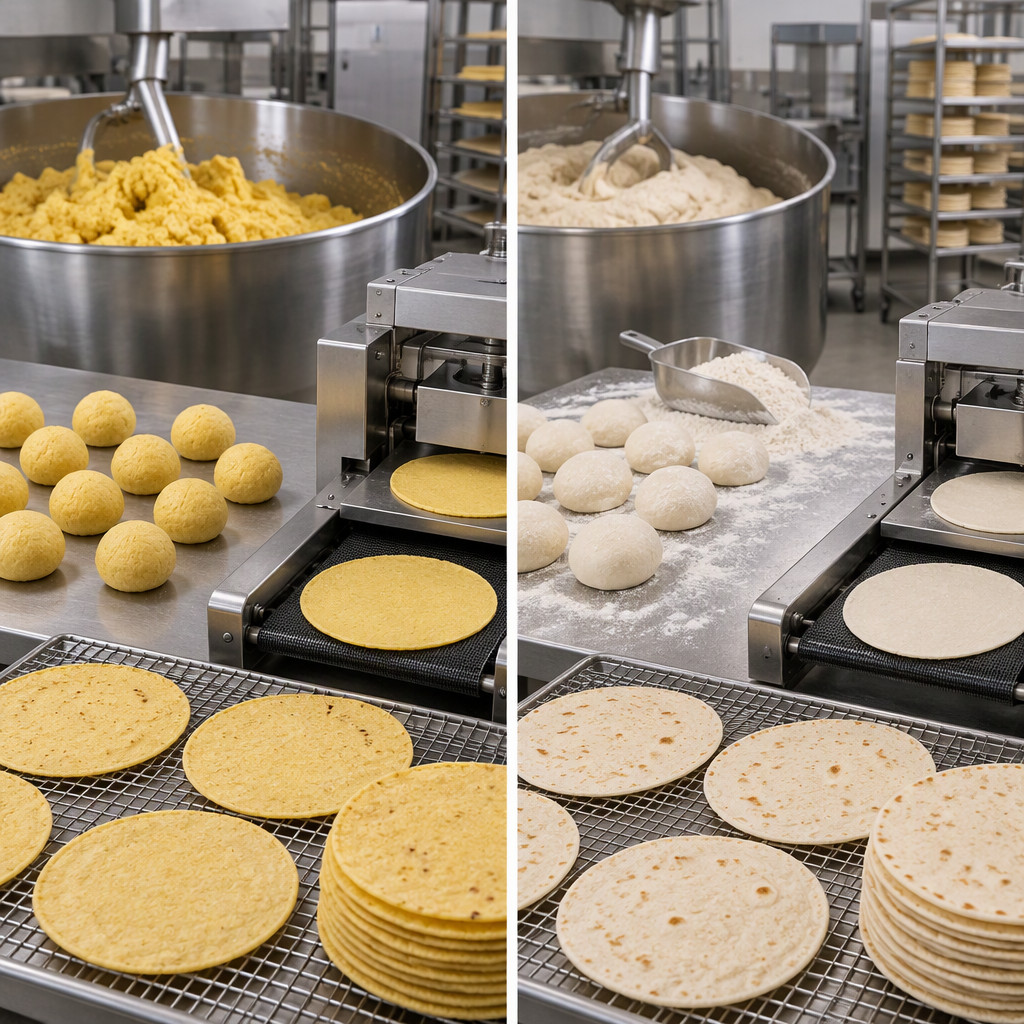
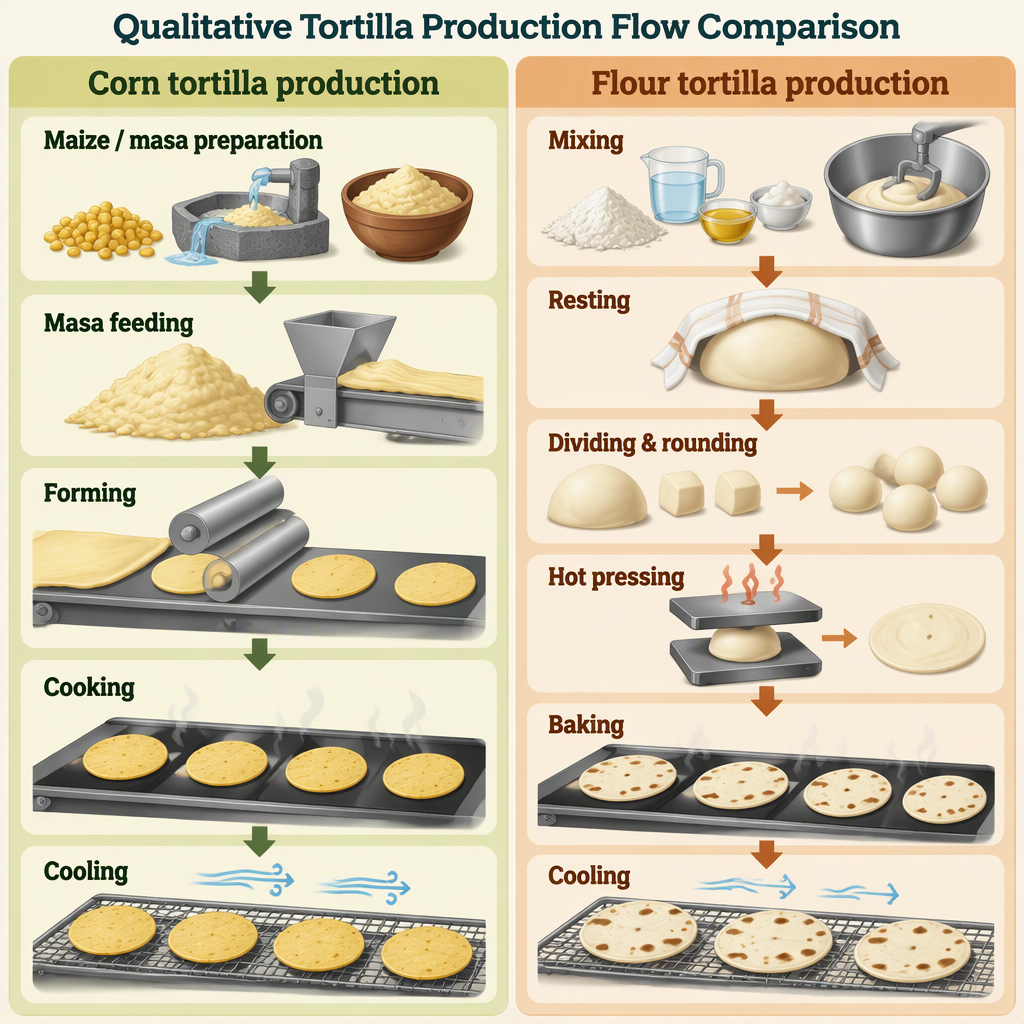
Corn tortilla production is driven by maize or masa behavior, including lime-cooking, washing, grinding, forming and cooking variables.Flour tortilla production is driven by wheat dough formulation, mixing, resting, dividing, hot pressing, baking, cooling and packing. For equipment selection, compare the dough route, forming method, heating and cooling demand, cleaning plan and line handoff before comparing machine names.
What changes in the dough?
Corn tortillas normally start from a maize masa route where lime-cooking, steeping or masa preparation influence process behavior.Flour tortillas use wheat flour dough with water, salt, shortening and leavening or conditioner ingredients, followed by mixing and rest steps.
Corn masa route
In a corn route, maize characteristics, lime concentration, cooking time, steeping and dry-matter losses can affect masa behavior and final tortilla quality. For a buyer, that means raw-material preparation is part of the production system, not only a recipe note.
Check whether the factory will use whole maize with lime-cooking and grinding, prepared masa, or masa flour.
Evaluate moisture control, masa consistency, forming stability and cooking response together.
Wheat flour route
In a flour tortilla route, wheat flour dough is mixed with water and functional ingredients, then normally moves through rest, dividing or rounding, hot pressing, griddle baking, cooling and packing.
Check dough extensibility, dough-ball handling, press release, size control and surface condition after baking.
Allow enough evaluation time for rest or proof stages before judging forming performance.
Which equipment stations change?
The corn route changes the front end around maize or masa preparation and the forming behavior of masa.The flour route changes the front end around wheat dough mixing, rest, dividing or rounding and hot pressing.A tortilla production line should still be judged as a coordinated system from dough preparation through forming, baking, cooling and packaging speed.
Station
Corn tortilla route
Flour tortilla route
Buyer check
Raw-material preparation
May include lime-cooking, steeping, washing and grinding into masa.
Begins with wheat flour, water, salt, shortening and leavening or conditioner ingredients.
Confirm whether your plant wants in-house masa preparation, prepared masa, or flour mixing.
Dough handling
Masa behavior is affected by maize hardness, cooking time, lime level and moisture losses.
Dough commonly passes through mixing, resting, dividing and rounding before pressing.
Request trials for stickiness, tearing, edge quality and dough transfer stability.
Forming
Masa forming must match the moisture and texture of the prepared corn dough.
Flour tortillas commonly use hot pressing after dough-ball preparation.
Do not treat a hot press and a masa former as interchangeable without trials.
Cooking and cooling
Corn tortillas are cooked after forming, with quality influenced by earlier masa preparation.
Flour tortillas are griddle baked, cooled and packed after pressing.
Compare heat profile, discharge moisture, cooling time and packaging readiness.
Line integration
Dough preparation, forming accuracy, resting time, baking temperature, cooling capacity and packaging speed need coordination.
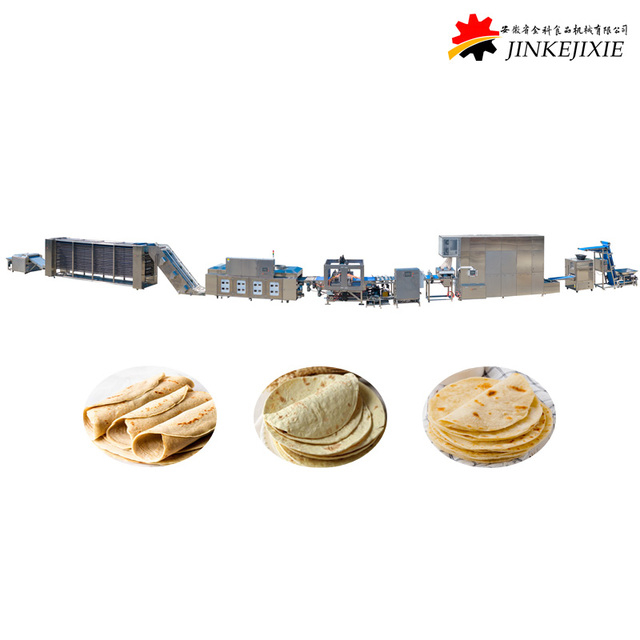
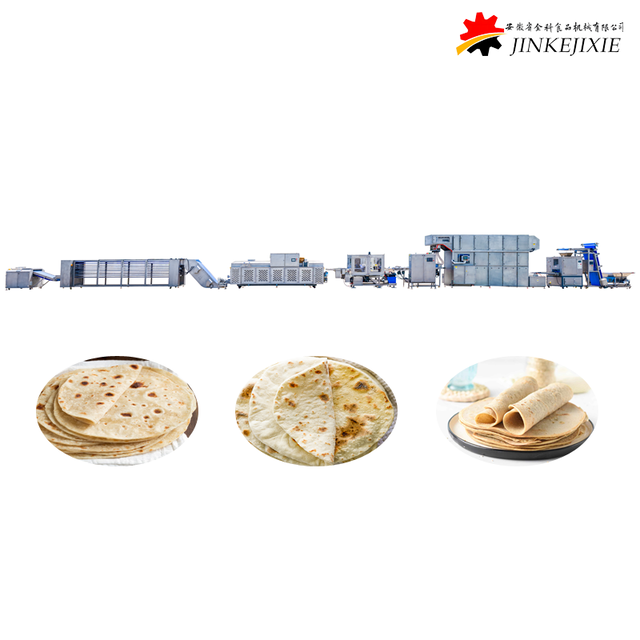
The same coordination logic applies when a plant designs a wheat flour tortilla line.
Balance upstream dough timing with downstream baking, cooling and packing capacity.
AnHui JinKe Foodstuff Machinery Co.,Ltd. presents industrial flatbread and tortilla production line equipment and dough-processing categories in its product-center content. Use that category coverage as a starting point for discussion, then confirm model-specific suitability by formula and trial data.
Where are the cost and selection boundaries?
The cost boundary is not only the purchase price. Corn production can add maize preparation, lime-cooking, washing, grinding and moisture-control considerations.Flour production can add dough rest, dividing, rounding, pressing, baking and cooling considerations.
Decision area
Choose a corn-focused route when...
Choose a flour-focused route when...
Consider flexible evaluation when...
Raw-material strategy
Your product depends on maize masa characteristics or an in-house masa route.
Your product depends on wheat flour dough formulation and dough-ball handling.
You plan to change recipes often and can validate cleaning, forming and heat settings.
Front-end equipment
Preparation steps such as lime-cooking, washing or grinding are inside your factory scope.
Mixing, resting, dividing and rounding are the main front-end process needs.
Separate dough paths or changeover procedures can be justified by expected production mix.
Forming investment
Masa consistency and sheet or form stability are the main risks.
Hot pressing of rested dough balls is central to the product.
Supplier trials prove both formulas can run without quality loss or unsafe changeover shortcuts.
Operating cost drivers
Water, lime handling, maize preparation yield and masa waste are material cost questions.
Mixing time, rest space, press performance, baking energy and cooling time are material cost questions.
You can measure actual scrap, labor, cleaning time and energy under your recipes.
Build the comparison around raw material, water use, thermal load, labor, cleaning time, changeover loss, scrap and packaging readiness.
Ask for test pieces from the same flour, maize, masa flour or formula that your plant will use.
Avoid ROI, payback or unit-cost promises unless your team has measured throughput, yield, energy and labor under your conditions.
What should be tested before equipment selection?
A factory trial should test dough behavior, forming repeatability, cooking or baking outcome, cooling stability, cleaning time and handoff to packaging. Corn trials should capture masa variables that affect quality.Flour trials should capture mixing, rest, dividing, pressing, baking and cooling behavior.
Define the product target: diameter, thickness, weight, texture, moisture target, shelf-life plan and package format.
For corn products, document maize or masa source, lime-cooking or masa-preparation route, moisture and forming behavior.
For flour products, document flour type, water absorption, shortening level, leavening or conditioner approach, rest time and dough-ball handling.
Run the planned forming method at realistic line speed and collect rejects for tearing, sticking, edge defects, size variation and transfer failure.
Measure cooking or baking effects after cooling, not only at the oven or griddle exit.
Check packaging handoff: stacking, cooling, surface moisture and product temperature should match the packaging system’s needs.
Bring the actual raw materials and target formula to the trial.
Record setup time, cleaning time, waste at startup, waste at shutdown and changeover steps.
Ask whether guards, covers and contact surfaces can be cleaned without improvised tools or unsafe access.
Before any manual cleaning, inspection or clearing of powered equipment, switch off and disconnect the relevant power source, then follow only the access steps allowed in the model manual.
Request written operating limits for dough moisture, product size range and recommended cleaning method from the supplier.
What sanitation and line-handoff requirements stay the same?
Both routes need hygienic equipment design, sanitary operation, controlled plant conditions and a line layout that keeps dough preparation, forming, heating, cooling and packing synchronized. FDA CGMP guidance addresses personal hygiene, plant design and construction, plant equipment, sanitary operations, facility sanitation and production/process controls.
FDA CGMP guidance provides U.S. regulatory context for sanitation planning, including plant equipment, sanitary operations and production/process controls. Confirm the rules that apply in your target market, because local food-safety law, retailer standards and customer audits may add requirements.
Review equipment surfaces, access points, cleaning methods and sanitary-operation procedures as part of the purchase decision.
Check whether dough preparation, forming, baking, cooling and packaging speed are balanced as one system.
Confirm how the line will manage flour dust, masa residue, oil or shortening residues, water exposure and cooling-zone condensation.
For any manual cleaning or clearing task, switch off and disconnect power first, then use only the supplier-approved access points and procedures.
Ask the supplier for maintenance and cleaning instructions before purchase, not after installation.
Conclusion: choose by dough route, not by product name alone
The practical decision is to choose the production route that matches your dough, forming method, heat process, cooling need, sanitation plan and packaging handoff.
Corn tortilla production should be evaluated around maize or masa preparation and the process variables that affect masa quality.
Flour tortilla production should be evaluated around wheat dough mixing, resting, dividing, hot pressing, baking, cooling and packing.
A tortilla line should be treated as an integrated system, so downstream cooling and packaging must be assessed with upstream dough and forming choices.
Use supplier product categories only as a starting point; request trials and written limits for the exact product you plan to make.
For corn vs flour tortilla production, the safest selection path is to define the formula first, run plant-relevant trials second, and compare equipment only after the dough route is clear.
FAQ
These short answers help equipment buyers frame supplier discussions before requesting trials or quotations.
Does corn tortilla production require nixtamalization?
Traditional maize-based production commonly uses lime-cooking, steeping, washing and grinding to make masa. A factory may also evaluate prepared masa or masa flour, but the equipment decision should still account for masa moisture, texture and forming behavior.
Why does flour tortilla dough often need resting or proofing?
Flour tortilla processing commonly includes rest or proof stages around divided dough balls before hot pressing. Buyers should check how rest time affects floor space, buffering, dough-ball handling and line balance.
Is hot pressing the same as corn tortilla forming?
Hot pressing is part of the wheat flour tortilla sequence described for flour tortillas.Corn tortilla production is tied to masa preparation and masa forming behavior. Treat the forming method as a product-specific trial point.
Does FDA CGMP guidance prove global compliance?
No. FDA CGMP guidance is useful U.S. context for topics such as plant equipment, sanitary operations and production/process controls. For global projects, confirm the applicable local rules and buyer audit requirements before final equipment approval.
Can one line make both corn and flour tortillas?
Corn masa and wheat flour dough follow different preparation and handling routes.A shared line should be considered only after trials show that both doughs can be formed, heated, cooled, cleaned and changed over safely under your target conditions.
What should be prepared before asking for a quotation?
Prepare the target product size, formula, raw-material route, expected packaging format, cleaning expectations, plant utilities and required trial conditions. Because line speed, resting, baking, cooling and packaging need coordination, a quotation should be based on the complete process route rather than on the tortilla name alone.